Earlier this year I started making a set of beaded beads. I love beaded beads, they’re something I come back to time and time again when I need a beaded piece for an outfit, when I’m stuck creatively, or when I want to really dig into some new 3D techniques and ideas. I went back to geometric solids and started playing with some methods and ideas I’ve been back and forth with over many years. I was trying to put together ’99 Red Balloons’ for a competition (Bead a Song) – that didn’t work out (I’ll tell you what did another day) but returning to such a versatile method made me realise I needed to get this one published and out of my system.
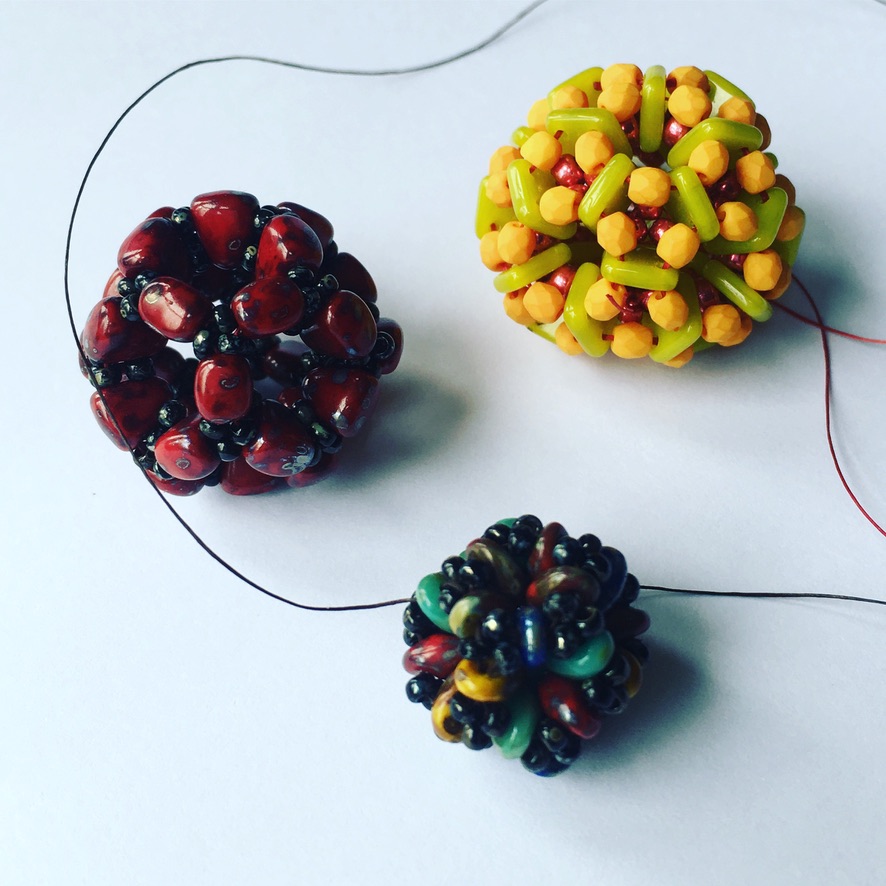
About 10 years ago I started making dodecahedra a lot, first using well known methods to do single layered versions alongside icosahedra. Those can be self supporting if you weave through enough (and you’ve picked the right bead size), and I loved that. A self-supporting beaded bead is hollow, often see through, and you don’t have to faff around finding exactly the right size and colour of inner support bead. 2 holed beads were starting to become mainstream, so I made double layered versions using Twins and SuperDuos and found that if I used the right combinations of beads I could make rigid 2 layered beaded beads, and also use (if I wanted) feature beads to the outside layer. The first of these were made with Twins and Pips and I used them a few years later to enter a Preciosa competition in 2017. The Pip versions were pretty good but at this stage the naked Twins were still a little wobbly.

So far fine, but nothing revolutionary. I played around a bit and worked out that other 2 holed beads worked, made a few pretty solid sets with Nib Bits, and even started playing with 4 holed beads with limited success (I need to go back to that one day). Other beaders were doing way better things with multi-holed beads and geometric builds and my efforts were cute but not really clever enough on their own compared to work being done by others, so I put them away.
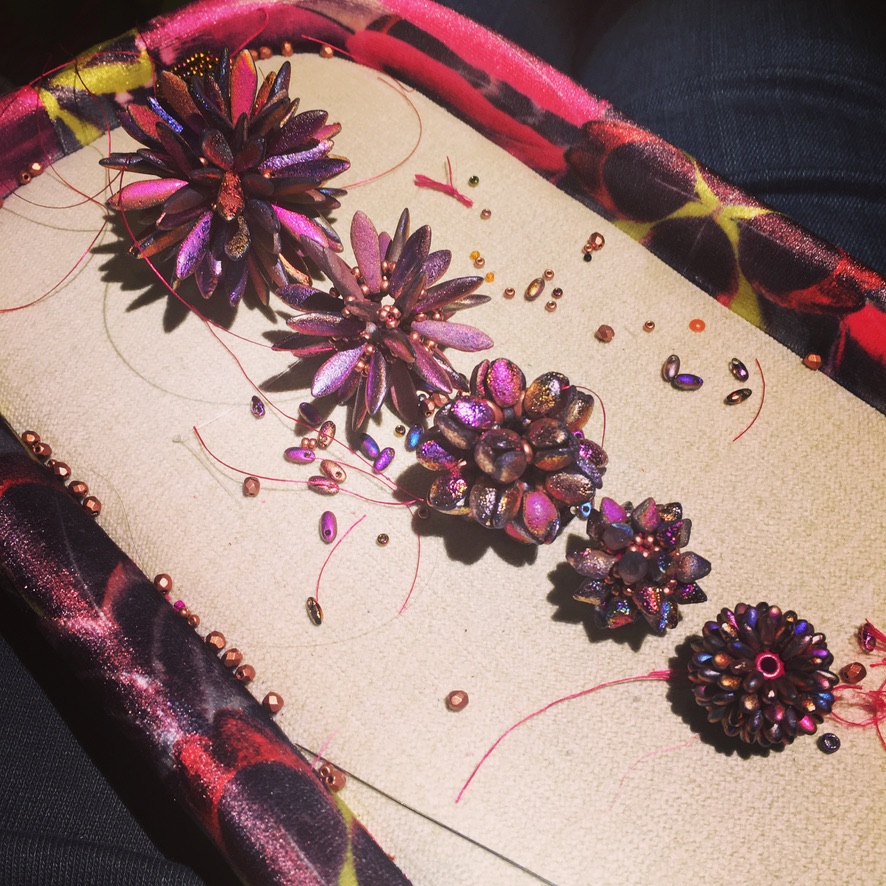
Then I started working with etched beads more, and at the same time, buying wholesale for my Materials Packs. I treated myself to packs of all sorts of Etched Slipperit beads in different shapes as this was my favourite finish at the time, and suddenly found myself with big enough bags to really delve and experiment. I tried different feature beads such as the Tulip Petals, and even 2 holed daggers (sometimes with single holed ones too for extra daftness) and at last something more interesting seemed to be coming.
I was still as you can see above also pursuing the supported bead options – the right hand two have wooden centres, and they were nice but the hollow beads were really starting to be an obsession. I worked with whatever shaped beads I could get in that colour/finish in wholesale packs, and I even started adding Bucky Balls (Truncated Icosahedra) to the Dodecahedra.
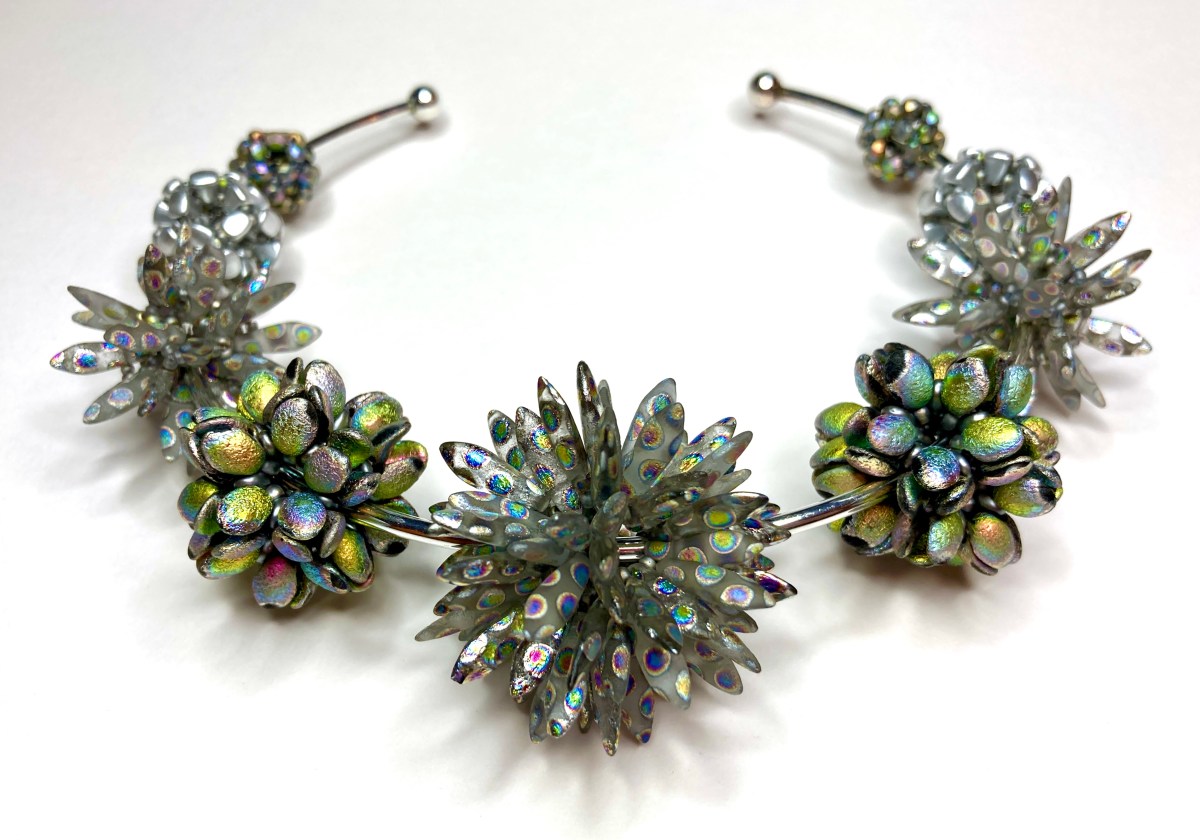
The result of that obsessive period was this necklace (along with some pretty awesome Christmas Baubles).
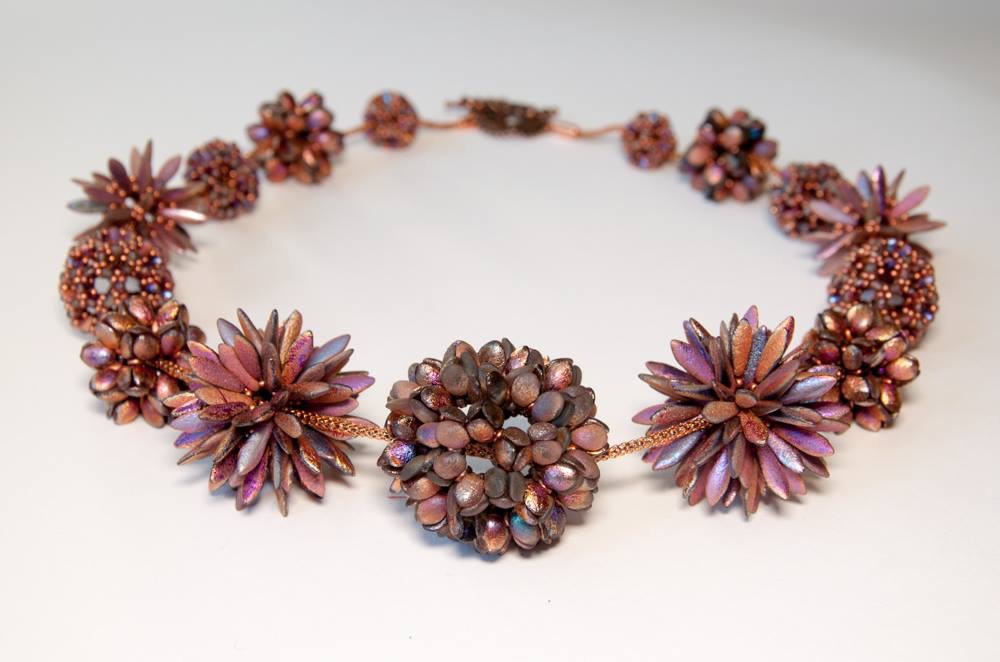
But the trouble was, I couldn’t work out how to write this up. I hate writing up 3d beadwork – it’s just really really difficult, and I know from making these pieces that it’s really easy to get lost as you bead, which means not only do you have to deal with multiple layers as you draw, you have to help your beader know where she is. Even something like CRAW is hard for many beaders to follow, so how on earth could I extend that to this and not make them feel defeated? So I looked at the lovely necklace, felt proud, and put it away. Every so often I’d make some more, ponder the write up and give up again.
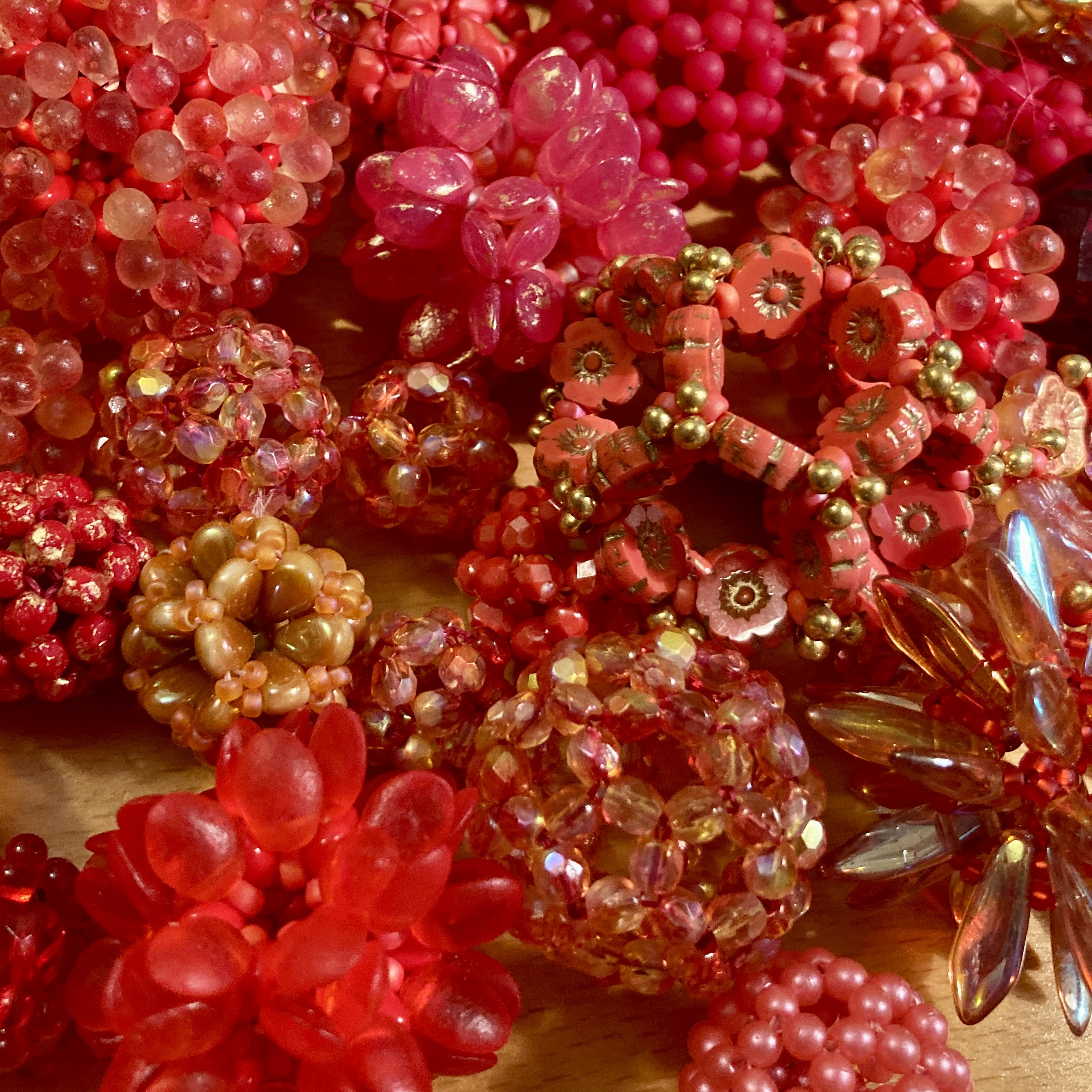
Fast forward to this year and the 99 Red Balloons. I made about 44, decided I would go mad if I made 99, and also that the song itself, being about accidental nuclear war probably wasn’t best represented in a long string of jolly red beaded beads (however much I tried to play up the ‘atomic’ structure). I made my competition piece about a completely different song, using completely different techniques and colours, and then once that was posted looked at the huge pile of red, pink and orange beaded beads and thought ‘hmmmmm….I love these so much, I’m so proud of them that I want to show them off, and I have all these extra combinations now – is now the time to make myself work this through?’
In the bead world if you do show off your work but don’t tutorialise some ignorant beaders think it’s then OK to reverse engineer. It’s really not OK, your work is yours whether you commercialise it yourself or not, but more and more I’m seeing discussions where the good guys are having to work very hard to stamp this kind of practice out, and also where the ‘no tutorial’ argument seems to be trotted out more and more often even by the helpful, respectful beaders. If I want to show these off, I run the risk of copying if I don’t also publish as a tutorial. I’ve been bitten before, bullied by other beaders who’ve ostensibly asked for ‘permission’ to reverse engineer a piece I’ve chosen not to publish for valid and important reasons (too close to the work of other beaders I wanted to protect) and then even when I’ve begged them not to have big fat done it anyway, and then against my wishes shared their methods (just because you don’t charge doesn’t make that OK – you know who you are). So I’ll be honest, me forcing myself to work out how to teach this is as much about protecting my own ideas and techniques as it is about wanting to share them. I absolutely do want to share them – these are completely addictive and a joy to make once you’ve properly learnt how, and I want other beaders to be able to knock up these super beaded beads too, and to start to play with their possibilities. So anyway, sorry for the digression, but this is pretty much why I had to get over myself and work out how to write these up once and for all, and here at last we arrive at the finished tutorial:
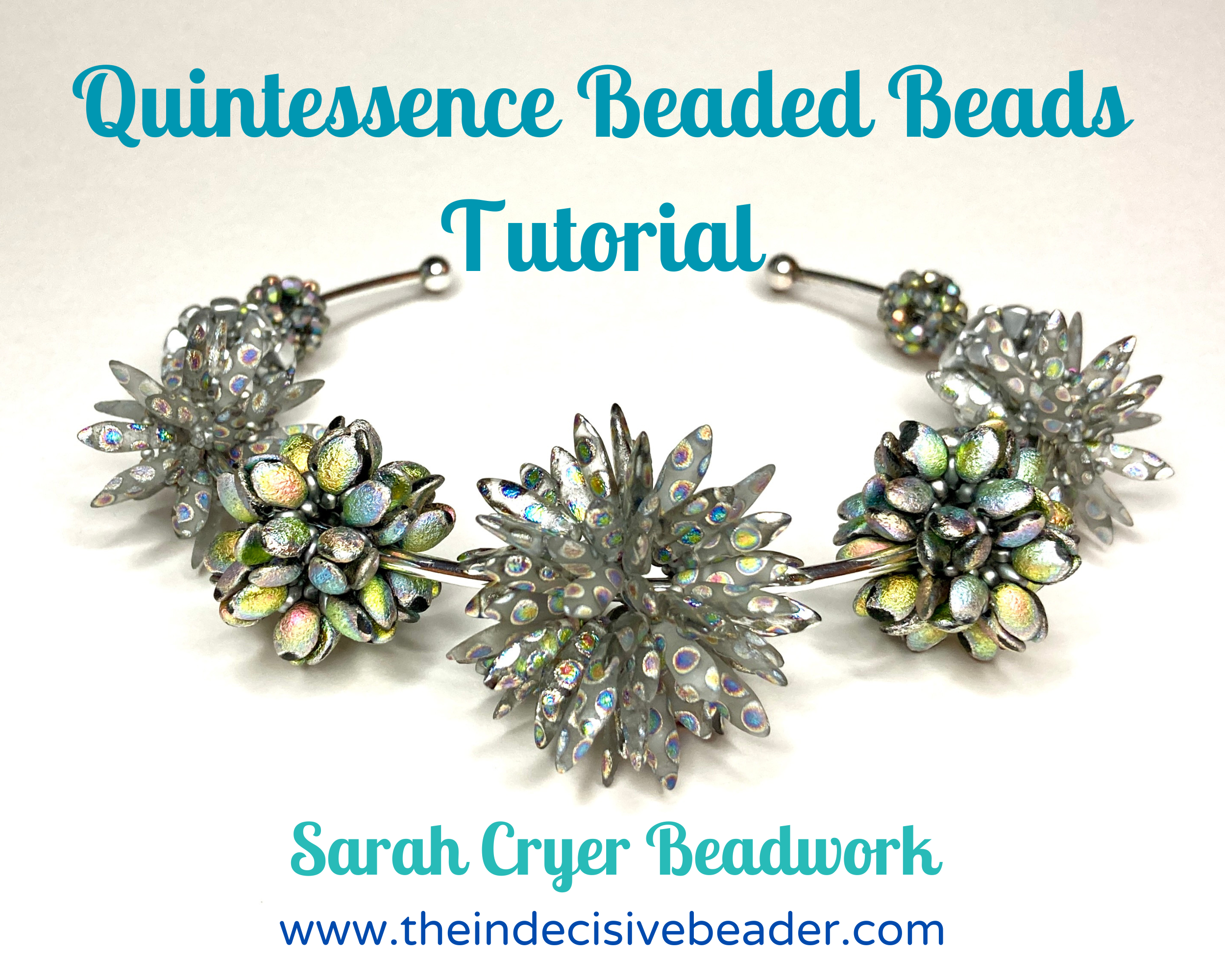
Techniques – Angle Weave
Difficulty Level – Advanced. Experience with RAW and CRAW/PRAW, good tension control (consistently able to vary from soft to medium to tight as instructed), and experience with following complex instructions for 3D layered beadwork.
This is a set of instructions to teach a method for building self supporting hollow dodecahedra (the fifth platonic solid or ‘quintessence’), using a variety of layouts or models, each of which can be used with a variety of bead recipes to give endless beaded bead combinations.
The 6 lessons will teach you each model step by step, and focus on learning the techniques, thread paths and understanding the layouts. They need to be done in order to learn the different variations logically. At the end of each lesson you can either try some alternative bead combos, or move onto the next lesson. The masterclass includes lists of the different bead combos you can use in an Appendix, as well as hints and tips for designing new combinations using the 6 methods, and for moving beyond dodecahedra into other geometric solids.
Because I’m planning to continue pushing through the multi-holed bead options, and feature bead options, I’ll inevitably have more recipes to add to Appendix 2 of this tutorial, so I’ve developed a secret formula which is explained there, which you can then use when you look at that page (linked in the tutorial) to decipher which beads and which techniques from the tutorial to use. I’ll also publish a notification when I update the page to my Facebook and Instagram pages. I know it sounds a bit mysterious but again, I want to share as much as possible whilst also protecting my work – if you buy the tutorial it will all make sense (and you can always contact me if it doesn’t!!).
The tutorial is now available in my Etsy and PayHip shops, and I will have ‘orientation bead packs’ available too in my Etsy shop in the next couple of days. If the tutorial sells well I’ll follow that up with some curated bead packs to make sets of Quintessence Beads.
I’ve loved spending more time on this series, although to be fair the write up has been a long slog (51 pages and countless diagrams and photos). The beading has been a delight – at the last count this morning I’d made over 70 this year alone (and that’s not including the ones I frogged because I needed to re-do photos etc) – I took a photo a few days ago but the eagle eyed among you will see I forgot the Lesson 6 samples (among quite a few others!):


 The Indecisive Beader
I have played around with beaded beads myself using double PRAW dropduos, rizo beads, twisted daggers and mini daggers over the last 15-20 years. You are not the only one to do this. This 5 bead RAW bead is rife throughout Asia where it seems to have originated possibly centuries ago ( see what Valerian Hector has to say). All you can claim in this space is your tutorial instructions. The basic technique is as old as the hills. I myself have developed a way of making half pom pons with double PRAW and circular 3D RAW so you don’t have spiky bits digging into your neck and it sits flush. Please do not try and claim this technique as your personal province when there are already many well known bead artists who have covered much of this ground already. Silly me, I paid good money about 5-7 years ago for a 5 bead RAW beaded bead which I was already making. The instructions worked but were way more complicated than the version I use. The ‘new’ version wasn’t worth my time or energy since it was so complicated, I couldn’t keep it in my head.
Lillian. Thank you for the comment. You make some allegations about me claiming credit for the beaded dodecahedron, which if you read both the blog page and the tutorial description is absolutely not something I am doing, so I thought it best to reply to you and allay any concerns you may have.
I am well aware that PRAW based variations sit deep within many beading cultures, and like you have beaded many of them myself – my abandoned red series from earlier this year as you correctly spotted contains groups such as the Platonic solids and many Archimedean solids as well as dodecahedra. I choose to focus on the dodecahedron for this tutorial as it’s a simple shape once you have learnt it, and usually a useful size when complete – for example my favourite Bucky Balls are often a bit huge in double layers and can be confusing to navigate, and I shuddered to think of how on earth to even approach writing those up! Additionally other beaders such as Cindy Holcshaw have done wonderful work with cube and octahedra based beaded beads, so I’ve avoided those all along – no sense in driving oneself deliberately too close to a design collision. Most importantly as you have rightly pointed out, the single layered PRAW bead is well served already, most particularly by Valerie’s amazing work and scholarship, so throughout the ten years I’ve beaded the double layered forms I’ve made sure that any single layered beaded beads are only ever companion pieces, fillers, and that’s absolutely why it’s the double layered pieces which are the focus of this tutorial, not the single.
Within my tutorial the Beader is taken through the basic single layered dodecahedron so that she has a solid, established, relaxed technique and is essentially ‘off book’ for dodecahedra by the time she moves into the double and triple layered versions. These are the focus of the tutorial, again then stepping from simple two hole and seed versions up to more ornamented variations, and different bead layouts. Of the six ‘lessons’ only two cover single layered work, and they are very much just a stepping stone, and not the end goal. As you know as someone who is clearly experienced with this area of beadwork it’s very easy to get lost, particularly when working with more than one bead type at a time, so my aim is to make sure that the beaders really get what they’re making, get used to my thread paths and terminology so that they can not only bead my double layered models comfortably, but that they are also potentially set up to explore by themselves into more shapes, both in terms of the multi-holed beads and decorative top layers. The two appendices then set out guidance and tips for further double and triple layered variations based on what they have learnt, and for expanding these into further geometric shapes, and I’m sharing any new variants to my website so that beaders who have already purchased can continue to benefit as I keep experimenting. At present there are 17 double and 2 triple layered variants included either in the PDF or on my site. I am not aware of any beaders sharing (either as photos or as tutorials) anything matching any of those variants, and I have spent a great deal of time in the days leading up to publication checking and double checking that – given the delay in me writing this up I had to make sure other beaders hadn’t arrived at the same place as me in the meantime, and happily they haven’t.
I do know from searching your name in All About Beadweaving that you also shared a lovely Drop Duo dodecahedron on my post sharing my Perlen Poesie piece way back in 2018, but I can assure you that the beads are not placed in the same way as they are in the Drop Duo beaded dodecahedra and truncated icosahedrons from my piece. My 2 holed beads are shared between adjoining dodecahedra – yours aren’t, as you share the seed beads along the adjoining edges instead in a way which is quite different from this or any of my other variations. Yes, they’re both based on a dodecahedron, and using the same key beads, but both are made differently, and look different, which for me is pretty amazing and exciting.
As you have said, there are lots of options and different ways to work with the opportunities these lovely loops of beads provide, and there is consequently plenty of space for beaders to continue to come up with different methods, bead combinations and exciting results – just look at how you and I took the same drop duos and beaded something different, or at how you managed a single layered version with Rizos and I can never get them to work? I’m sticking with my method, but I have a list as long as my arm of bead combinations to try just using that, plus all the Platonic solids and many of the Archimedean solids, so that will keep me occupied indefinitely, and some friendly fellow beaders are also trying new options too. Hopefully you’ll continue with your own methods and explorations – your comfortable dagger beaded bead sounds amazing, such a clever idea. I tend to wear the huge sliperit piece over a black polo neck for visual impact but given the weight of the double daggers plus the scratchiness of etched beads I do agree it’s not entirely comfortable, which is why the massive truncated icosahedron version I made ended up as a Christmas bauble……
Thank you for your measured answer to my message. I now understand where you are coming from. I am not quite understanding what you mean by layers though. I recently took a class with Sabine Lippert and she has been playing with double RAW extensively. So many things we were playing with in the noughties didn’t have a good descriptive name now have them. I believe that 5 bead+ RAW is now called prismatic RAW or PRAW.
Oddly enough Valerie Hector seems to use larger beads in the outer ring of her circles and seed beads in the inner ring. I do the opposite and have found that works very successfully expecially with twisted daggers and larger beads. I guess this is because it is easy to join seed beads rather than larger beads without creating big holes. Like you, I haven’t a successful way of using these in something that I feel comfortable wearing so they sit in a baggy waiting for inspiration. They are great fun though.
I understand that many people teach and write about beading for a living. Personally I have been unable to do more than sell beads and occasionally teach to fund my hobby. Even the selling of beads becomes more of a chore at times. So many people are trying to make a living at beading. Like any craft though, making a living doing a craft is very difficult and requires great dedication.
As we get older, many women stop beading because of health issues such as losing sight and dexterity. It seems a great shame to me that the things that are discovered by beaders are often lost since we lost Bead and Button and Beadwork magazines. We are fortunate to still have sites like Seed Beads and More and other forums. Hopefullly all of the knowledge held there will not get lost.
Hello again Lillian, thank you for your reply. If it’s ok with you I’d love to explain my layers, but via email because it kind of gives away the tutorial’s main point of difference! – I have your email through the blog administration information, but don’t want to use it unless you’re happy for me to contact you that way?
In terms of beading for a living, I’m not in that position – I work in IT, and run a successful micro business on the side selling beading tutorials and goldwork and beading supplies. I’ve being doing that for over 10 years now, part time and in terms of tutorial writing, extremely intermittently! As an artist, these days I’m probably better known for my bead embroidery works, but beadweaving is still something I try to do when I have time and I have a backlog of designs which are potential tutorials. Some can be written up more quickly (this one was over one hundred hours on the write up alone, and as you know 10 years of design development and sampling)! I’ve never taught, mainly because the tutorials are something I began when my children were babies, so going out to teach wasn’t a practical option, and even now with the advent of zoom classes, pdf tutorials are still a more practical undertaking within busy family life. And because the goldwork side has been a success too, that chore of selling ‘real’ things does as you say become a chore and a time sink, but I can only blame myself for that! Anyway, if you’re happy for me to email let me know and I’ll send through some pictures explain what I mean by double layered.
Hello Sarah, thank you for your response. I am happy for you to contact me directly via my email address. We can talk about double layers privately. If it is what I think it is, I am already doing this with circular modified RAW adding vertical rather than horizontal layers, much like stitch in the ditch with Peyote stitch.
Lovely, I’ll email you over the next couple of days. It might not be what you’re expecting, it’s more about how you use the 2 holed beads than any building up, but I’ll find a couple of photos that will probably make sense as soon as you see them.