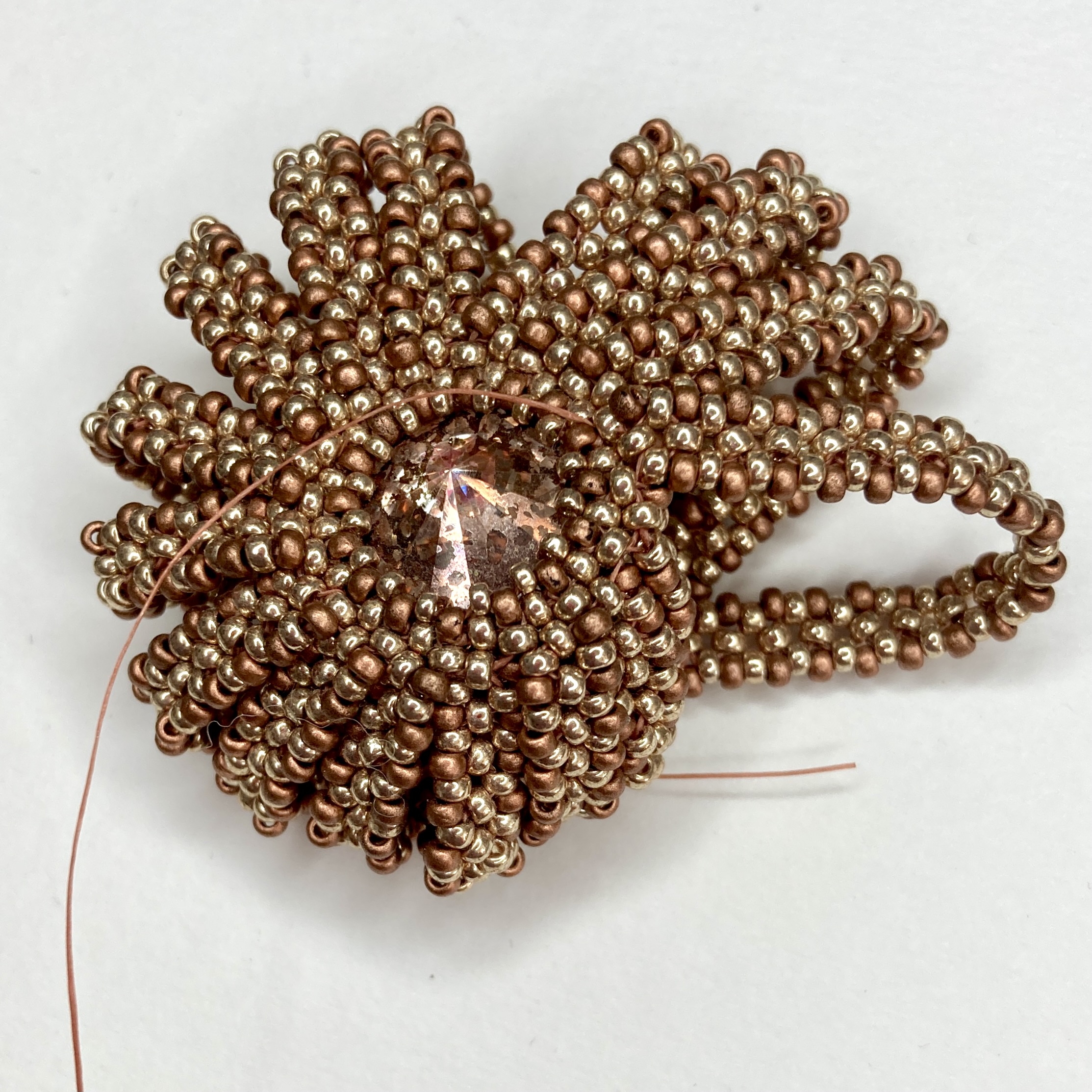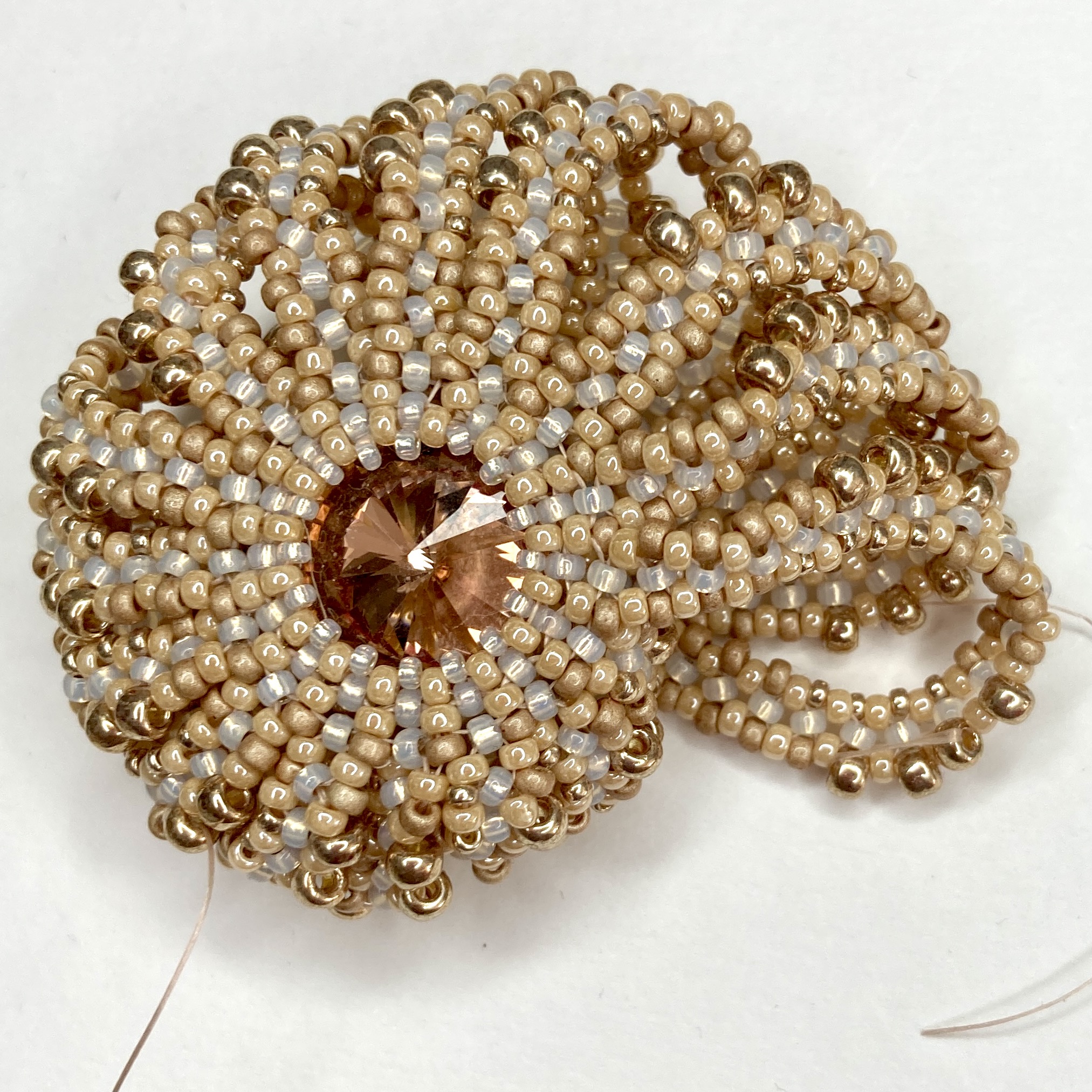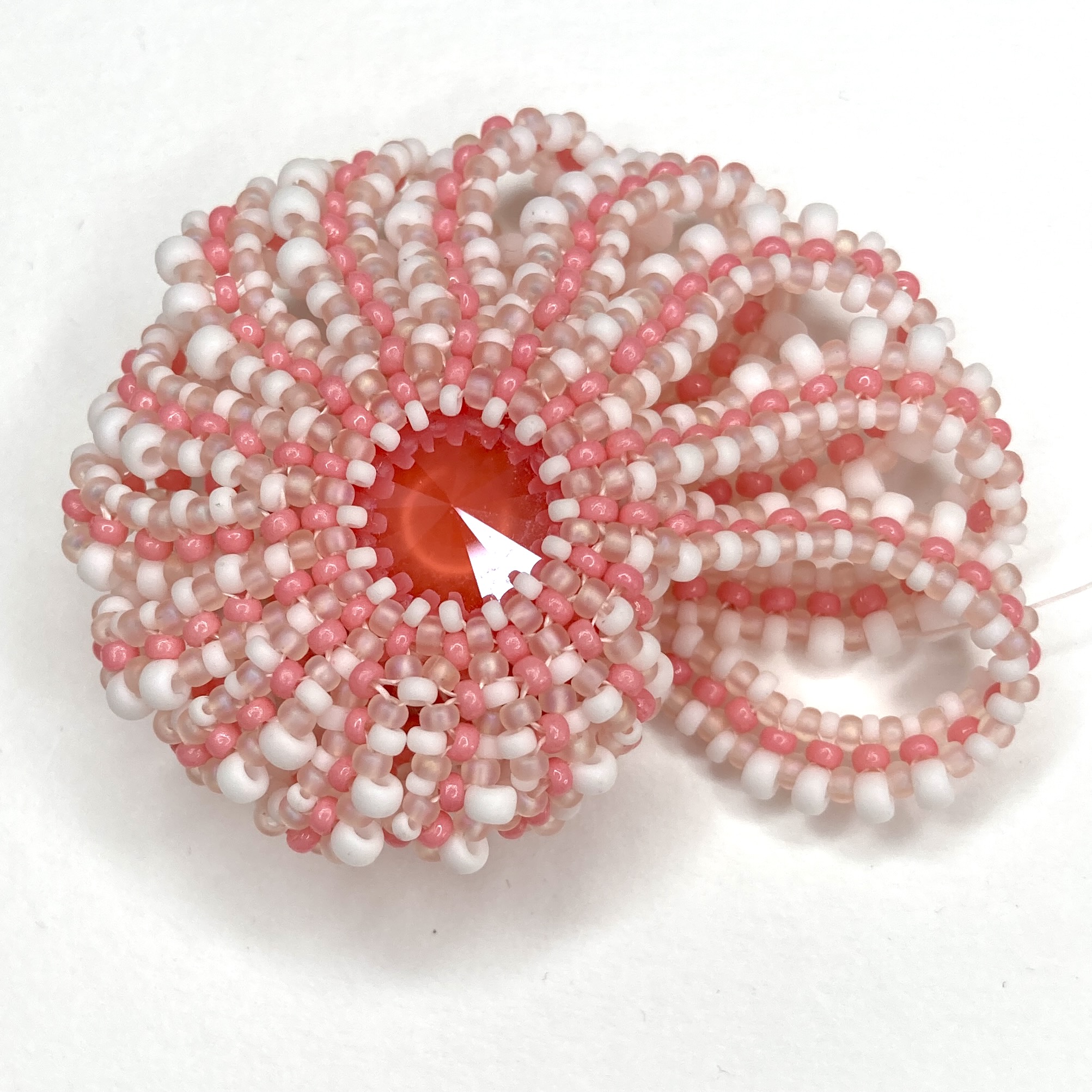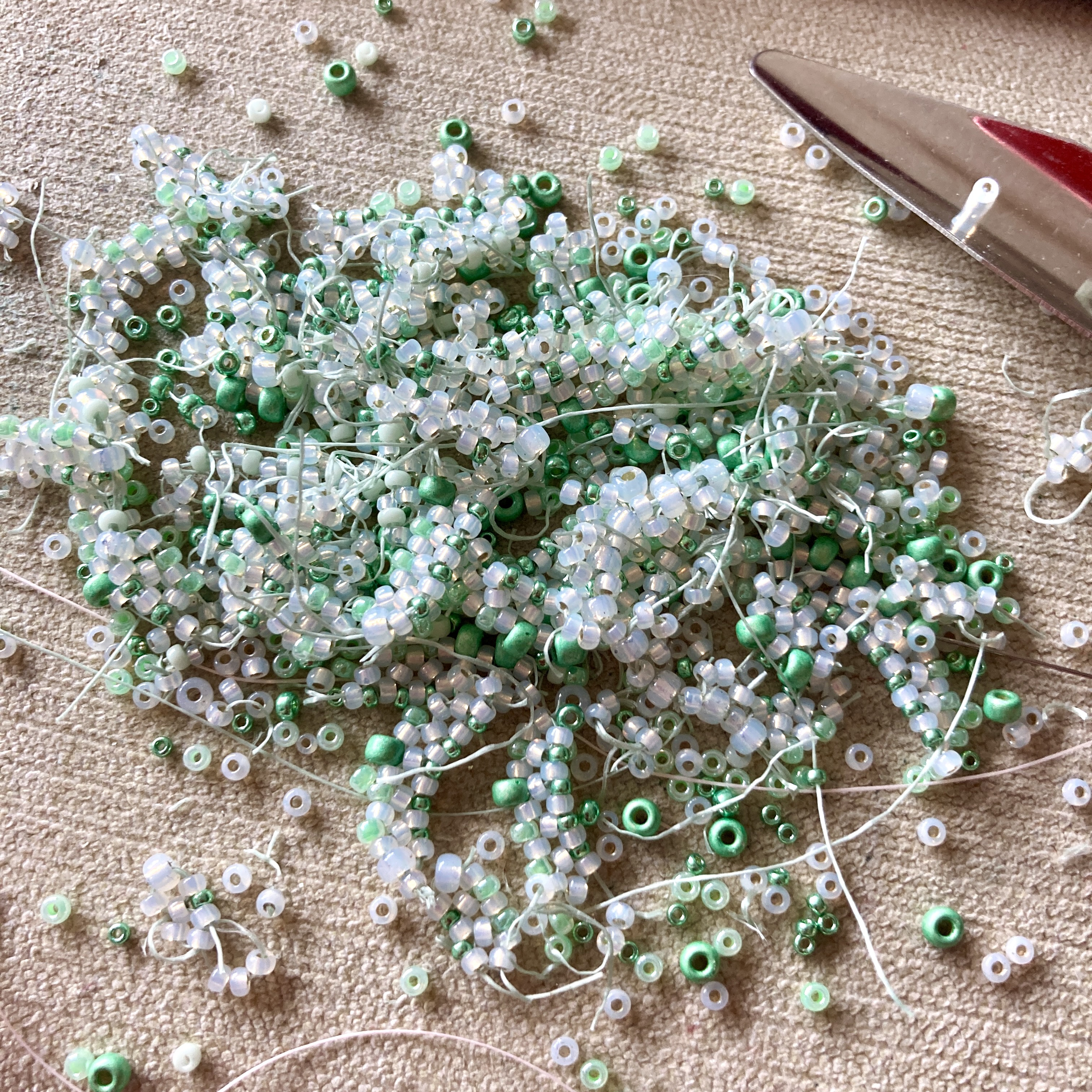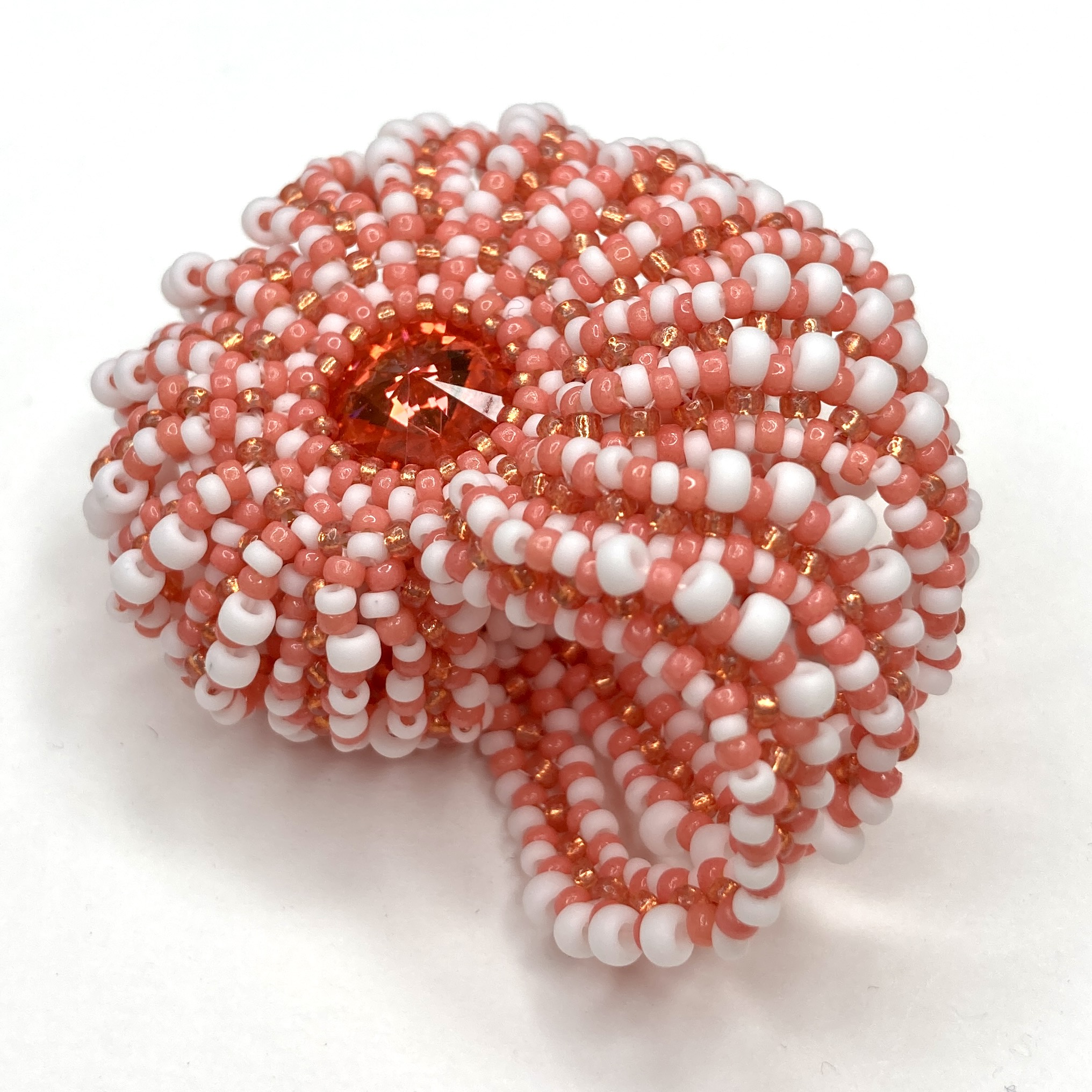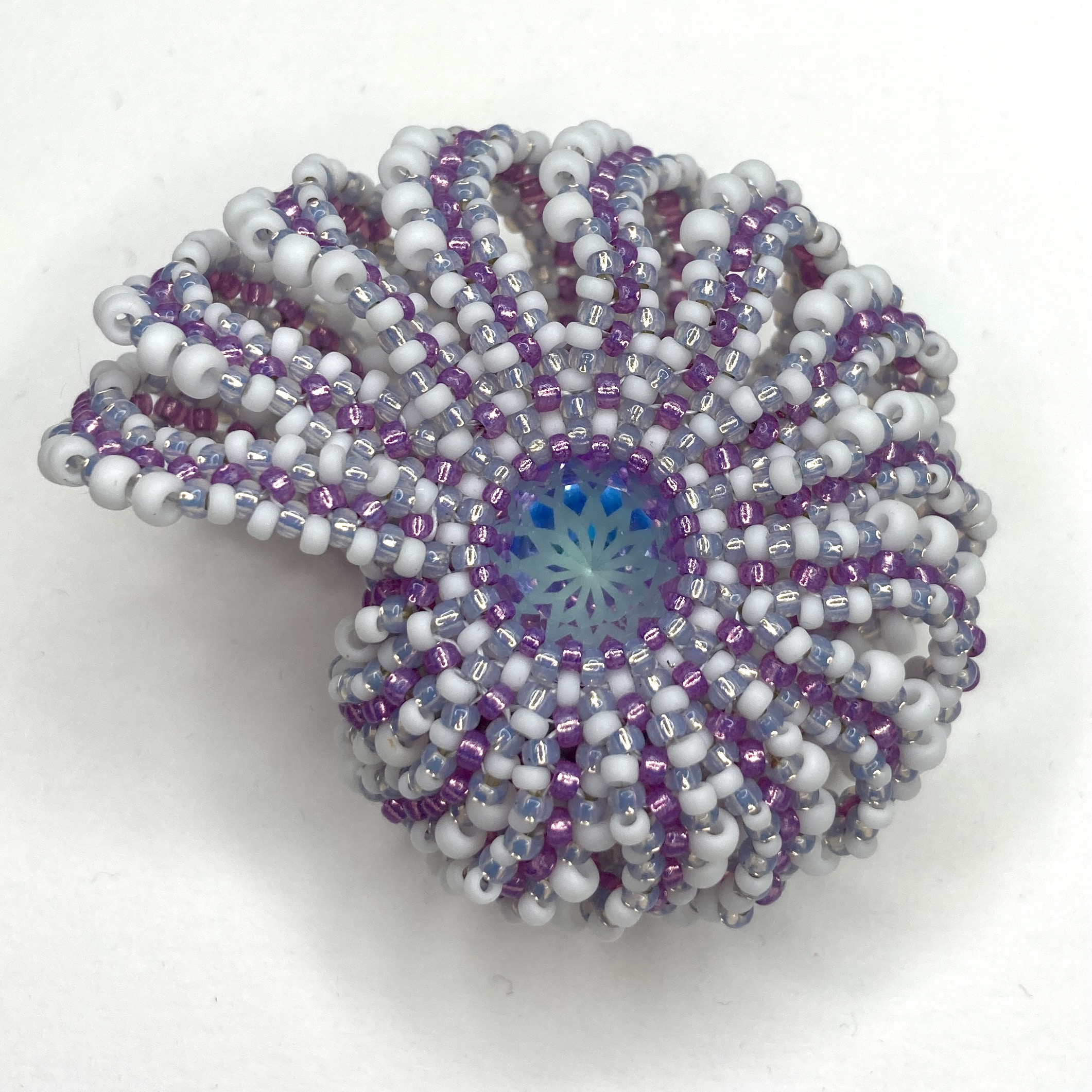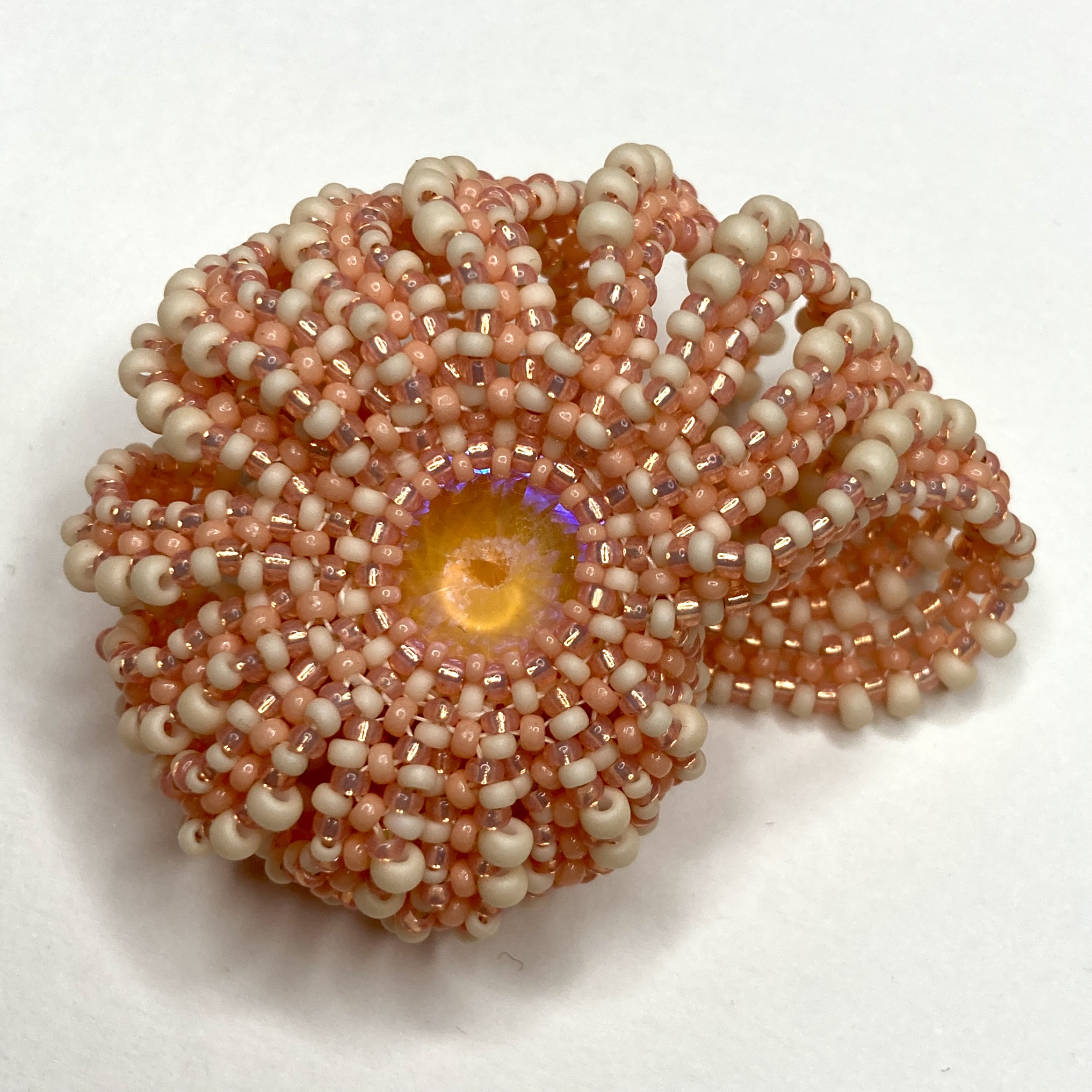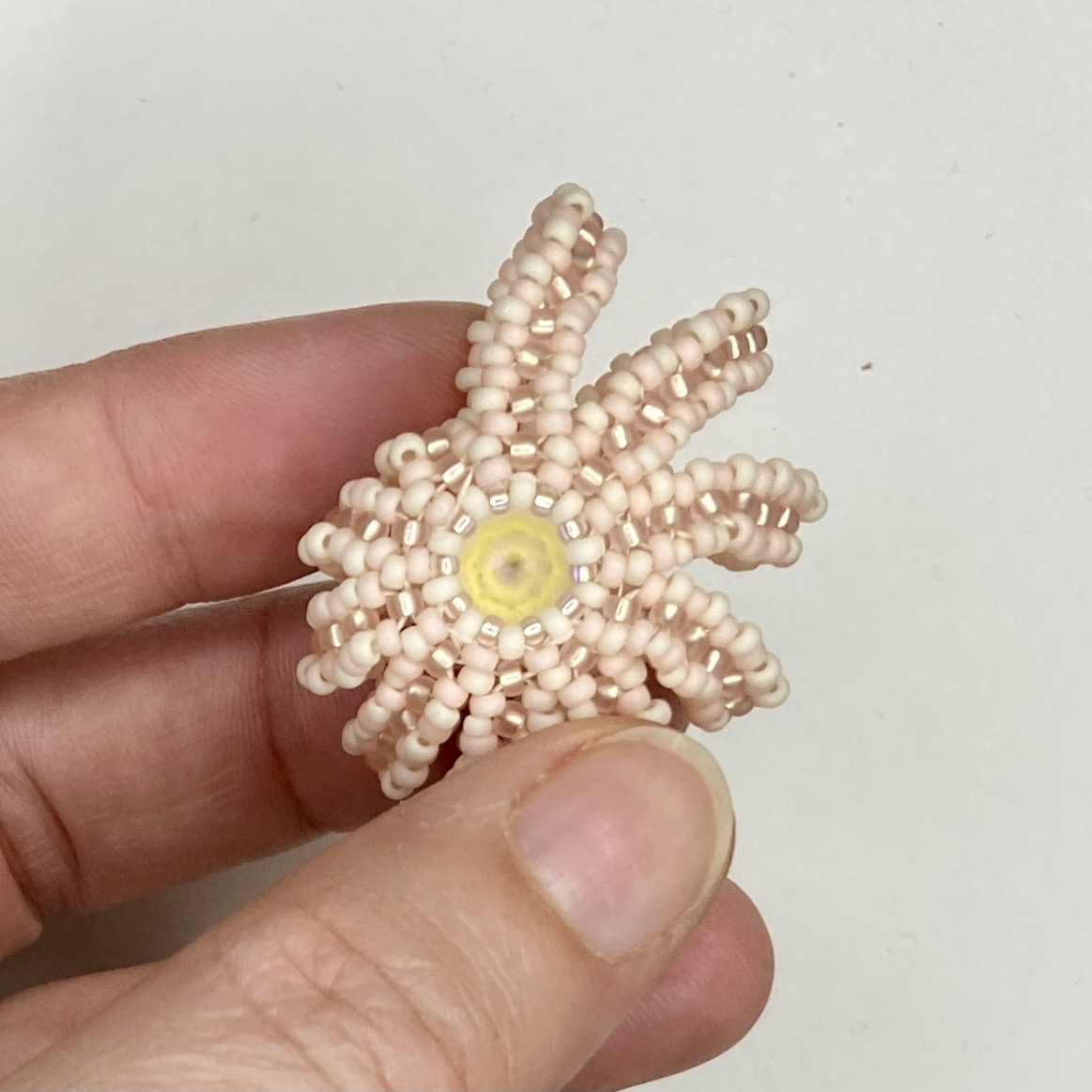
NEW TUTORIAL – Orbit

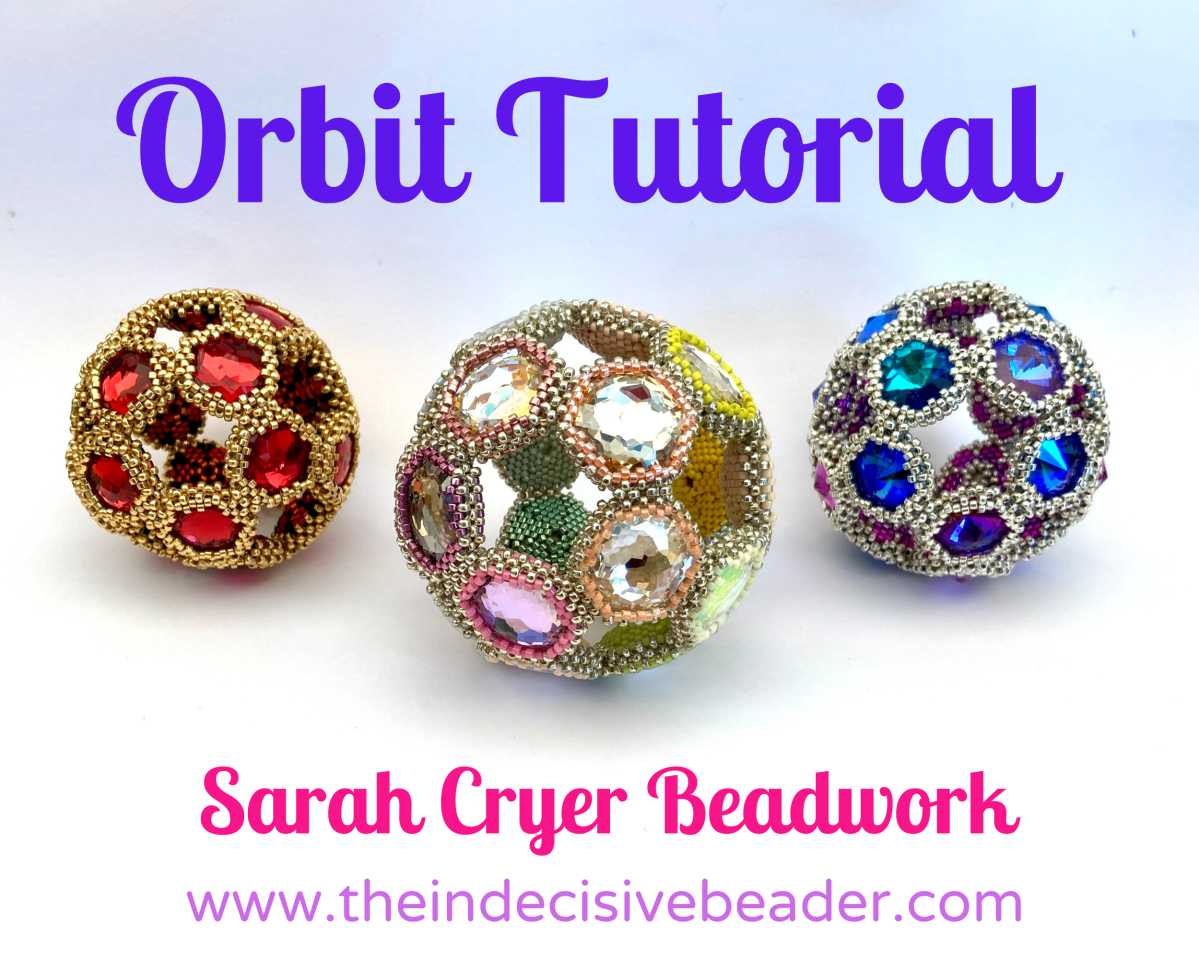
Orbit is a new tutorial, born from a pack of amazing intricately faceted hexagonal crystals from my regular supplier – I can’t resist trying new sparklies and a pack fell into my basket whilst I was restocking other lines.
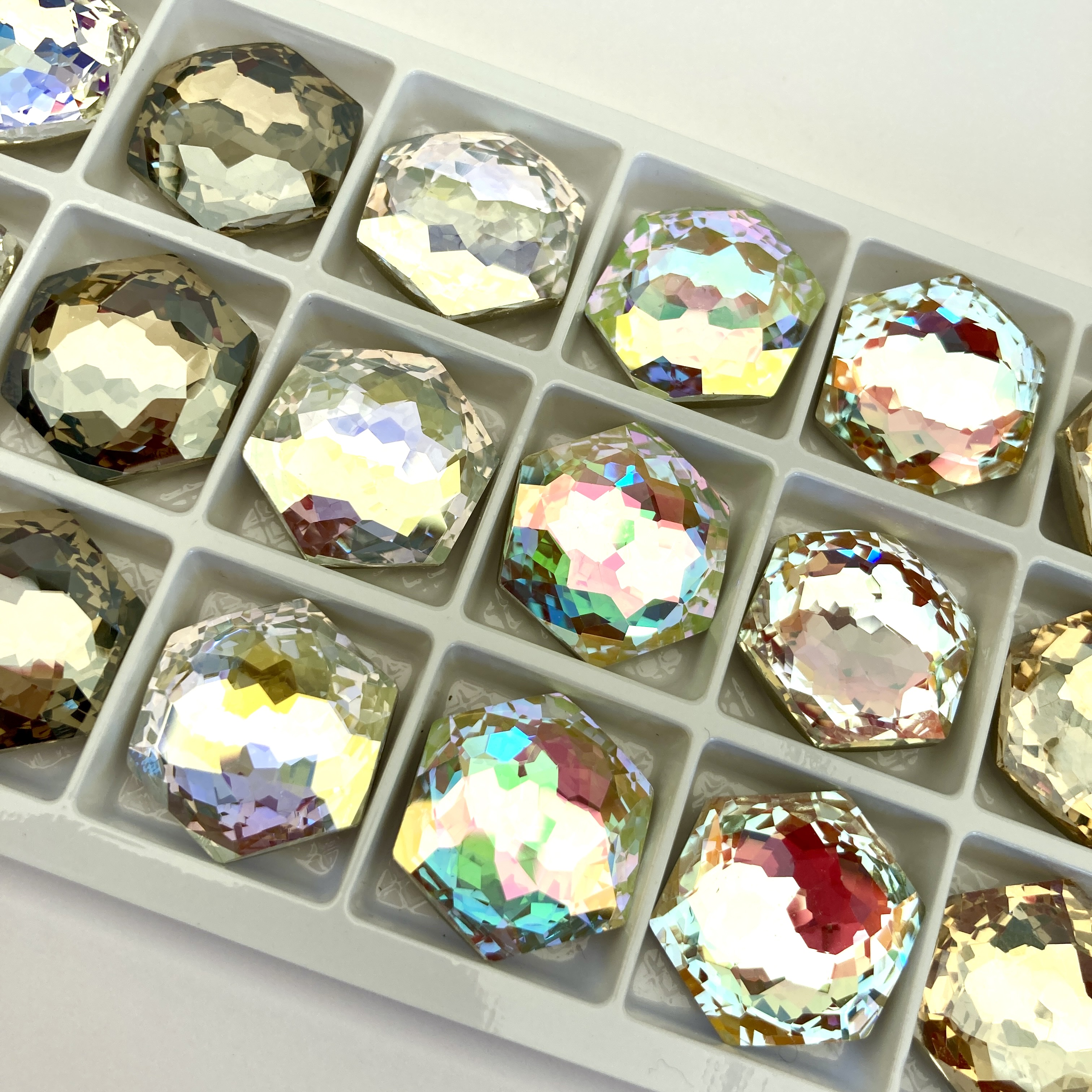
Absolute whoppers at 18mm across (21mm point to point) the colours and finishes were amazing, but I needed to come up with a design to use them. If they’d have been pentagons they would have been so much more useful for making my favourite dodecahedra, but they weren’t – hexagons tessellate to a flat sheet, so only make 3d geometric figures if they’re combined with other shapes which weren’t available to match. So I put them away and moved onto other things.

A few months later I was looking at them again, and had a go at my favourite MRAW bezel to see how best to start using them. I always try that first with new cyrstals, and if that fails try peyote combinations, and finally complex 3D netting. It worked, and made a lovely solid bezel (particularly when I used a hexagon on the backs), but when I joined it to another I couldn’t get it to sit flat – whatever combinations of beads and stitches I tried I could only get a nice finish that was either concave or convex.

That took me away from flat sheets and back to 3d shapes and got me to thinking about the 3d Geometric shapes which do use Hexagons. The best known of these is of course the Truncated Icosahedron, also known as the Bucky Ball, seen everywhere as the basic patchwork layout for the football (or for the US peeps, a soccer ball). It uses pentagons, each surrounded by a ring of 5 hexagons. All the hexagons are joined, which made me wonder, what would happen if I just missed out the pentagons altogether and left the resulting gaps as voids, viewing windows into the delica bezel backs? Could I create a structure which was rigid enough to feel solid even with the voids? Would the curvature be correct? My engineering brain said ‘maybe, if you have a solid joint, rather than a hinge joint’. In peyote 3d shapes we usually use point beads to join, giving a hinge. If every side has a join then those hinges act in combination to give a solid shape. Any missing sides or joins mean flexibility returns, so the shape won’t be rigid. So I needed to come up with a joint which was solid – it would need a bit of flexbility to allow it to shift during construction, but ultimately needed to lock into a solid formation. Once again the curvature showed me the way to go, and in the tutorial you’ll see how the two part joint gives you the rigidity you need.

So a plan, but no way to see if I was right other than beading it, we departed for Christmas with 20 pots of pastel delicas and 20 hexagonal crystals. I doggedly beaded them half askeep in front of the post Christmas telly whilst the boys built Lego and played with my Dad’s train set, and by New Year I was relieved to see that my gamble had paid off, and Orbit was born.
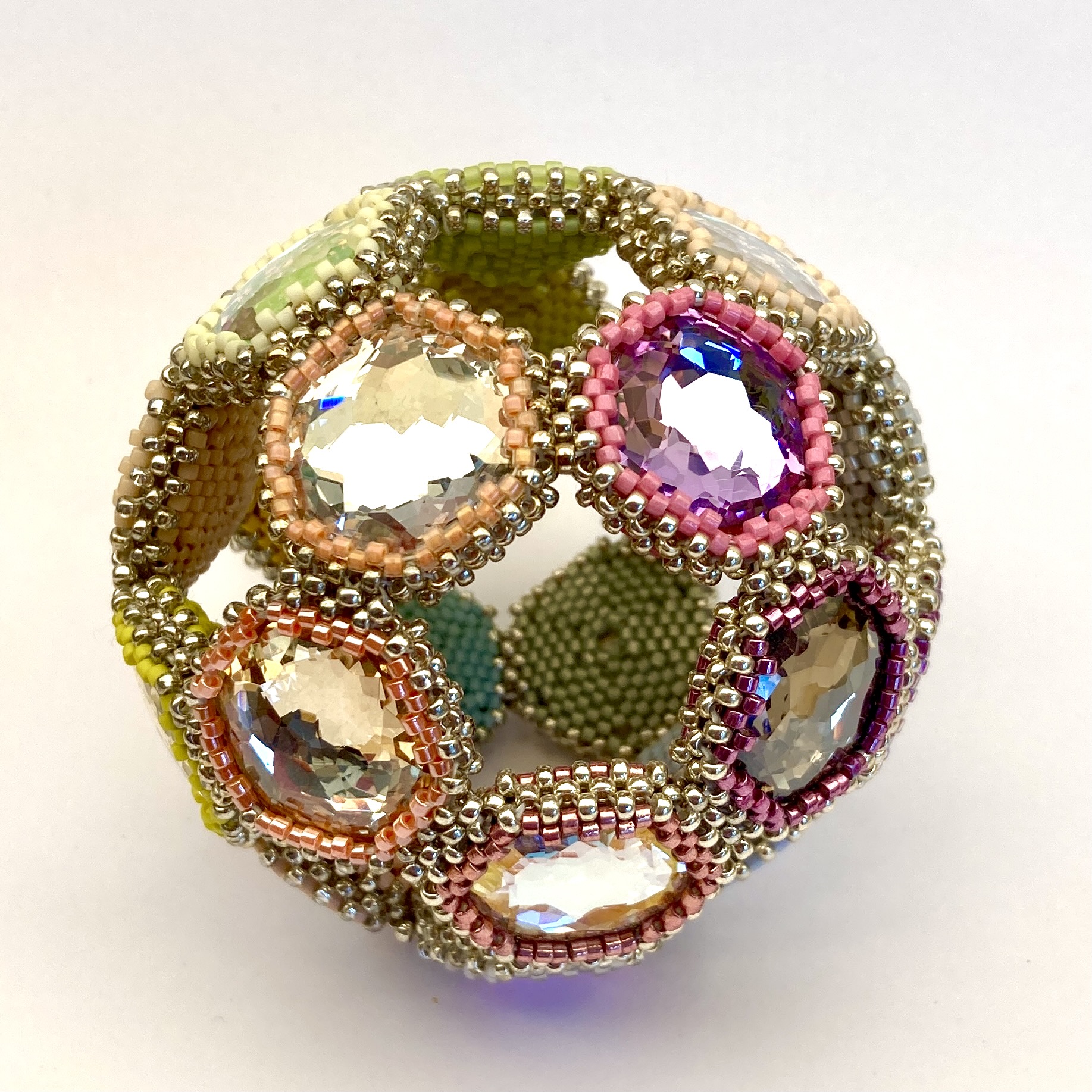
Orbit – a Beadweaving Tutorial by Sarah Cryer Beadwork

Next, a lone Swarovski 14mm crystal in my stash of the same shape and cut beckoned, and I managed to alter the bead count to get a bezel to work for that too. Crystal Idea in Lithuania had a good stock, so 19 more were ordered, and the Poppy variation followed.
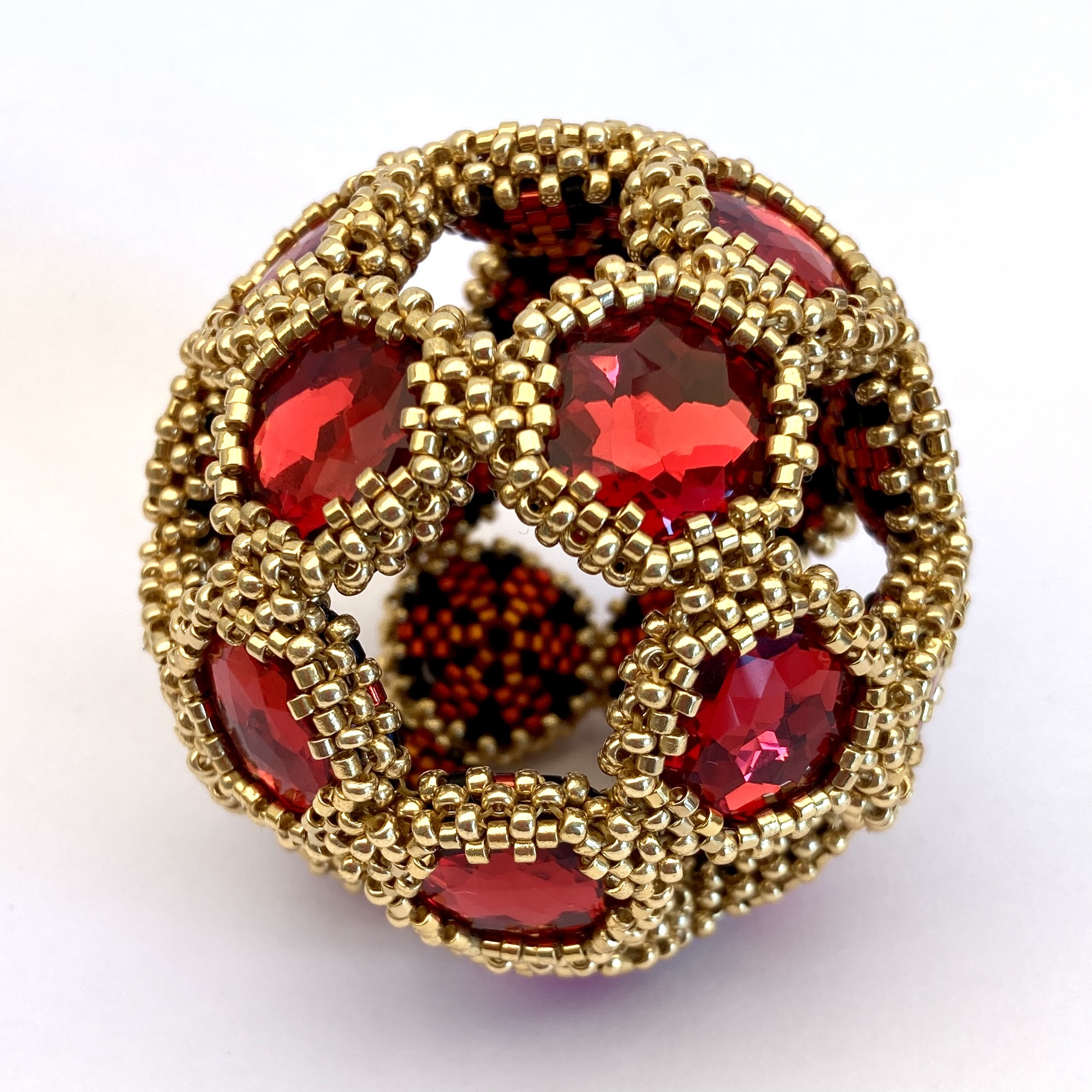
But those 14mm versions were eye wateringly expensive, what beader was ever going to chose them? I had been able to get enough stock of the 18mm original crystals for launch, but realistically that wasn’t going to serve more than a couple of dozen customers, so would really limit the market for the tutorial. Back to the bead mat then as I tried to make it work for different sizes of hexagons – 10mm NO, 12mm NO. More thinking. What about a 14mm Rivoli, the beader’s favourite – NO – too small. At this point I had drawn all the diagrams and invested a lot of time (and crystal money) and I was getting a bit discouraged.

Happilly one day I was working on the materials section of the tutorial and needed to measure the crystals, leading to one of those ‘doh’ moments when you realise you’ve been daft. They’re sized across the parrallel edges as 18mm or 14mm, but point to point they’re actually 20mm or 16mm. I had 2 lonely 16mm Rivolis in my stash and hooray, they fit the bead count for the 14mm hexagon. The bezel ended up circular, so the backs needed some changes to fill the gaps that opened up in the delica peyote, but eventually I came up with some slight tweaks to allow beaders to adapt the 14mm version to make this with 16mm rivolis – they’re way way cheaper and much easier to get hold of, so I very much hope this will allow more of you to enjoy making this piece. If I’m honest I prefer the look of the hexagon versions to the rivolis, and the join beads don’t sit quite as neatly. However, the 14mm hexagons were £70 in total, and the 18mm hexagons I sell are £20 for a set (plus post and packing) so it feels important to offer a lower cost option – I paid £10 for the 16mm Aurora Rivolis from Old Bicycle Shop Beads and I think you’ll agree that’s fantastic value.
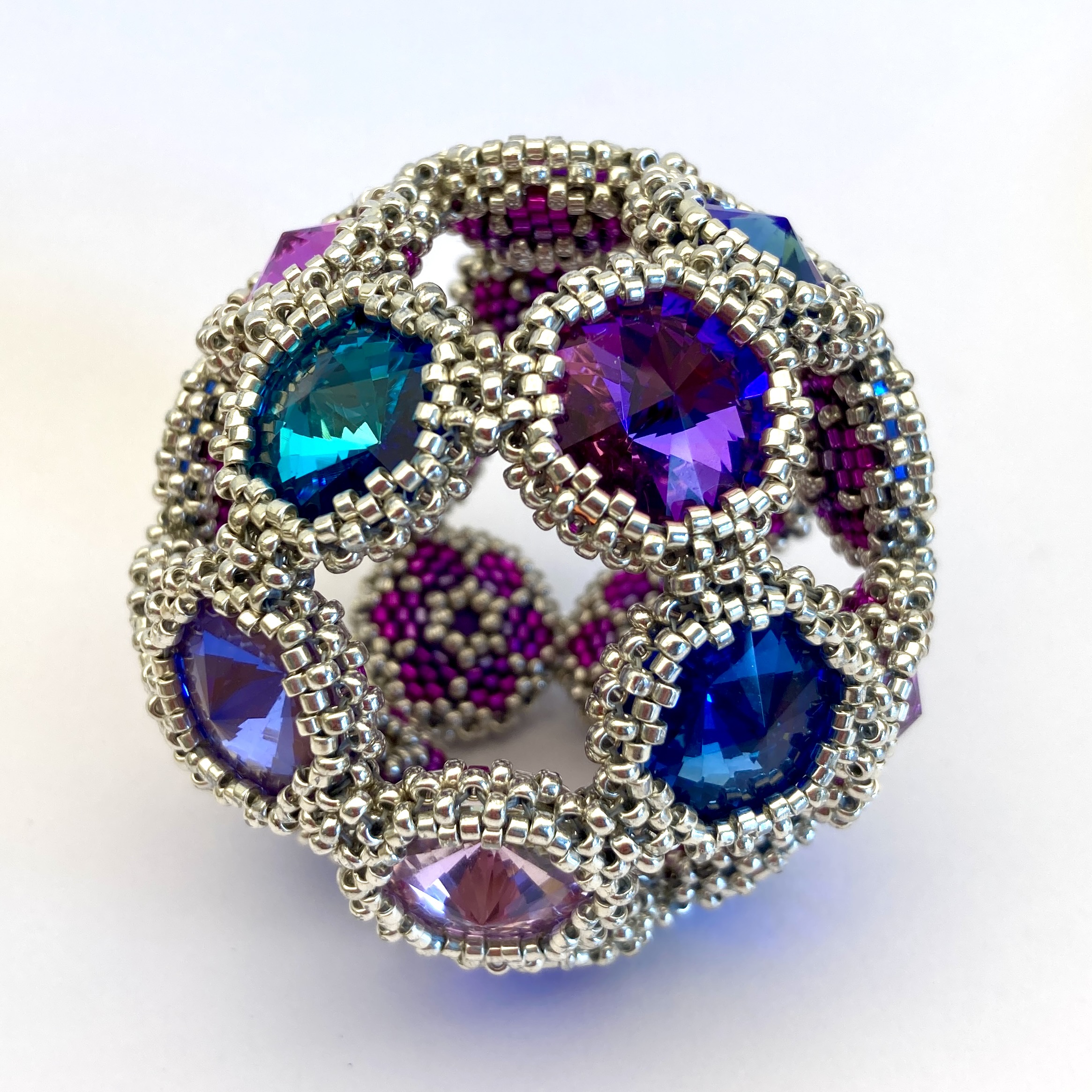
At some point I will also try to put together a 20mm rivoli version – I have some gorgeous vintage rivolis (again from Old Bicyle Shop Beads) all ready to try this with but as they’re a less easy to find size I concentrated on getting the 16mm tested first.

So here it is – Orbit, made with just Miyuki size 11 seed beads, size delicas and 20 gorgeous crystals using RAW, MRAW and Peyote stitches.

18mm Hexagon crystals which I think make the best version are available from my Etsy shop in packs of 20 (exactly the right number of course) here. Alternatively you can purchase the 14mm 4683 (under the brand name Primero) from Crystal Idea here or from other Swarovski stockists, or the 16mm Rivoli from Old Bicycle Shop Beads here (and probably lots of other places).

Intermediate level, suitable for anyone who is confident with RAW and Peyote, and patient enough to make 20 identical components and carefully follow a net to join them correctly. As usual it is fully illustrated with both diagrams and photos, written out steps and even some listed out colourways (with bead numbers) or your own colouring in sheets if you’d like to plan your own colours. A full detailed list of bead requirements is available on the usual page here.

Available in my Etsy or PayHip shops as a PDF download. Etsy don’t like my decent quality illustrations or photos so force me to turn it into 3 PDFs to meet their teeny file limit- if that annoys you as much as it does me, the PayHip version is a single PDF and exactly the same price.
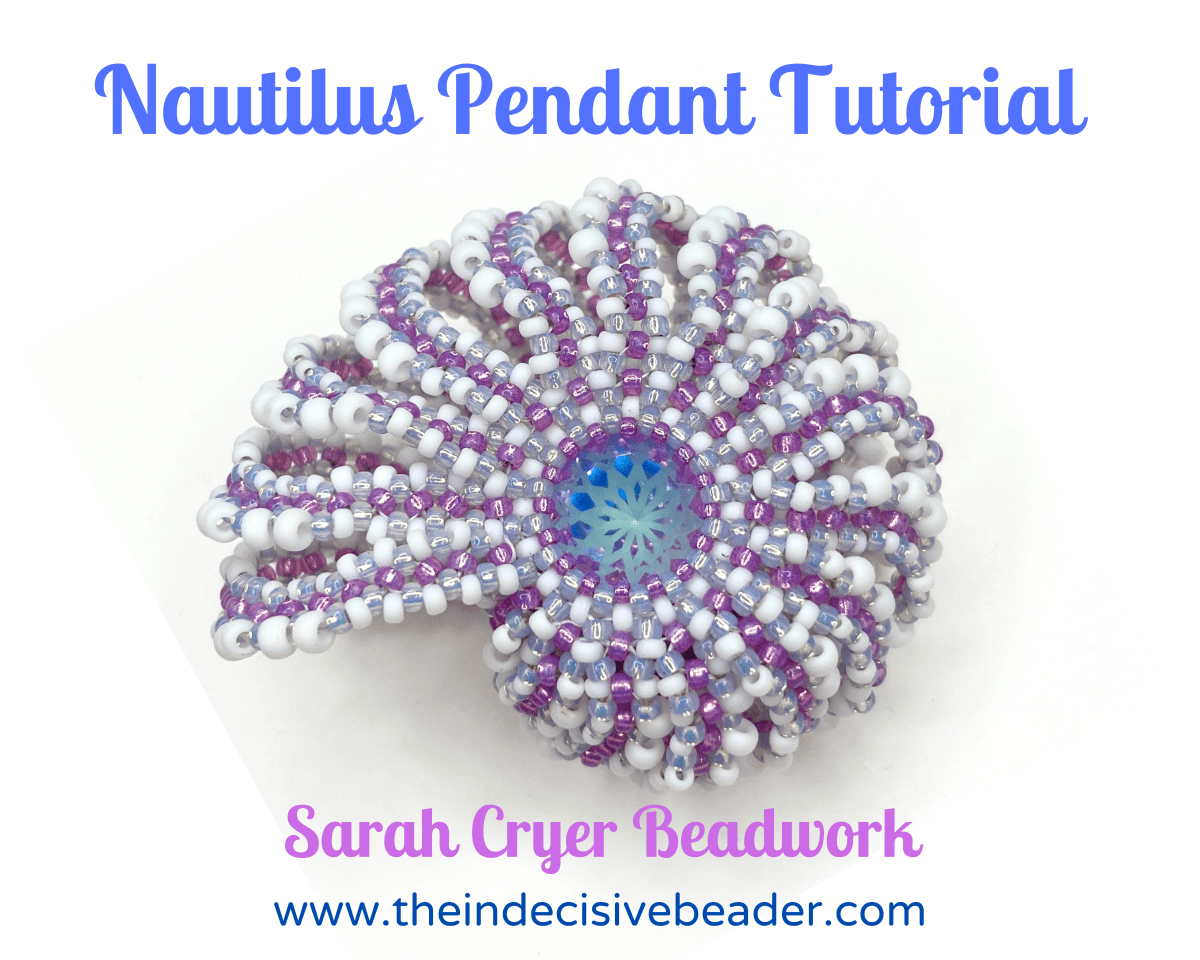
NEW TUTORIAL – Nautilus

I know, I’m on a roll, two new tutorials in a row! This one is another pure beadweaving tutorial – I’ve been doing a lot of bead embroidery and goldwork as part of other projects, so I’ve returned to beadweaving as a break from the stress of very creative work, spending some time refining some samples made a little while ago and writing them up.

This piece was started last year as an attempt to create a shell shape in beads.

The original idea was to work with CRAW, and whilst that came out as I’d planned, it wasn’t really shelly enough (you definitely had to be told what it was supposed to be!!). CRAW is also not a universally popular stitch – some beaders love it and some completely hate it, so I moved on…….

The idea of increasing strips seemed sensible, but there needed to be more of them to give a clearer shape, and they needed to not be CRAW – so I had a go with RAW, using twice as many strips and something altogether more shell like emerged.

There were a few mis-steps along the way – early versions had a terrible wobble in the middle until I changed the central join to make it more rigid, and I had a lot of trouble getting the spines rigid enough without busting needles weaving through (and getting bored as well as annoyed in the process). A offset version was hopeless but did give me some ideas. Overall the set up was a little plain – still not shelly enough, and the metallic beads weren’t helping either.

Then I had the idea to add Cellini to the spine edges – that immediately gave a beautiful S shaped curve and an instantly rigid shape, but I was still having issues with getting through some of the beads to get the spines in place and to make them rigid enough. That meant lots of new versions, trying different bead sizes, thread paths, even altering the bezels. Colours became less metallic, sometimes a little bright (for clarity) but mainly staying in a ‘shell’ palette.

After all that fiddling and frogging I had a breakthrough, managing to come up with a cunning trick to improve the thread path at a critical point to save needles, remove the need to weave through to strengthen and best of all, preventing bad language! Ironically the diversions were all red herrings – the final piece is very close to the two first Cellini versions, just with that slight critical adjustment. Brighter colours to help with picture taking at this stage……

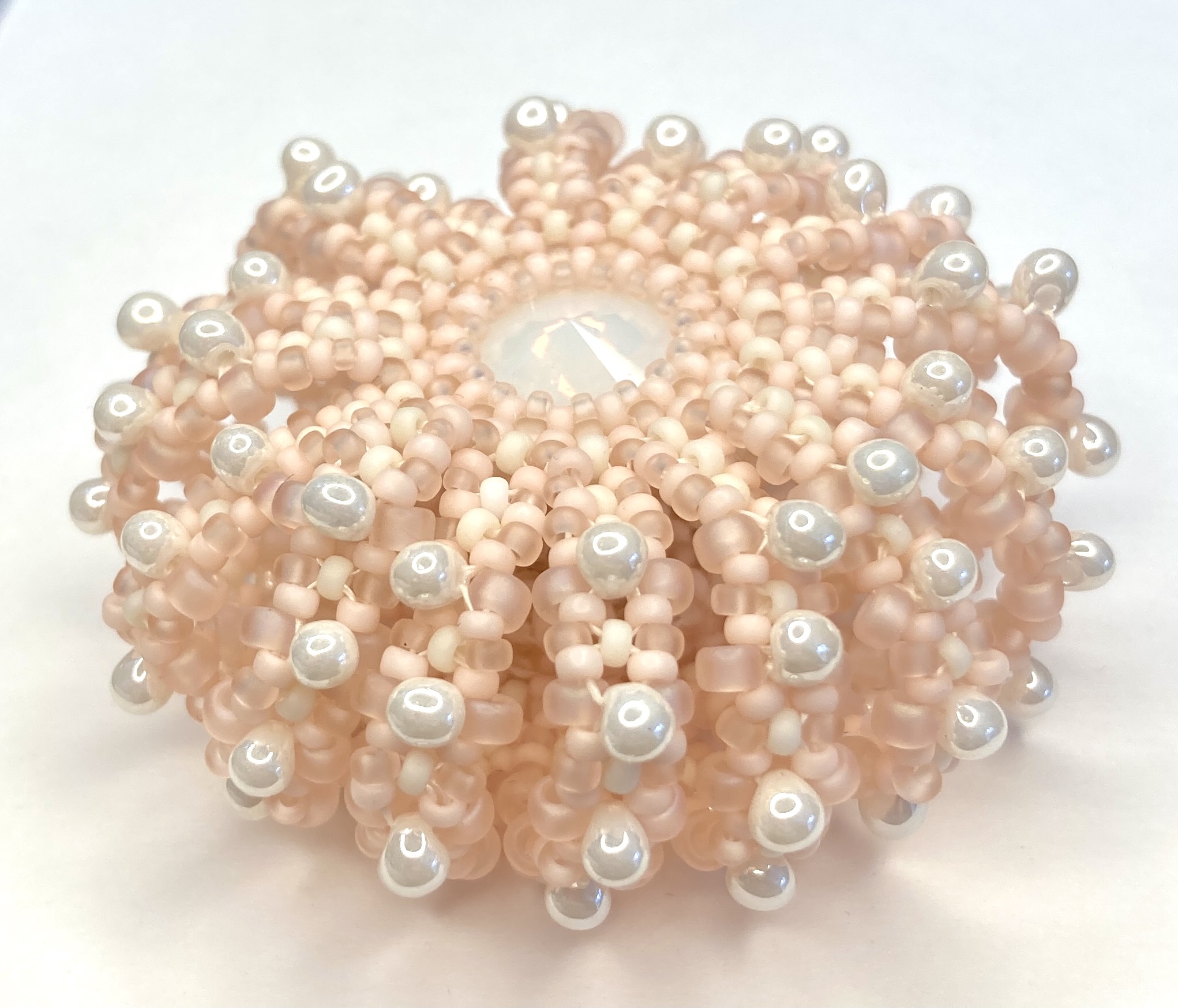
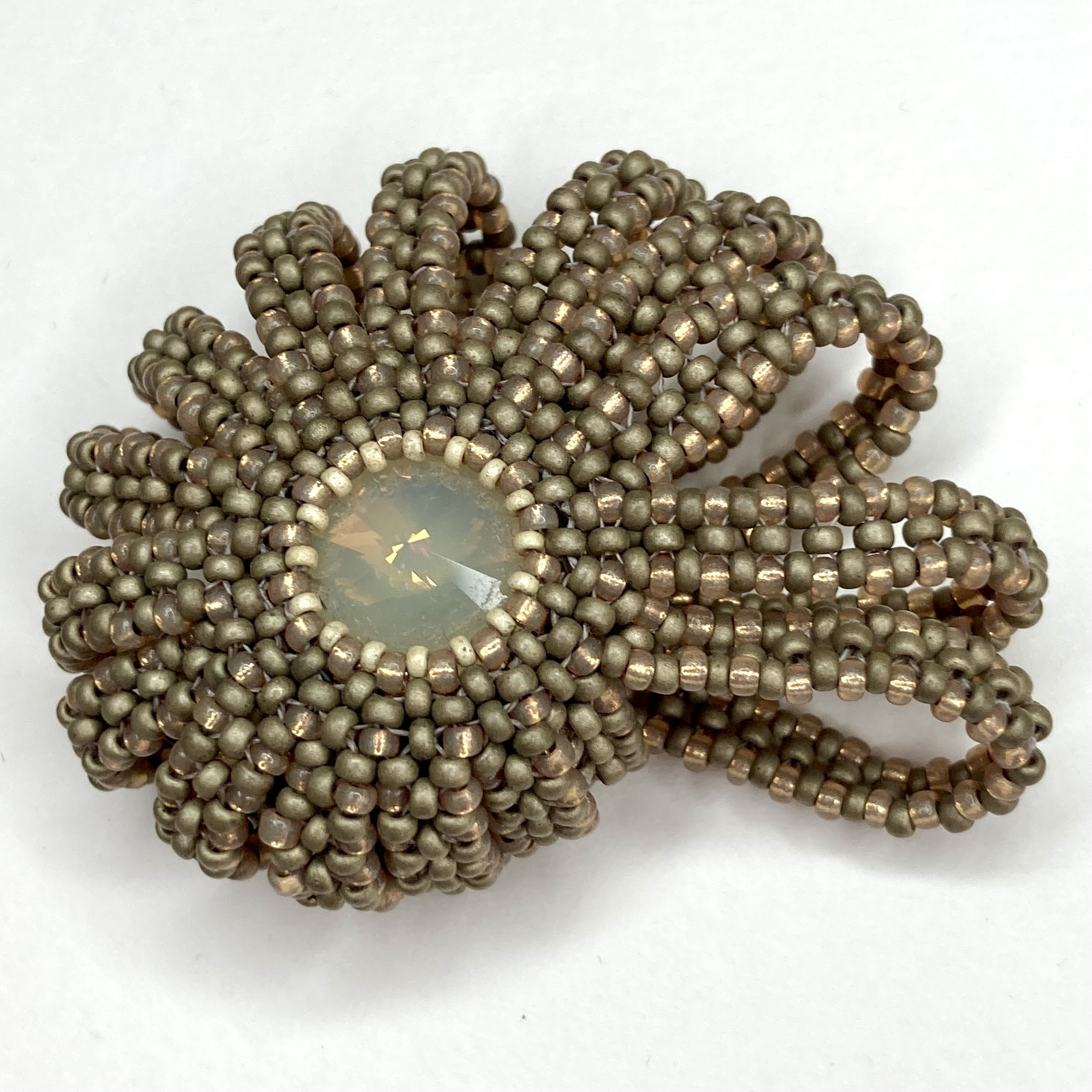
Along the way I made another plain version (no Cellini, but refined from the earlier plain versions), and after some useful comments on Instagram when I showed some in progress pieces, I added a baby variation using an 8mm chaton, and a Sea Urchin variation using the 14mm and some 3.4mm drops. These are in my favourite colour palettes for this piece – warm palest peachy pinks and soft creams or whites (very pretty and an indulgence after having to work with more distinctive colours for tutorial images).

So here it is – Nautilus, made with just Miyuki seed beads and 2 14mm Rivolis or Chatons (any brand will do), using RAW, MRAW and Peyote stitches.

Intermediate level, suitable for anyone who is confident with RAW strips in particular (there are 16!), and fully illustrated with both diagrams and photos, written out steps and even some listed out colourways (with bead numbers) or your own colouring in sheets if you’d like to plan your own colours. A full detailed list of bead requirements is available on the usual page here.

Available in my Etsy or PayHip shops as a PDF download. Etsy don’t like my decent quality illustrations or photos so force me to turn it into 3 PDFs to meet their teeny file limit- if that annoys you as much as it does me, the PayHip version is a single PDF and exactly the same price.
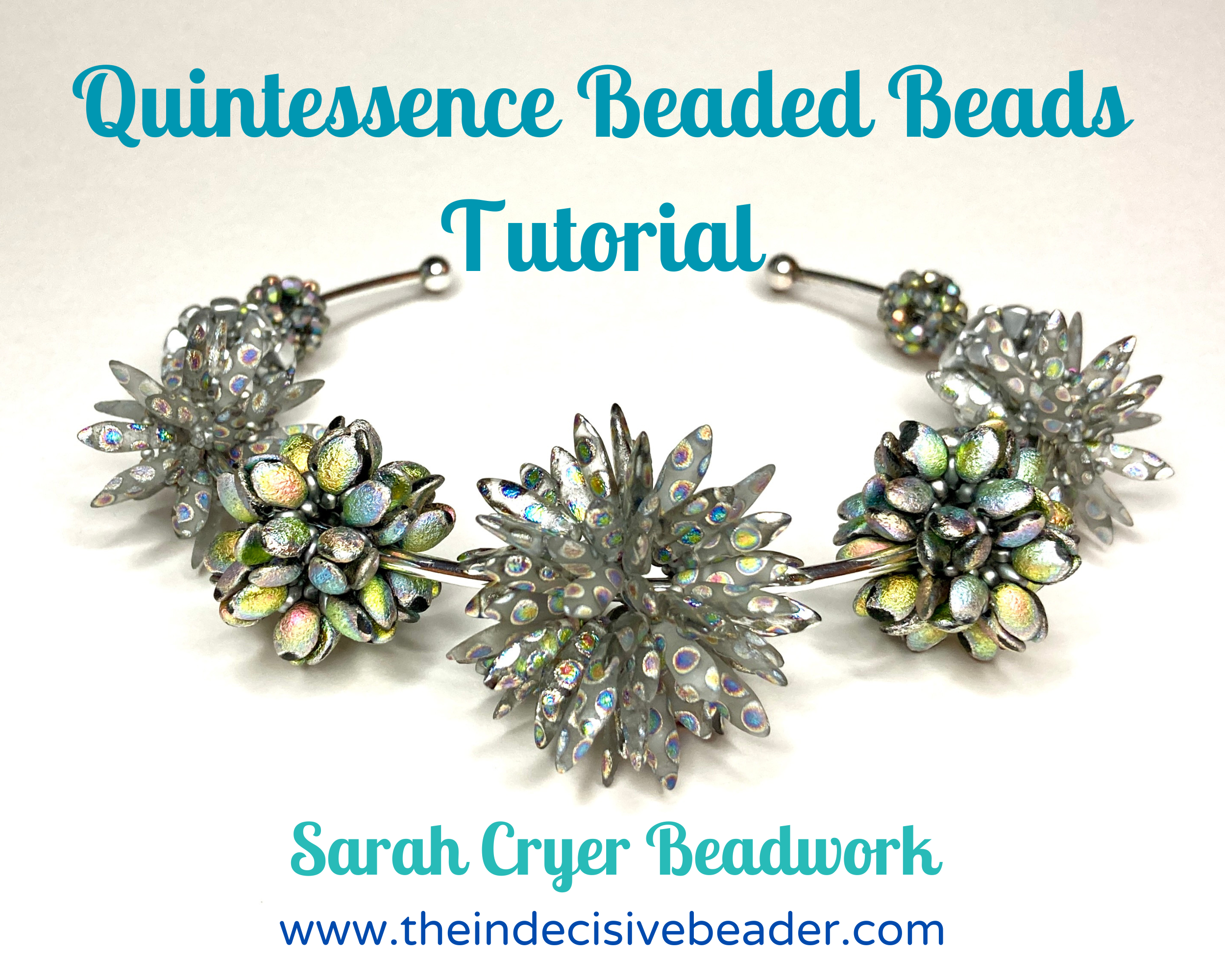
NEW TUTORIAL – Quintessence Beaded Beads

Earlier this year I started making a set of beaded beads. I love beaded beads, they’re something I come back to time and time again when I need a beaded piece for an outfit, when I’m stuck creatively, or when I want to really dig into some new 3D techniques and ideas. I went back to geometric solids and started playing with some methods and ideas I’ve been back and forth with over many years. I was trying to put together ’99 Red Balloons’ for a competition (Bead a Song) – that didn’t work out (I’ll tell you what did another day) but returning to such a versatile method made me realise I needed to get this one published and out of my system.

About 10 years ago I started making dodecahedra a lot, first using well known methods to do single layered versions alongside icosahedra. Those can be self supporting if you weave through enough (and you’ve picked the right bead size), and I loved that. A self-supporting beaded bead is hollow, often see through, and you don’t have to faff around finding exactly the right size and colour of inner support bead. 2 holed beads were starting to become mainstream, so I made double layered versions using Twins and SuperDuos and found that if I used the right combinations of beads I could make rigid 2 layered beaded beads, and also use (if I wanted) feature beads to the outside layer. The first of these were made with Twins and Pips and I used them a few years later to enter a Preciosa competition in 2017. The Pip versions were pretty good but at this stage the naked Twins were still a little wobbly.

So far fine, but nothing revolutionary. I played around a bit and worked out that other 2 holed beads worked, made a few pretty solid sets with Nib Bits, and even started playing with 4 holed beads with limited success (I need to go back to that one day). Other beaders were doing way better things with multi-holed beads and geometric builds and my efforts were cute but not really clever enough on their own compared to work being done by others, so I put them away.

Then I started working with etched beads more, and at the same time, buying wholesale for my Materials Packs. I treated myself to packs of all sorts of Etched Slipperit beads in different shapes as this was my favourite finish at the time, and suddenly found myself with big enough bags to really delve and experiment. I tried different feature beads such as the Tulip Petals, and even 2 holed daggers (sometimes with single holed ones too for extra daftness) and at last something more interesting seemed to be coming.

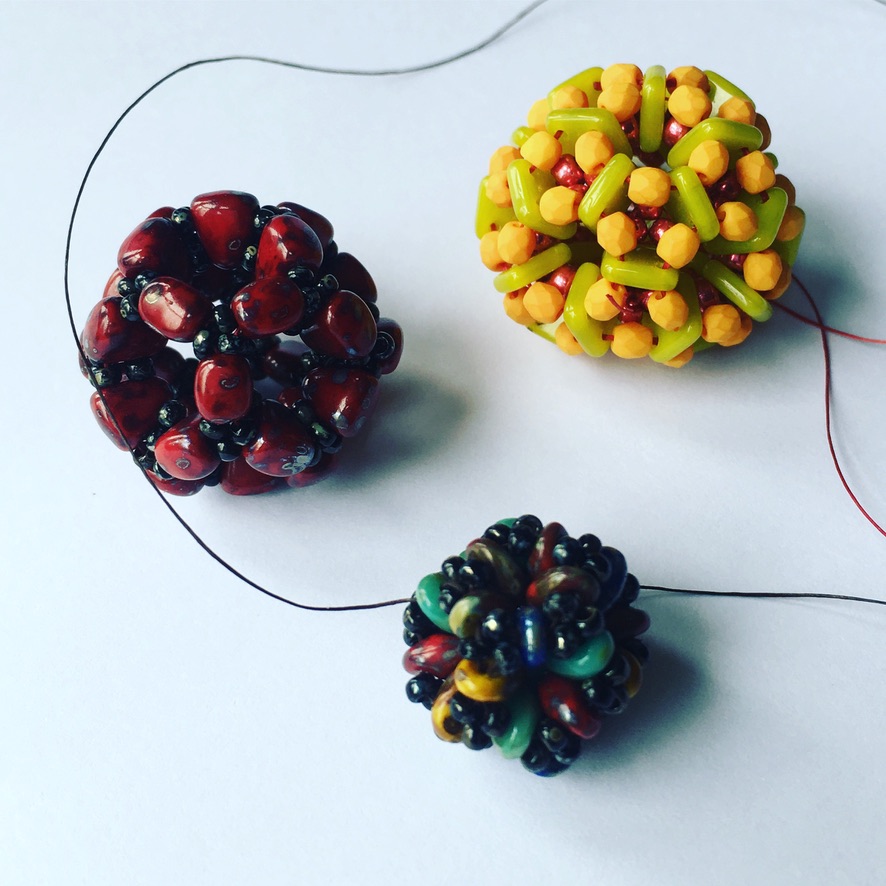
I was still as you can see above also pursuing the supported bead options – the right hand two have wooden centres, and they were nice but the hollow beads were really starting to be an obsession. I worked with whatever shaped beads I could get in that colour/finish in wholesale packs, and I even started adding Bucky Balls (Truncated Icosahedra) to the Dodecahedra.

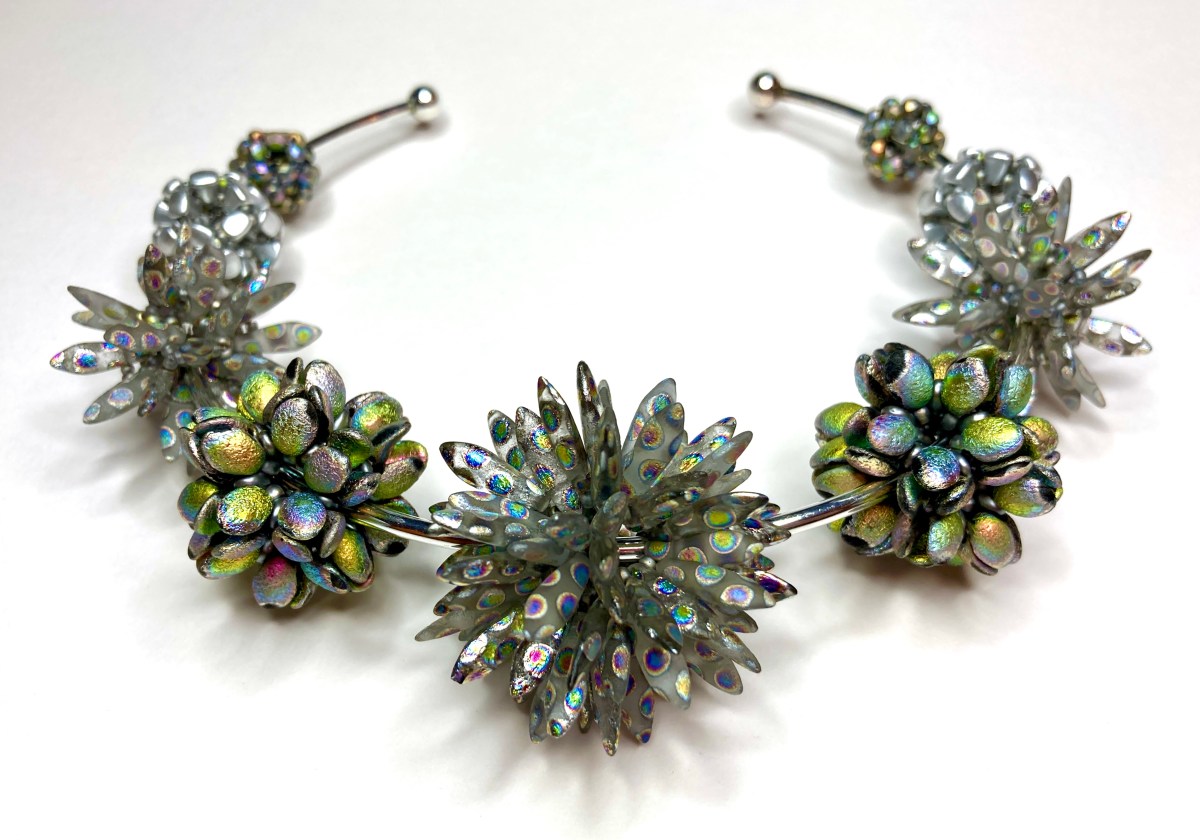
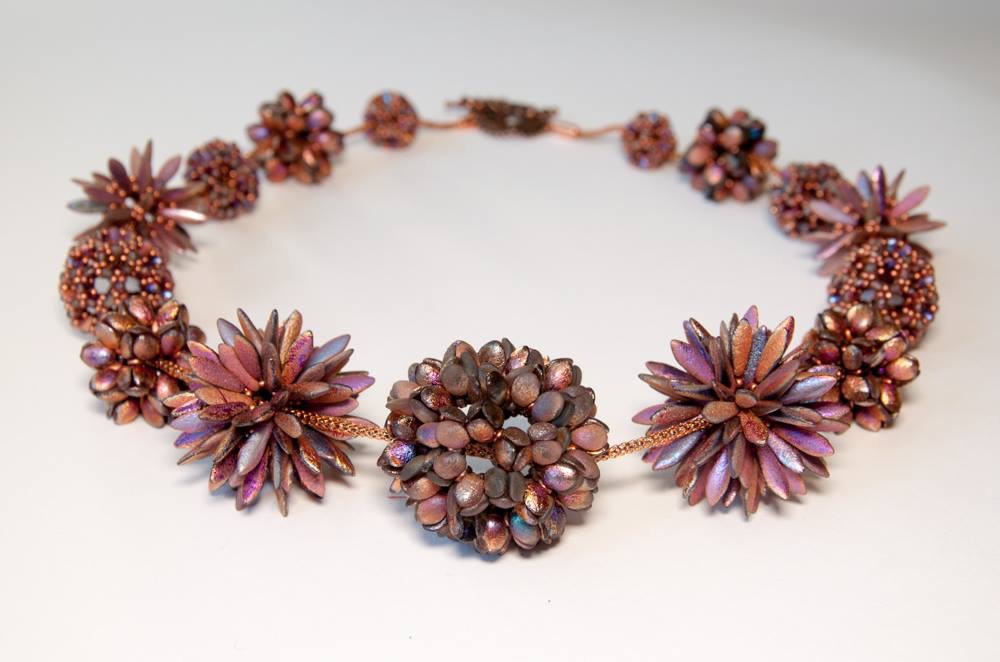
The result of that obsessive period was this necklace (along with some pretty awesome Christmas Baubles).

But the trouble was, I couldn’t work out how to write this up. I hate writing up 3d beadwork – it’s just really really difficult, and I know from making these pieces that it’s really easy to get lost as you bead, which means not only do you have to deal with multiple layers as you draw, you have to help your beader know where she is. Even something like CRAW is hard for many beaders to follow, so how on earth could I extend that to this and not make them feel defeated? So I looked at the lovely necklace, felt proud, and put it away. Every so often I’d make some more, ponder the write up and give up again.

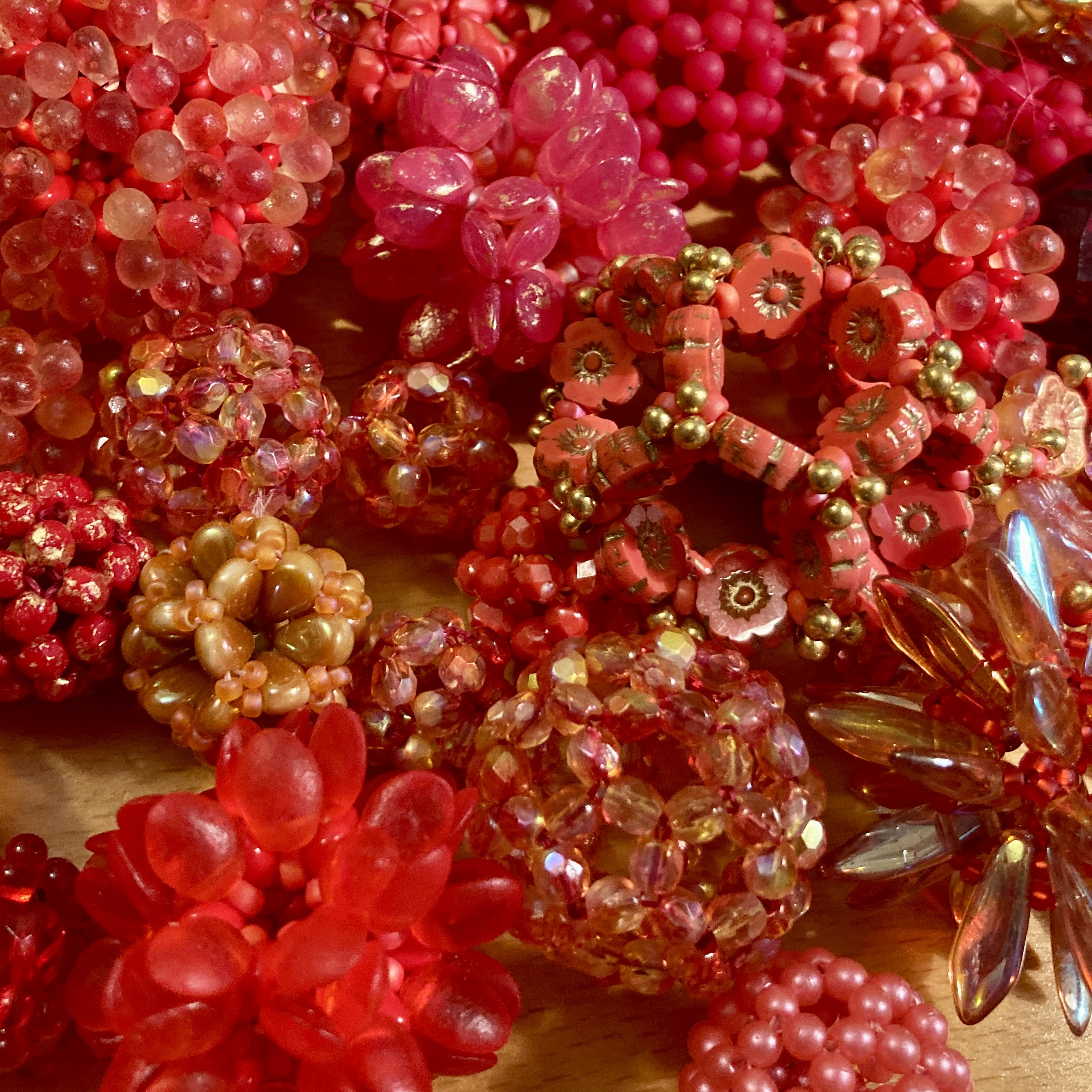
Fast forward to this year and the 99 Red Balloons. I made about 44, decided I would go mad if I made 99, and also that the song itself, being about accidental nuclear war probably wasn’t best represented in a long string of jolly red beaded beads (however much I tried to play up the ‘atomic’ structure). I made my competition piece about a completely different song, using completely different techniques and colours, and then once that was posted looked at the huge pile of red, pink and orange beaded beads and thought ‘hmmmmm….I love these so much, I’m so proud of them that I want to show them off, and I have all these extra combinations now – is now the time to make myself work this through?’

In the bead world if you do show off your work but don’t tutorialise some ignorant beaders think it’s then OK to reverse engineer. It’s really not OK, your work is yours whether you commercialise it yourself or not, but more and more I’m seeing discussions where the good guys are having to work very hard to stamp this kind of practice out, and also where the ‘no tutorial’ argument seems to be trotted out more and more often even by the helpful, respectful beaders. If I want to show these off, I run the risk of copying if I don’t also publish as a tutorial. I’ve been bitten before, bullied by other beaders who’ve ostensibly asked for ‘permission’ to reverse engineer a piece I’ve chosen not to publish for valid and important reasons (too close to the work of other beaders I wanted to protect) and then even when I’ve begged them not to have big fat done it anyway, and then against my wishes shared their methods (just because you don’t charge doesn’t make that OK – you know who you are). So I’ll be honest, me forcing myself to work out how to teach this is as much about protecting my own ideas and techniques as it is about wanting to share them. I absolutely do want to share them – these are completely addictive and a joy to make once you’ve properly learnt how, and I want other beaders to be able to knock up these super beaded beads too, and to start to play with their possibilities. So anyway, sorry for the digression, but this is pretty much why I had to get over myself and work out how to write these up once and for all, and here at last we arrive at the finished tutorial:

Techniques – Angle Weave

Difficulty Level – Advanced.  Experience with RAW and CRAW/PRAW, good tension control (consistently able to vary from soft to medium to tight as instructed), and experience with following complex instructions for 3D layered beadwork.

This is a set of instructions to teach a method for building self supporting hollow dodecahedra (the fifth platonic solid or ‘quintessence’), using a variety of layouts or models, each of which can be used with a variety of bead recipes to give endless beaded bead combinations.  

The 6 lessons will teach you each model step by step, and focus on learning the techniques, thread paths and understanding the layouts.  They need to be done in order to learn the different variations logically.  At the end of each lesson you can either try some alternative bead combos, or move onto the next lesson. The masterclass includes lists of the different bead combos you can use in an Appendix, as well as hints and tips for designing new combinations using the 6 methods, and for moving beyond dodecahedra into other geometric solids.

Because I’m planning to continue pushing through the multi-holed bead options, and feature bead options, I’ll inevitably have more recipes to add to Appendix 2 of this tutorial, so I’ve developed a secret formula which is explained there, which you can then use when you look at that page (linked in the tutorial) to decipher which beads and which techniques from the tutorial to use. I’ll also publish a notification when I update the page to my Facebook and Instagram pages. I know it sounds a bit mysterious but again, I want to share as much as possible whilst also protecting my work – if you buy the tutorial it will all make sense (and you can always contact me if it doesn’t!!).

The tutorial is now available in my Etsy and PayHip shops, and I will have ‘orientation bead packs’ available too in my Etsy shop in the next couple of days. If the tutorial sells well I’ll follow that up with some curated bead packs to make sets of Quintessence Beads.

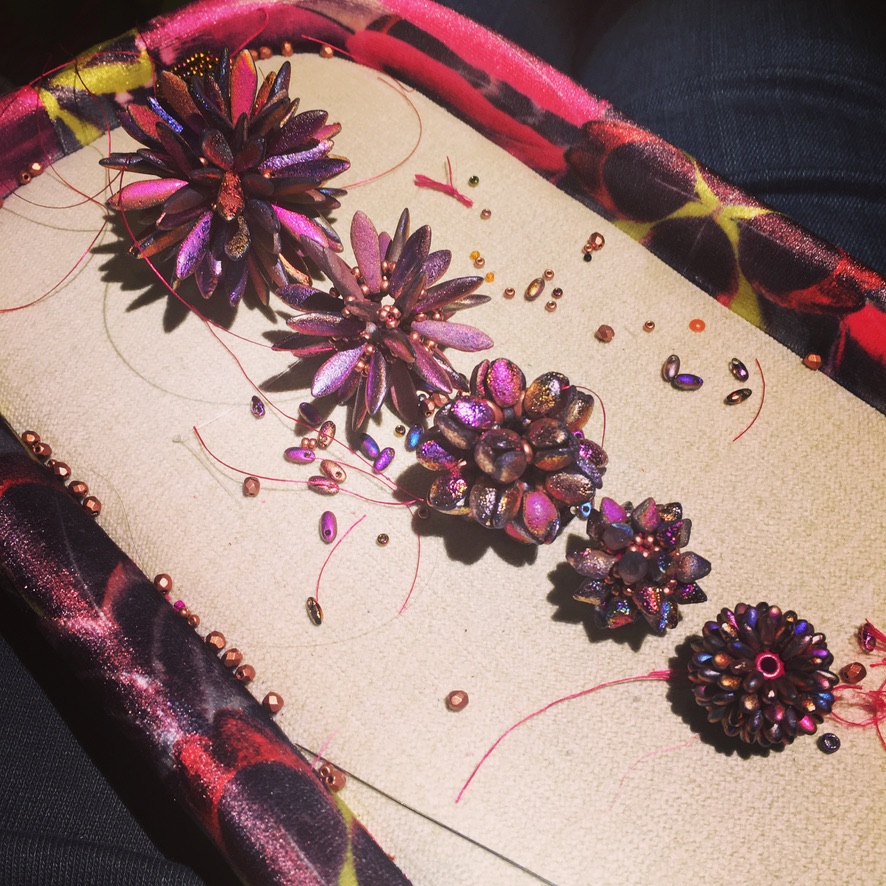
I’ve loved spending more time on this series, although to be fair the write up has been a long slog (51 pages and countless diagrams and photos). The beading has been a delight – at the last count this morning I’d made over 70 this year alone (and that’s not including the ones I frogged because I needed to re-do photos etc) – I took a photo a few days ago but the eagle eyed among you will see I forgot the Lesson 6 samples (among quite a few others!):