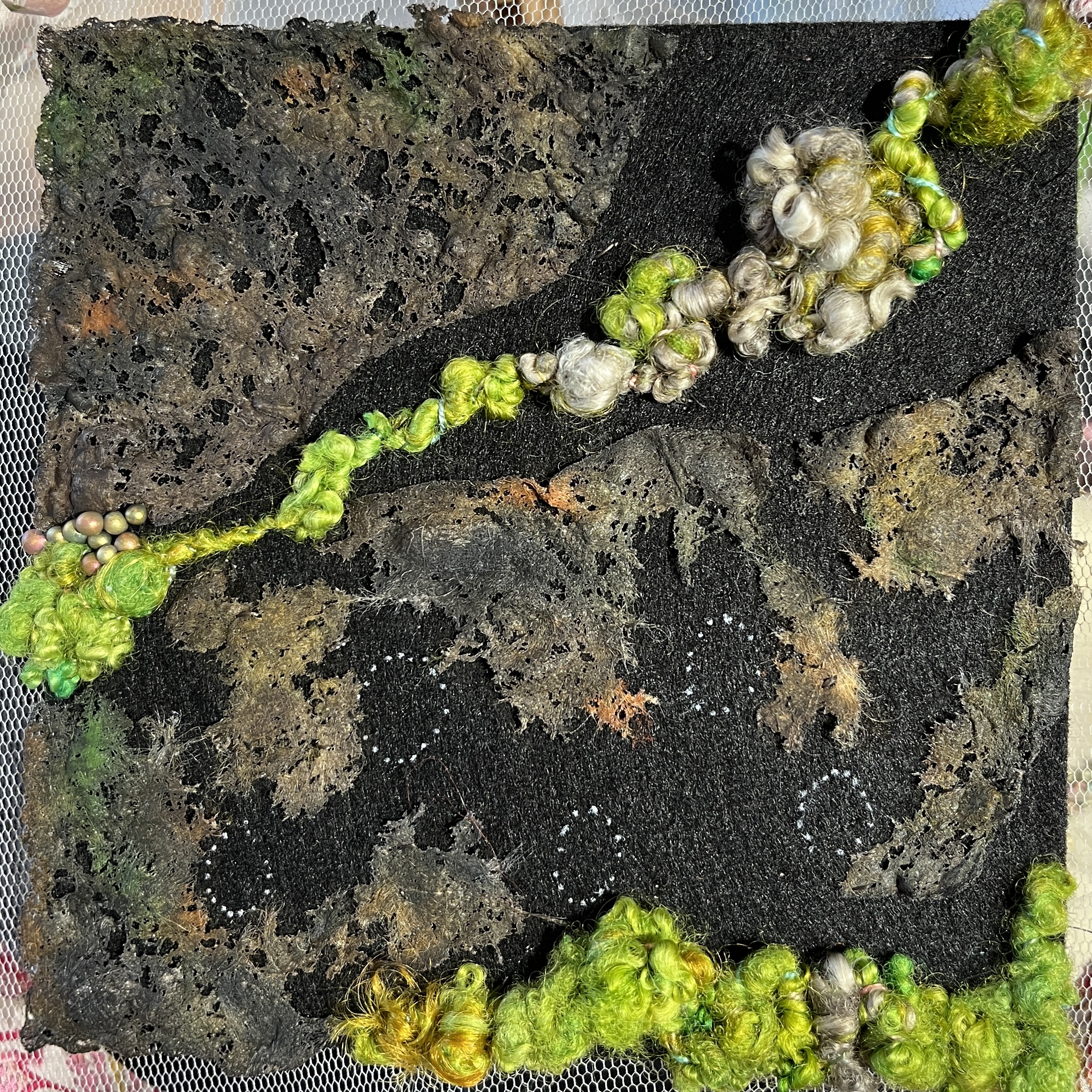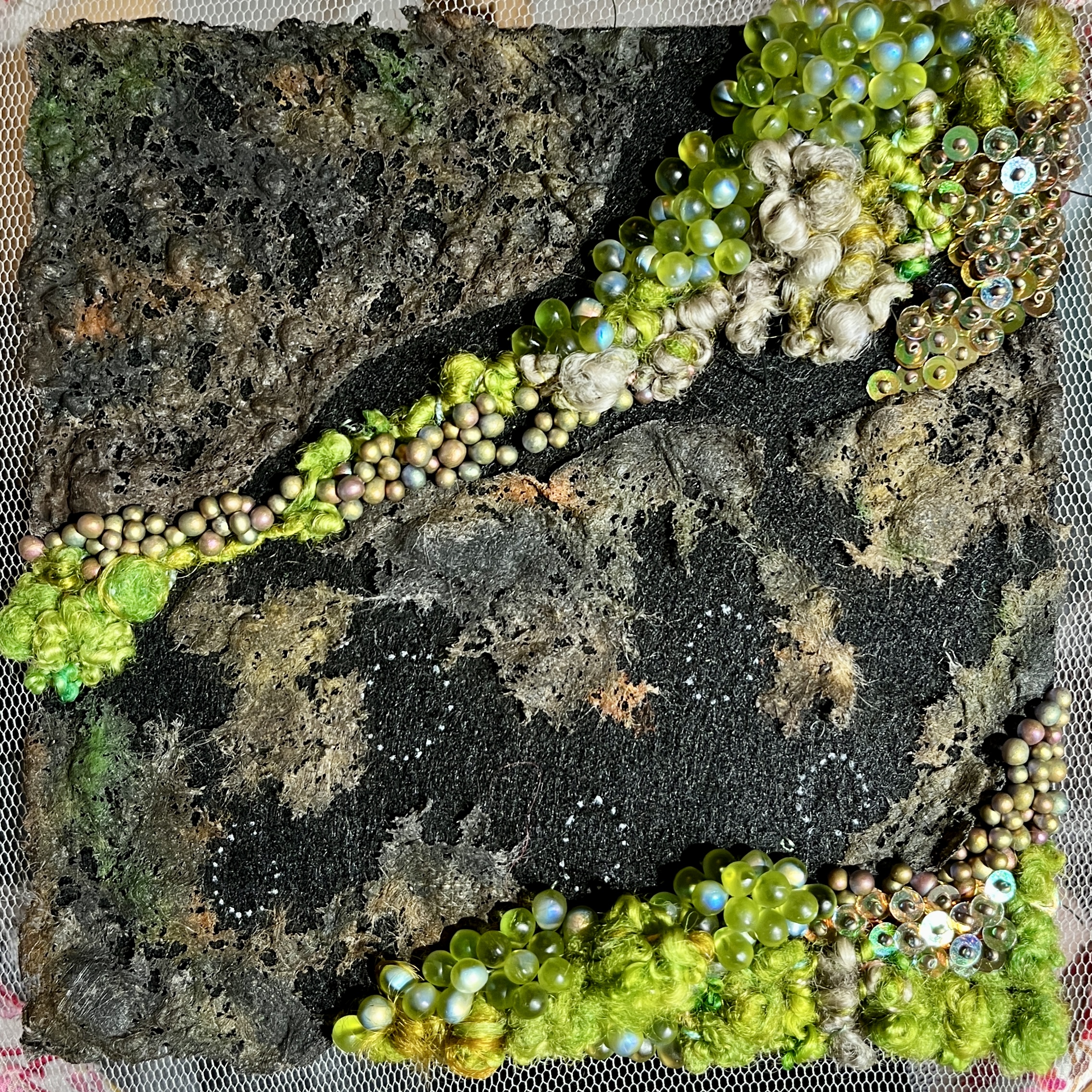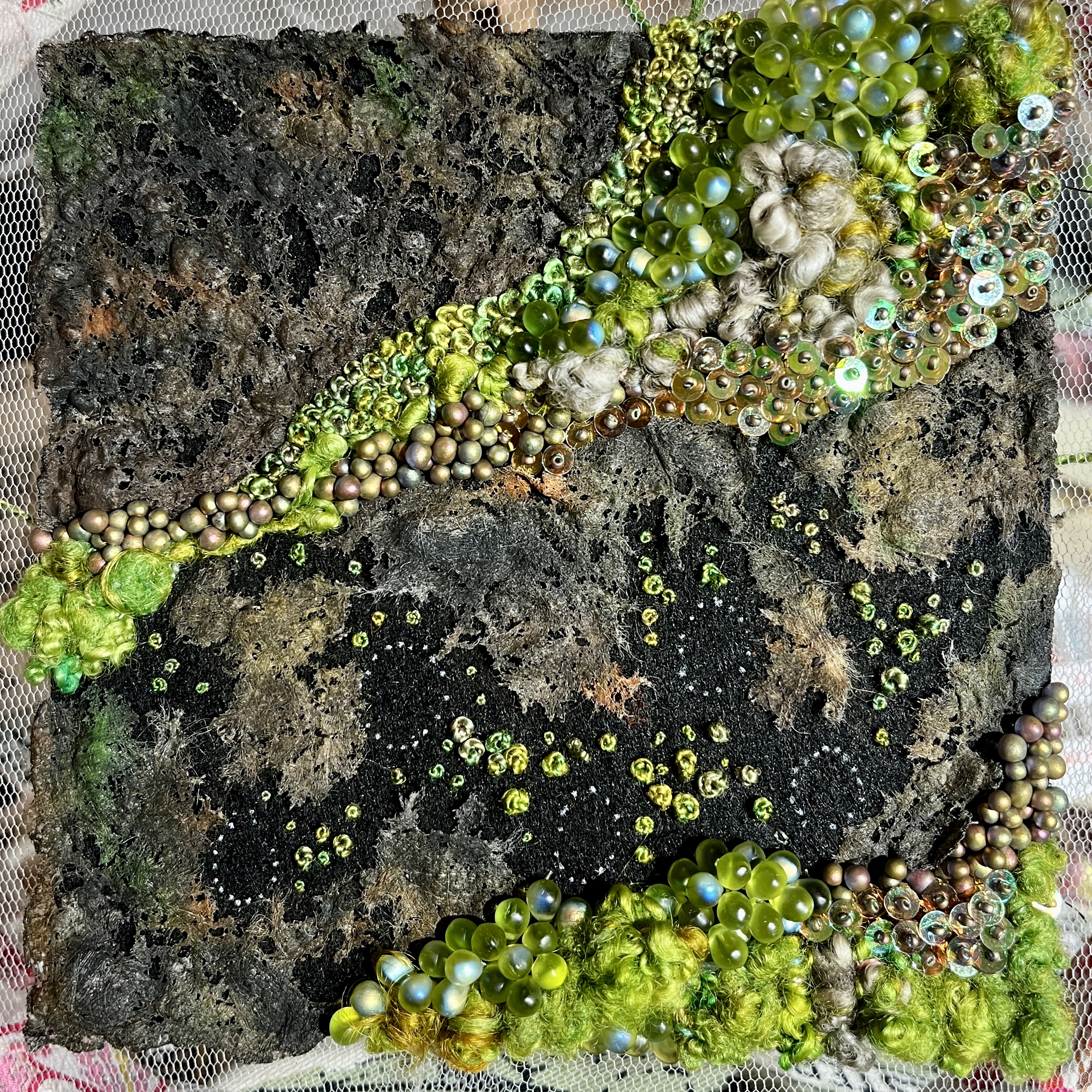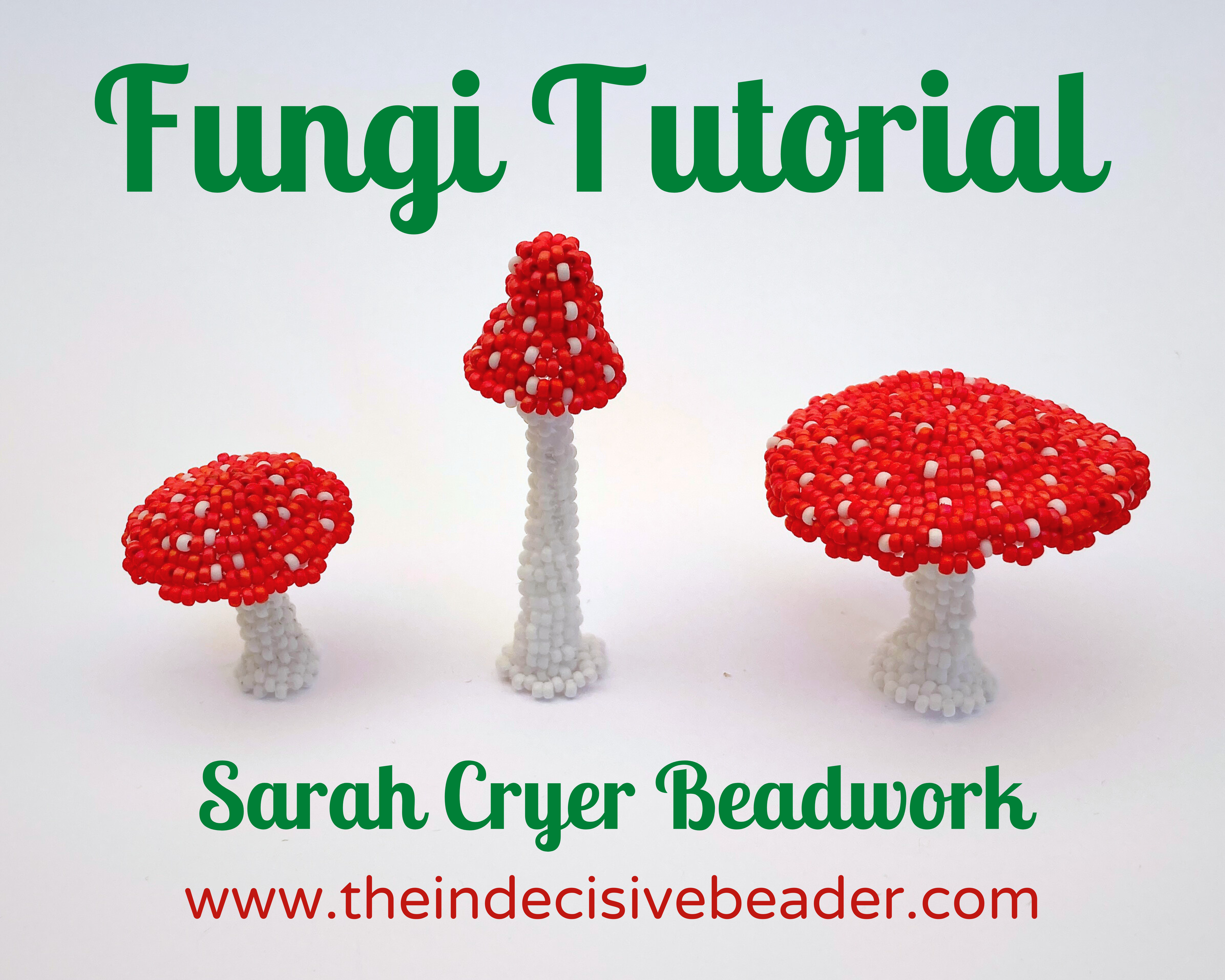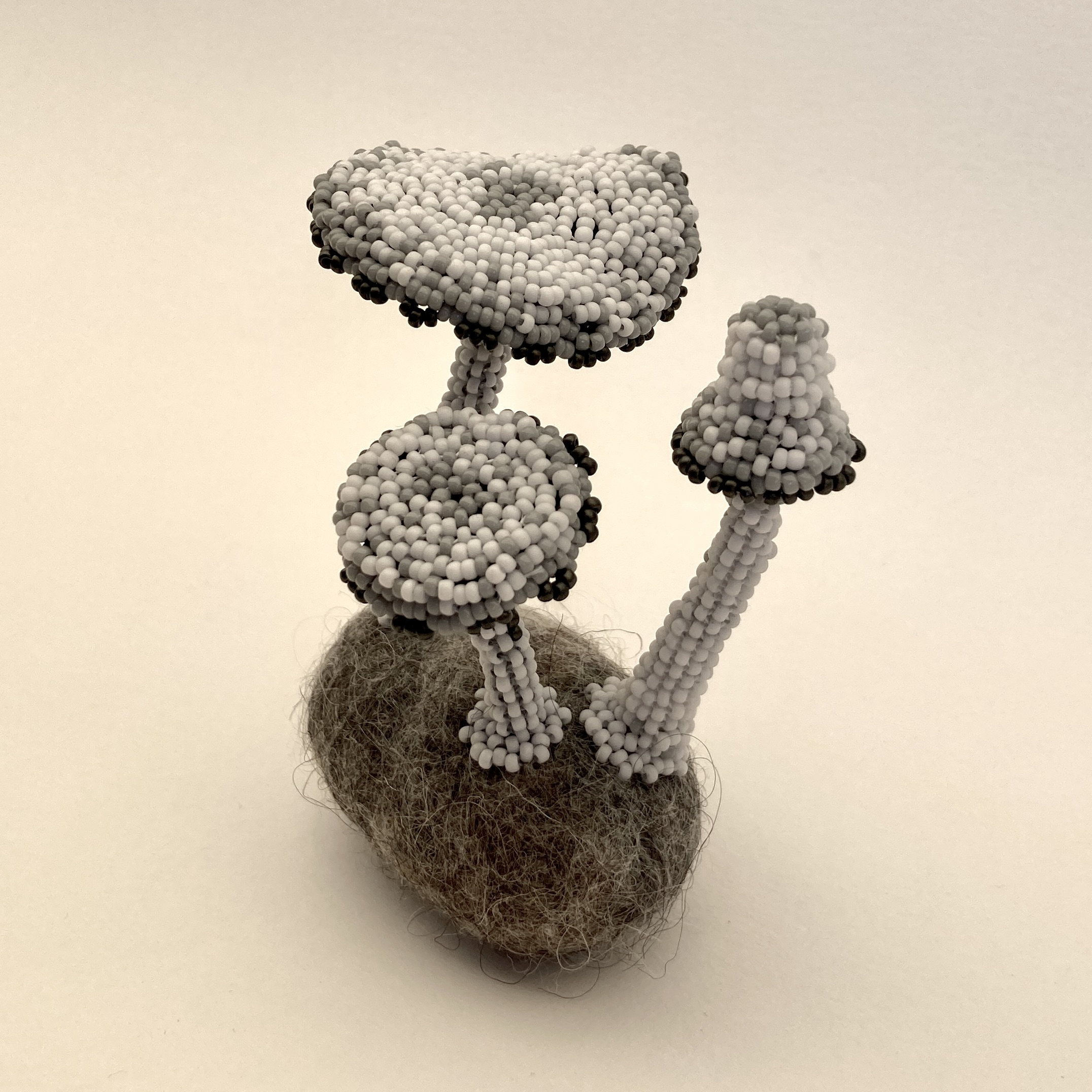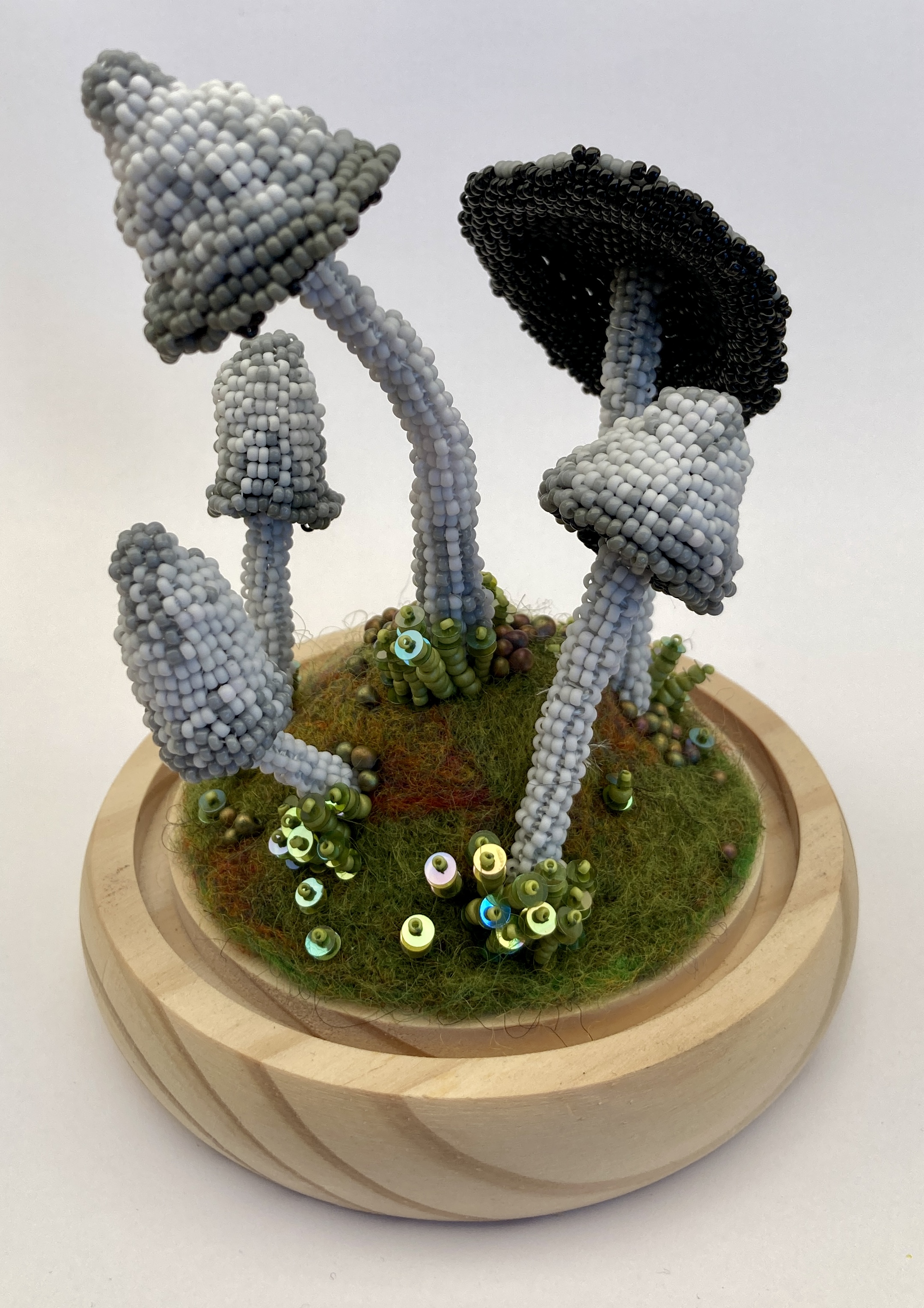
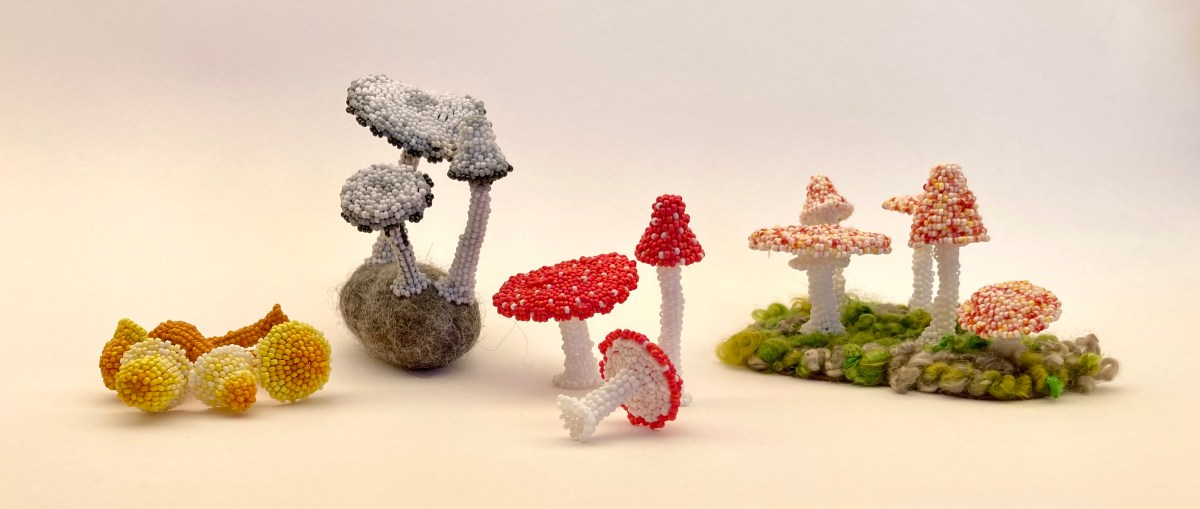
This trio are based on the Ink Cap mushroom, and there are charts and instructions for using the tutorial methods to make these on p47. They’re mounted on a lovely wet felted pebble.
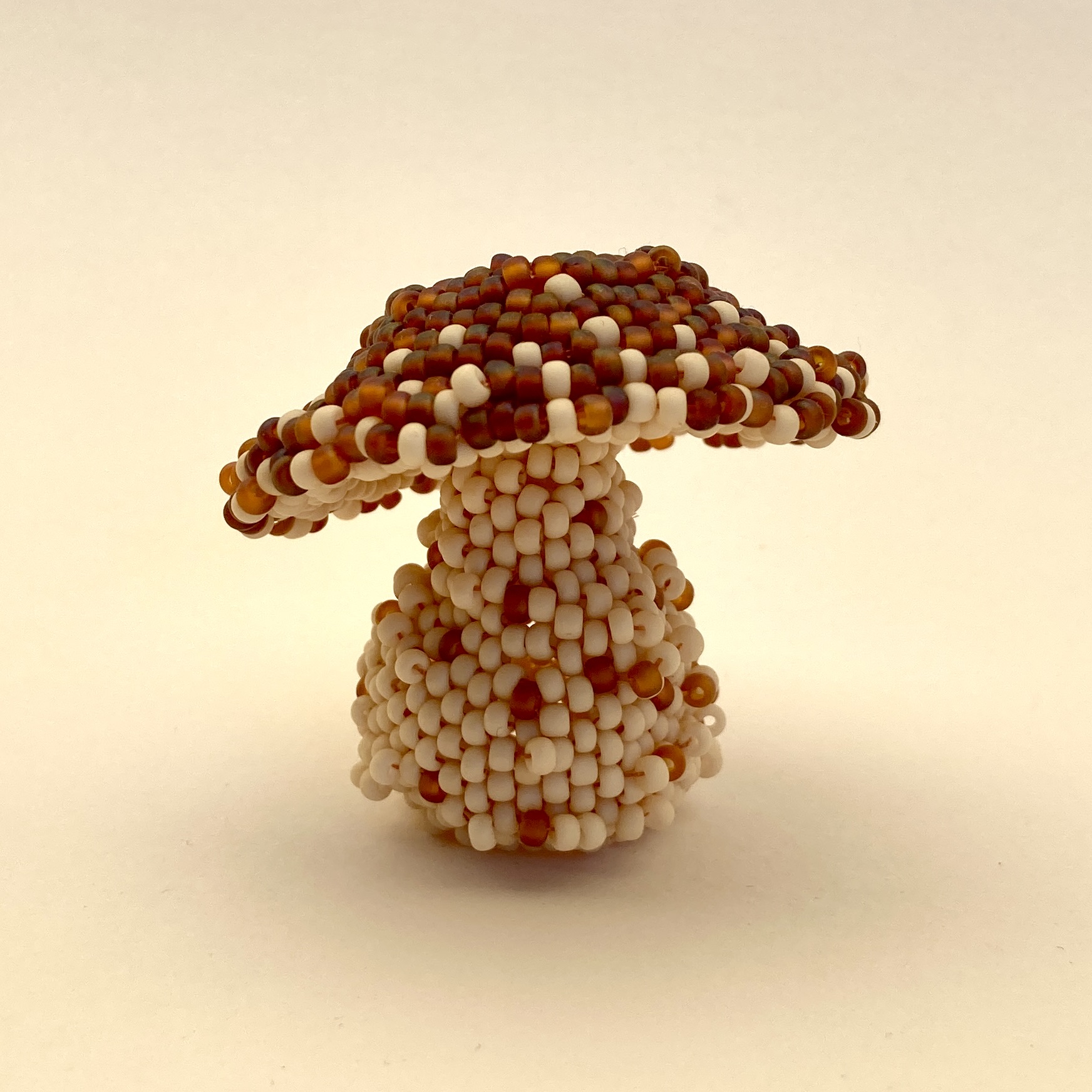
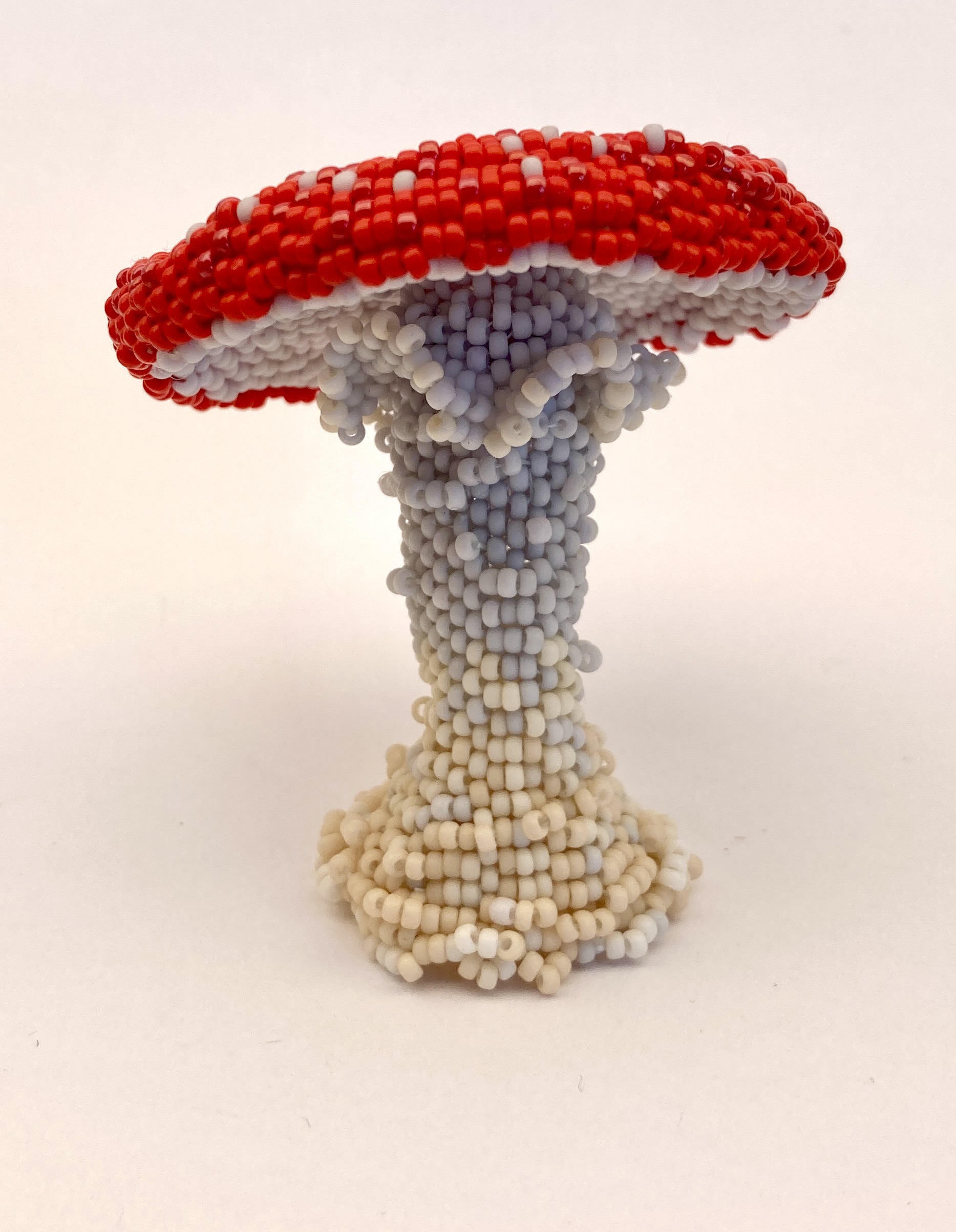
This little one is actually not that little, as it was made with size 8 seeds instead of the usual size 11. The top is a cone (4 repeat) version of the small flat top (notes on p45), with a fattened stalk made by adding increases from around row 5 of the stalk, then decreasing when it was nearly long enough to give a lovely fat belly. The shaping changes ever so slightly with 8s – they’re proportionally slightly wider than 11s, it’s really marginal but enough to make the 5 repeat flat tops too wavy and structurally unsound, so the having the 4 repeat cone option is great here.
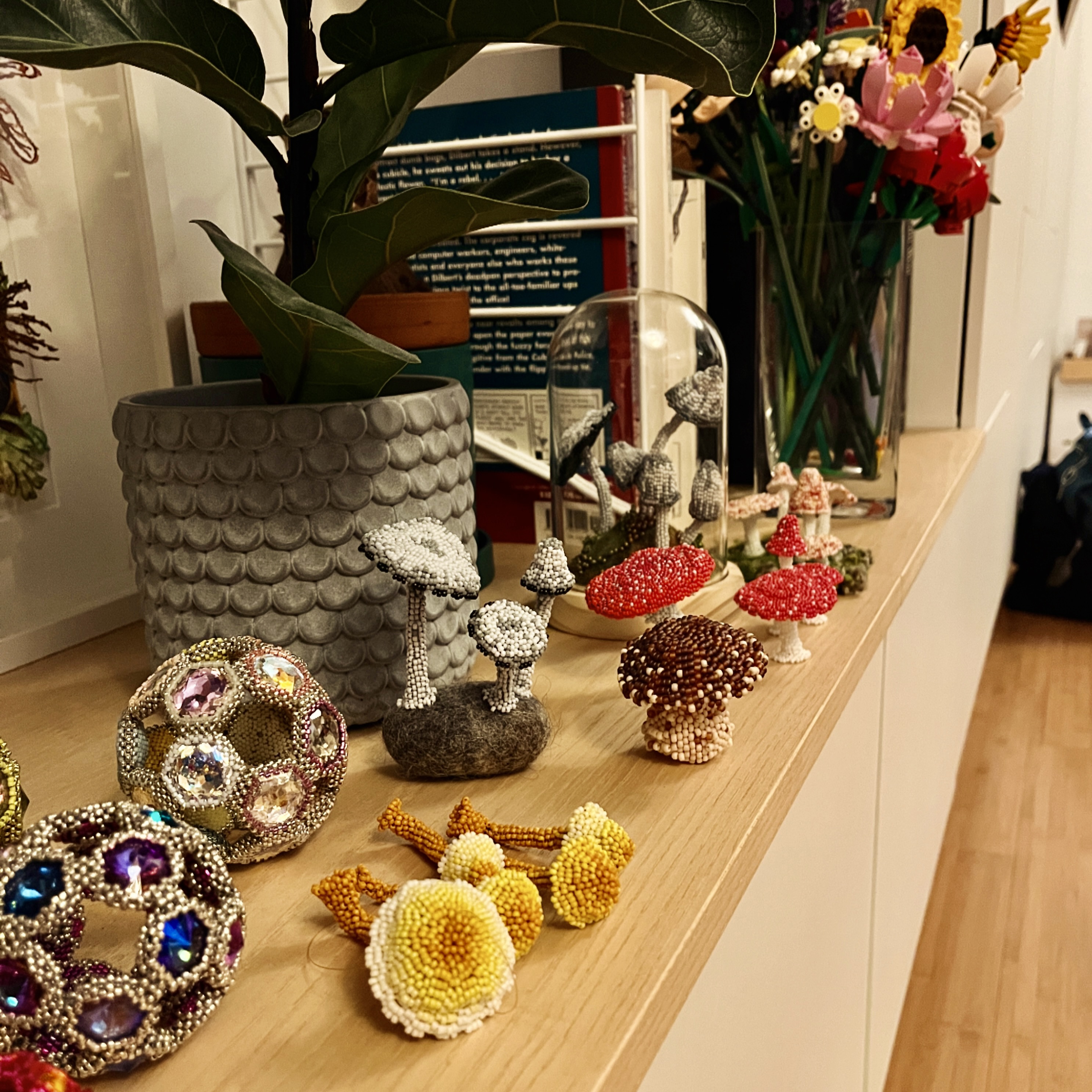
As you can see from the collection on display here with a couple of my Orbits, I’ve now made quite a lot of these, and the range is still growing. In the foreground here you can see my ombre yellow ‘cone’ samples from the tutorial – Sulphur Tufts. I’m now making a couple more of these and am working on introducing bends into the stalks to allow them to be mounted on a vertical surface, as if growing from a cut log in the wild. More on that soon.
Last Autumn I visited the Knitting & Stitching Show at Alexandra Palace, and spent some time talking to the lovely Bev Caleno, a textile artist. I came away with a kit for a rock pool, which I’ve since made, but some of Bev’s other works with fabric fungi also intrigued me. When I made my Recycling box some years back I’d tried to add some beadwoven mushrooms to the top, but the scale was wrong and to some extent the box was too abstract for such literal forms. I put them away and promptly forgot about them. But Bev’s pieces reminded me of that attempt, and some time later I decided to have another go. This time I would go bigger, working pretty much life size, and the results after some trial and error were a series of unique sculptures. I was super pleased with them but every stitch, every row had been created individually – no two neighbouring stitches were the same, and there was no way that they were ever going to be suitable for tutorials. So that was that – I had some fantastic art pieces which I was really pleased with, and I was happy that they were unique.
Fast forward to our summer holiday this year, and whilst packing for our epic Interrailing trip (Brussels, Cologne, Hamburg, Copenhagen, Berlin & Amsterdam) I decided to take just size 11 seeds with me in a small range of colours. I’d loved the purity of only working with one size of beads on the sculptures, and wanted to repeat that with some new forms – but what to make? Well the answer surprised me – my creative brain decided that some smaller, simpler mushrooms were worth a try – could they in fact be simplified so that each row was normal repeated patterns of beads that I would actually be able to write up (and that a beader would be able to follow without loosing their marbles)? And thankfully the answer was at least partially ‘yes’ – the top parts absolutely could be simplified. The stalks however could not – as soon as I made them regular they looked completely unnatural – so they remain a pig to write up, but as they are smaller I’ve managed it.
So, some many hours of train travel later I had a set of 3 – a classic flat top toadstool shape, a striking pointy ‘cap’ shape, and a smaller opened up baby, plus a few more using those as a starting point. When we got home I set to writing them up, and some months and an awful lot more samples and test runs later, here we are.
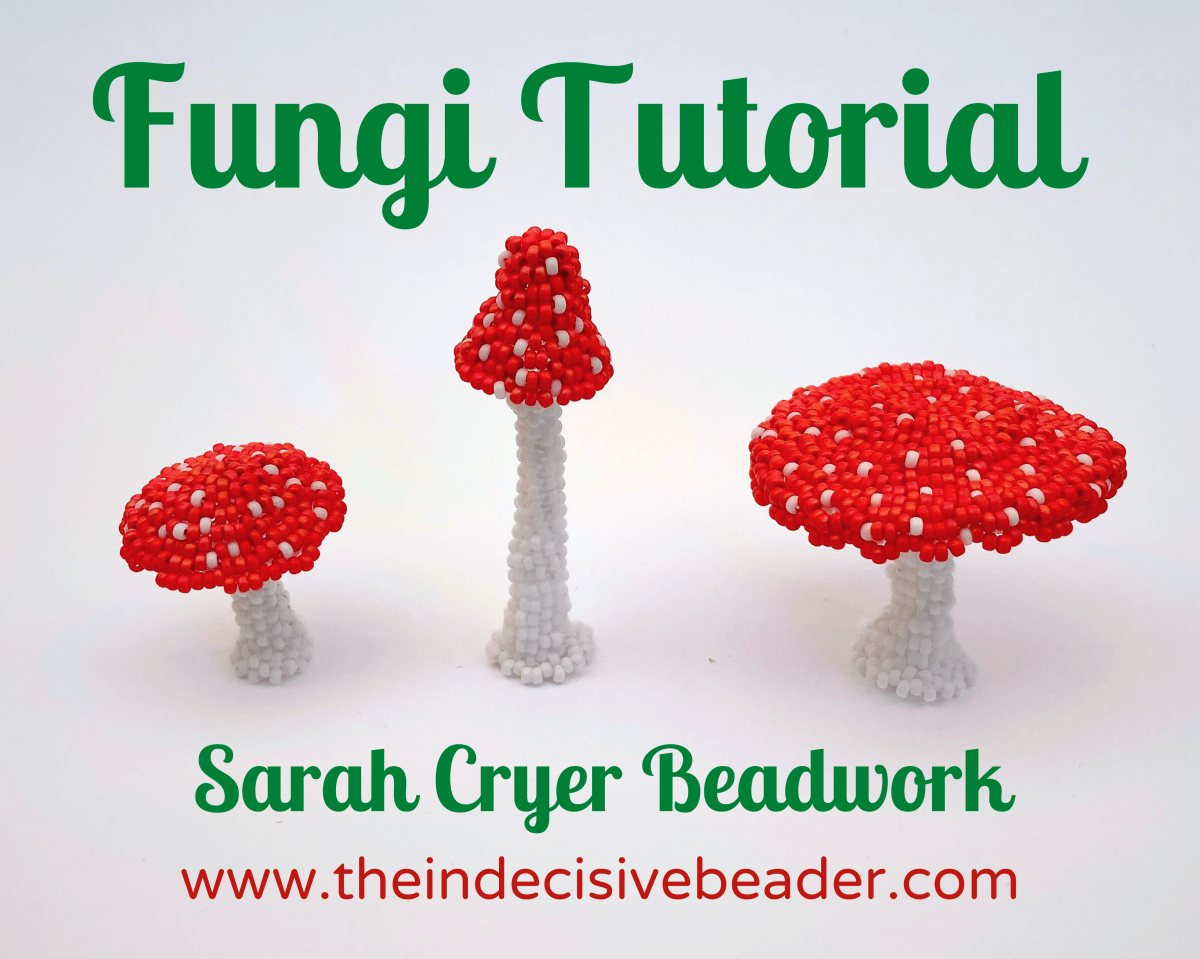
The tutorial has fully stepped out instructions for three specific mushrooms – the flat top A, the pointy B and then slightly briefer instructions for a smaller flat C.
In the Variations section there are charts to convert A, B & C to fabulous shaggy Inkcaps with tips for expanding that set further, and colouring in pages with blank charts for your own patterns. There are also tips for altering key elements of the size or shape for the flat or pointy, and for changing the length or shape of the stems – these are not fully stepped out, instead they are guidelines so you can understand how to create your own unique, naturalistic forms, aided by the Gallery section which shows all of my versions plus some larger and more complex related pieces.
I’ve really loved making these and already have several new sets on the go. The Fungi world is huge and diverse, and it’s great to never be short of inspiration – no creative thinking required, just go to nature and copy!
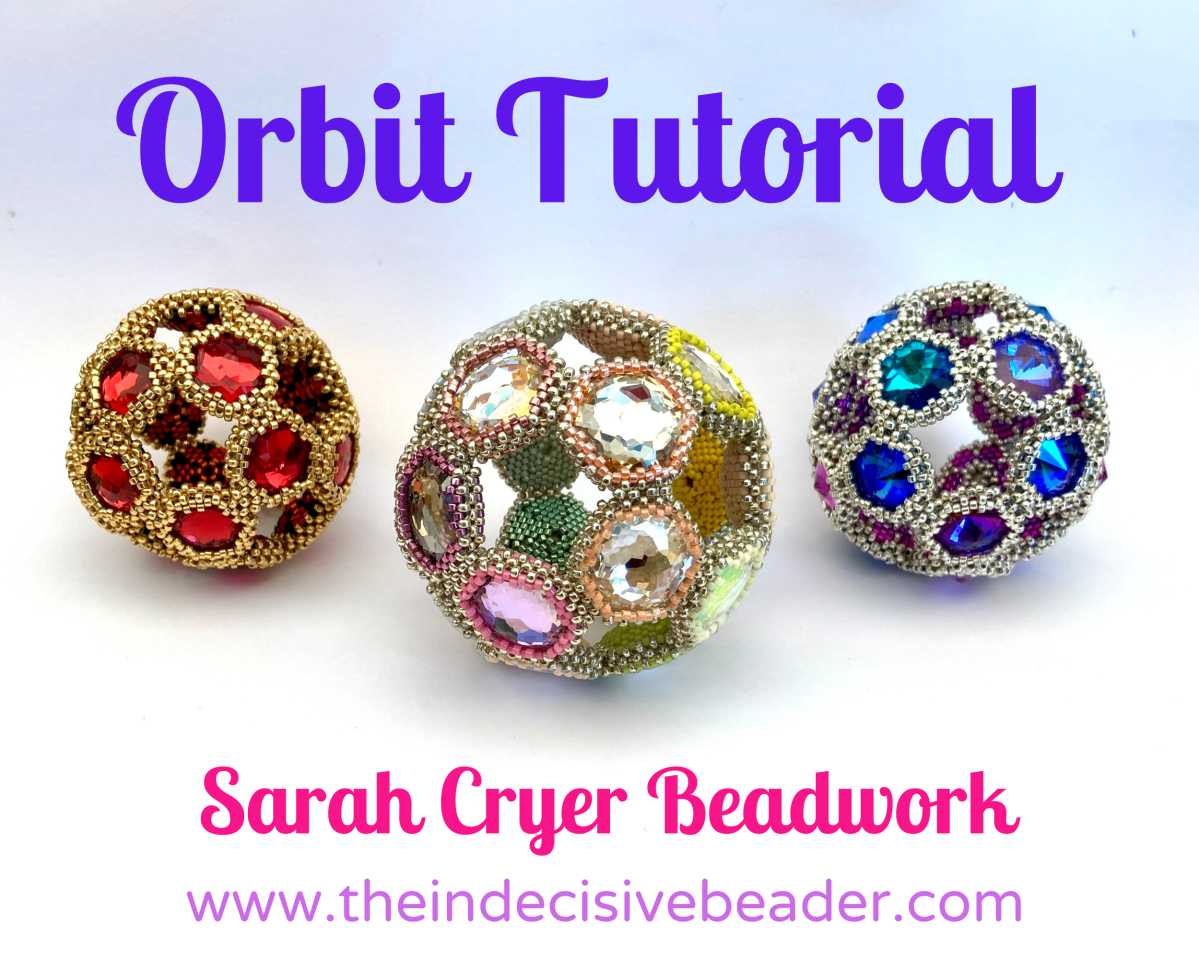
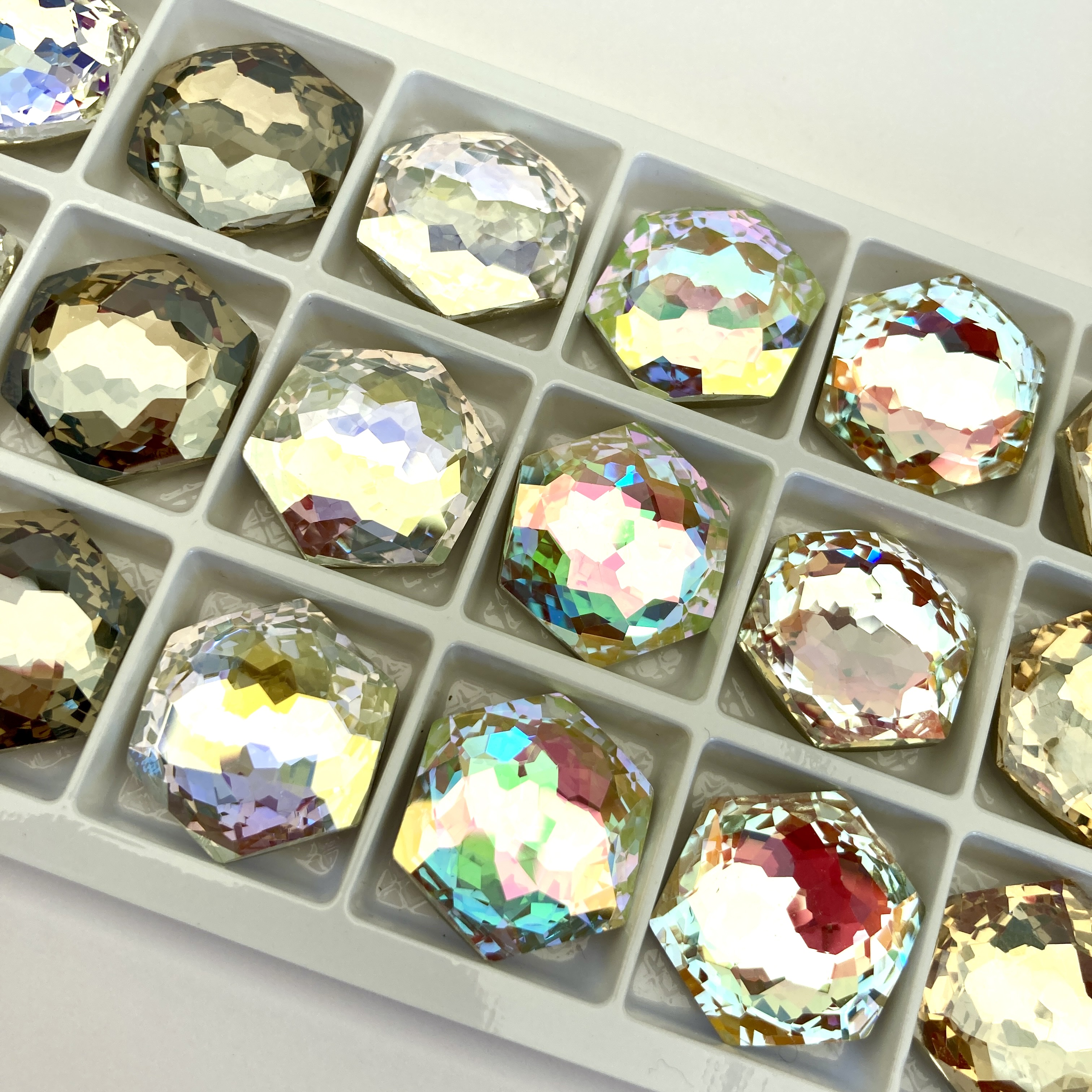
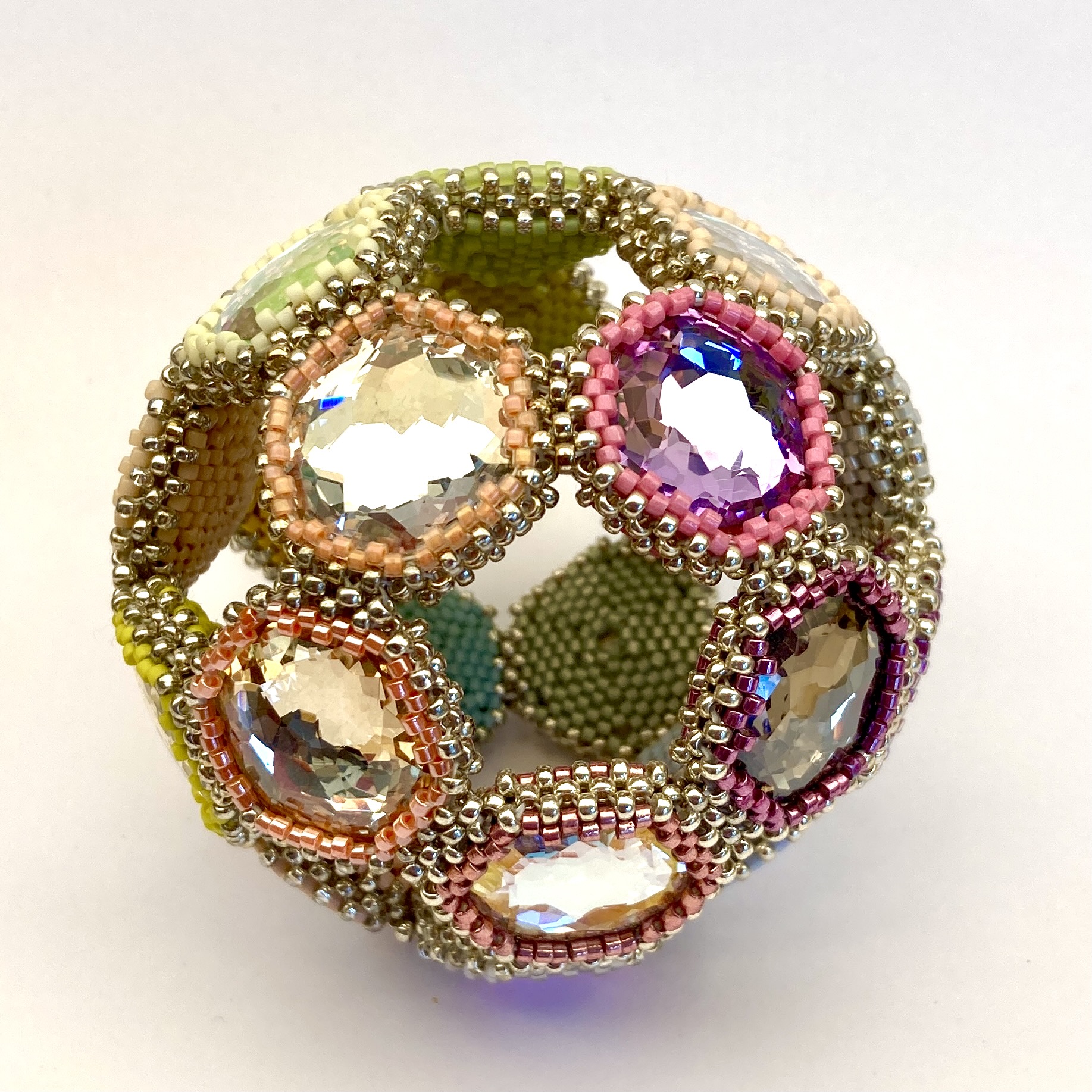
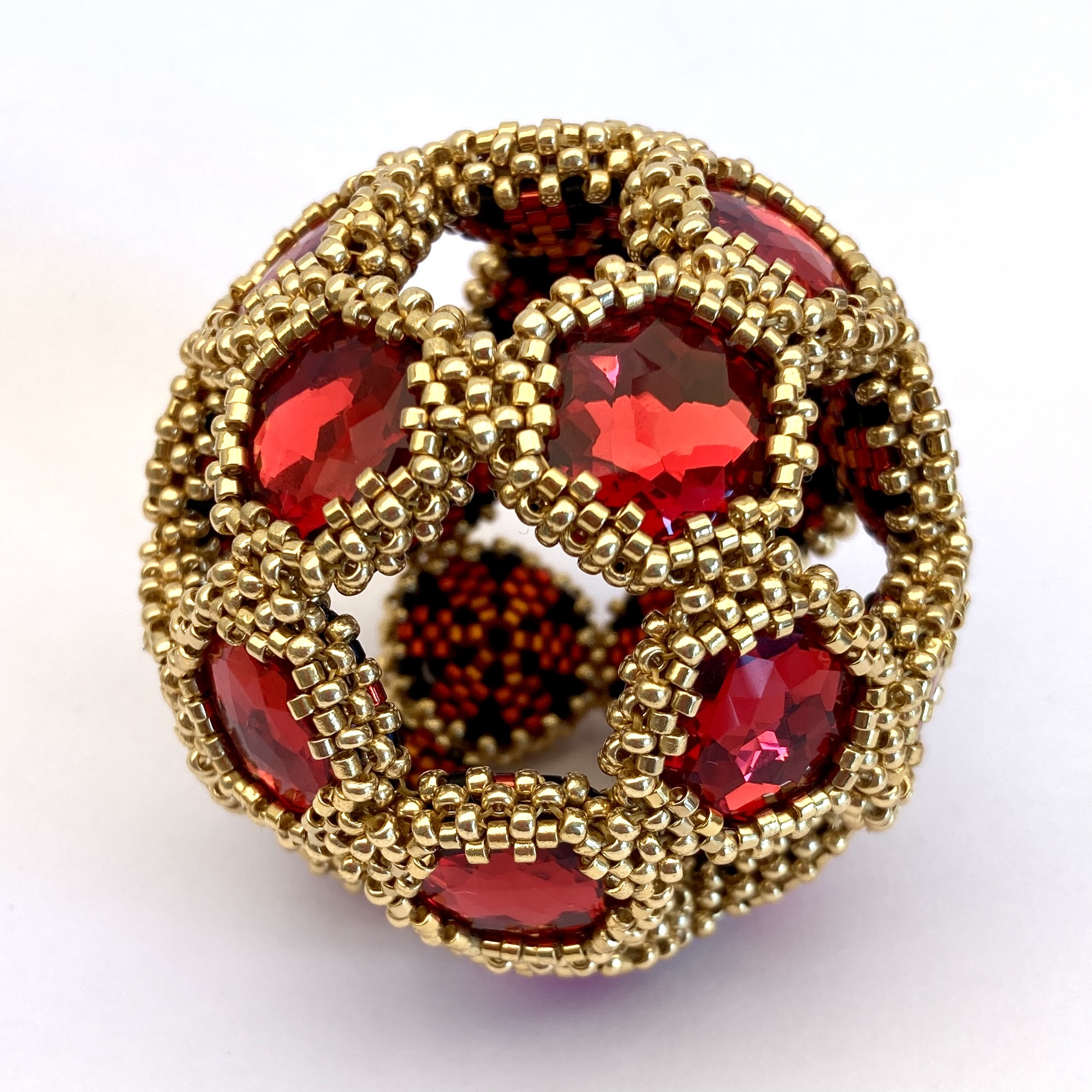
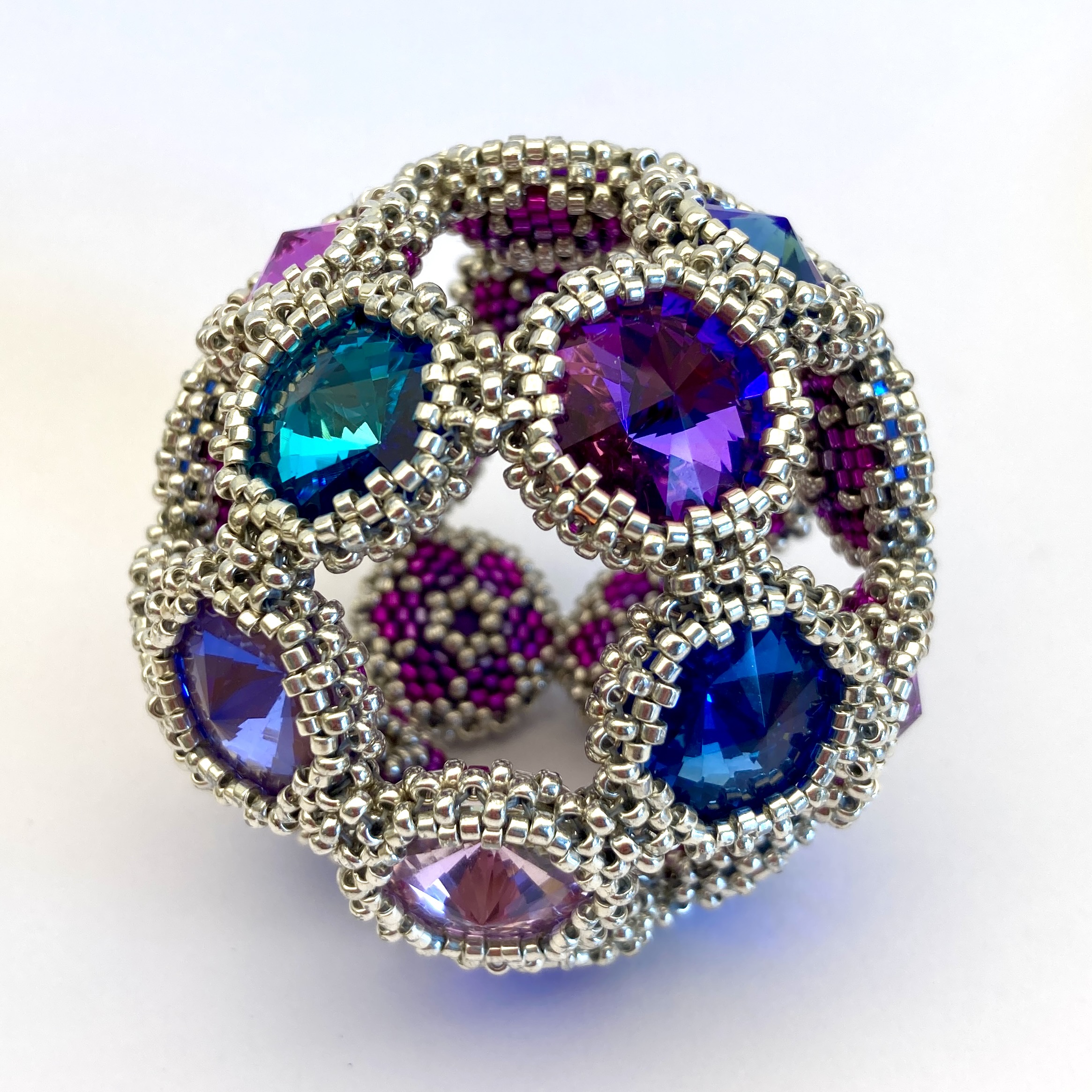
Orbit is a new tutorial, born from a pack of amazing intricately faceted hexagonal crystals from my regular supplier – I can’t resist trying new sparklies and a pack fell into my basket whilst I was restocking other lines.
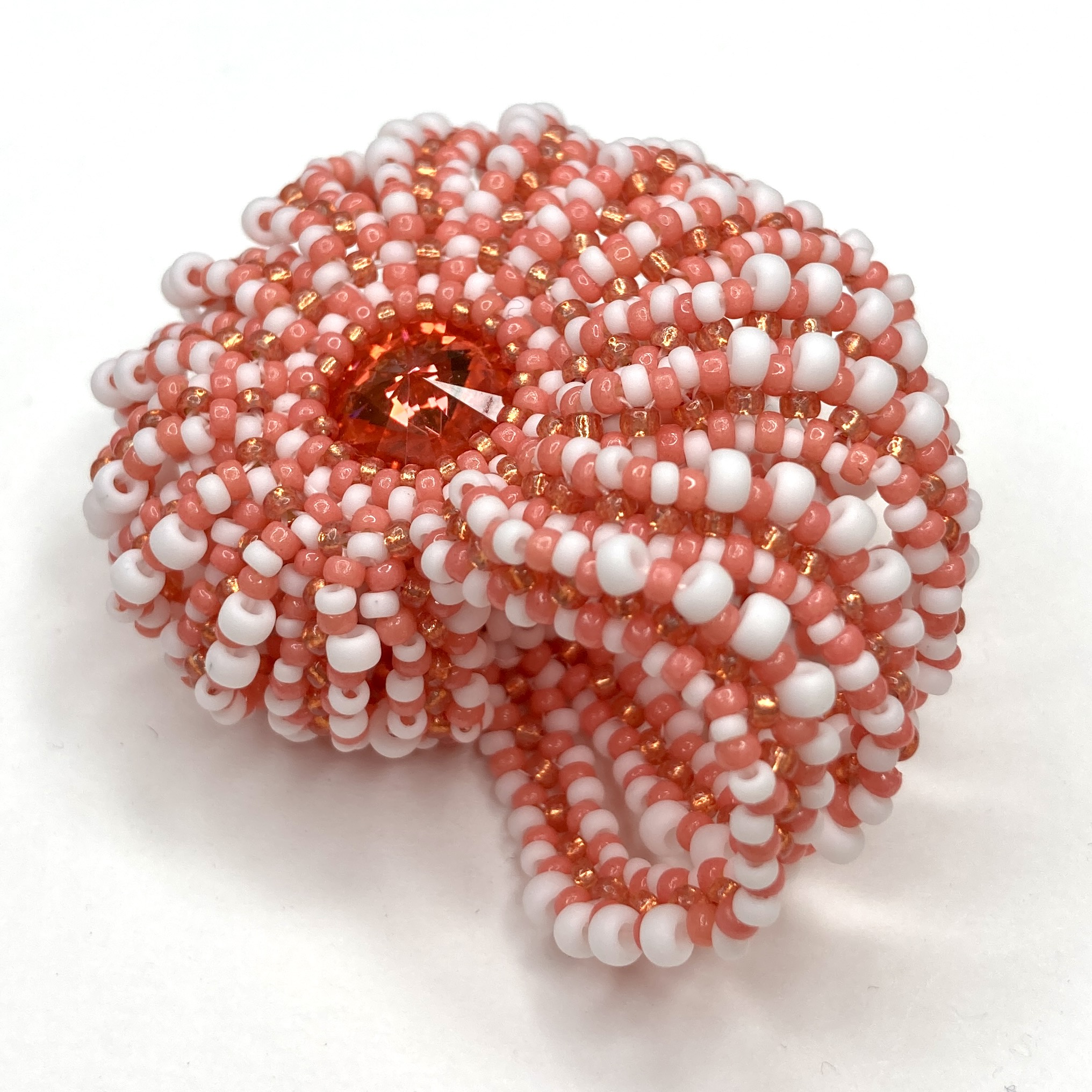
Absolute whoppers at 18mm across (21mm point to point) the colours and finishes were amazing, but I needed to come up with a design to use them. If they’d have been pentagons they would have been so much more useful for making my favourite dodecahedra, but they weren’t – hexagons tessellate to a flat sheet, so only make 3d geometric figures if they’re combined with other shapes which weren’t available to match. So I put them away and moved onto other things.
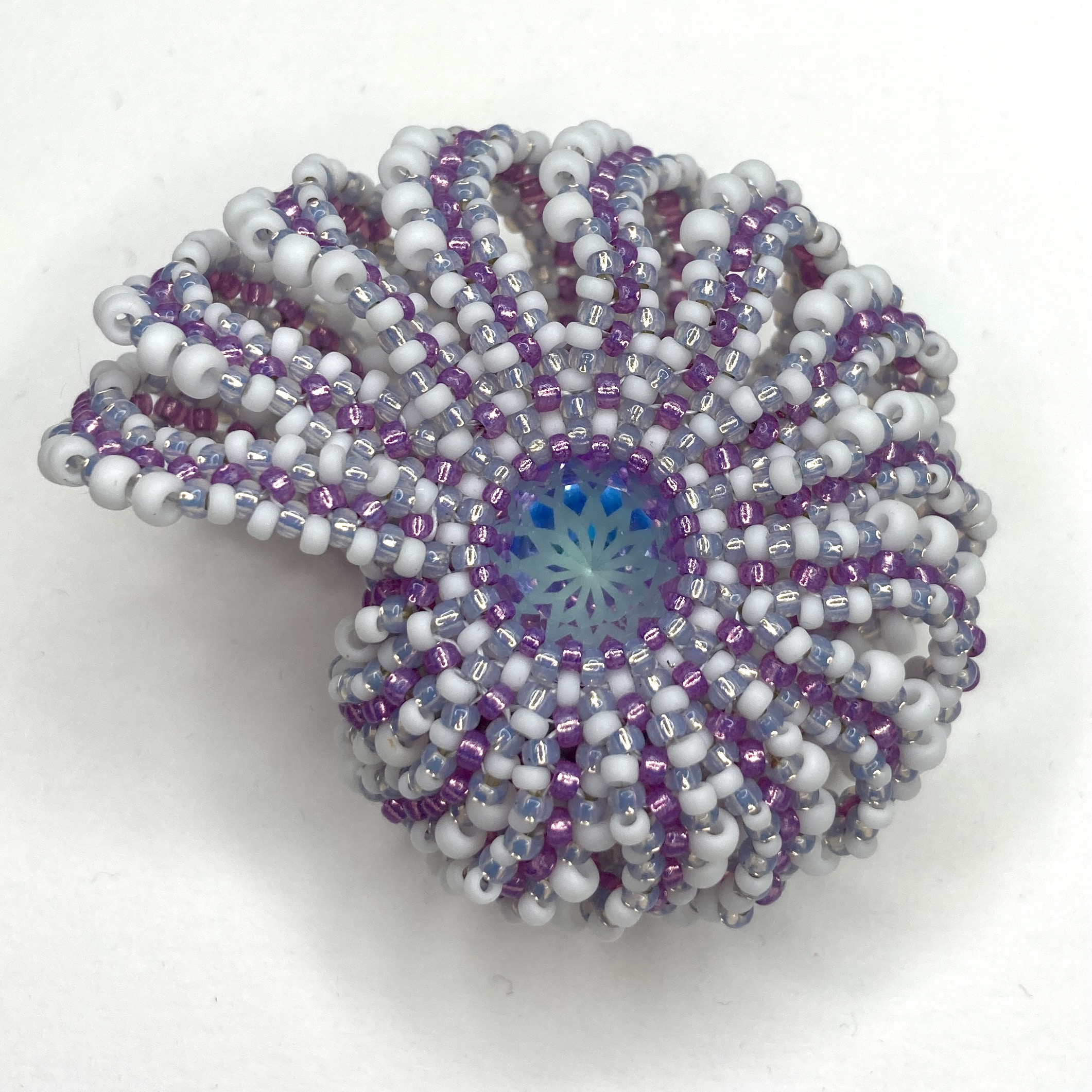
A few months later I was looking at them again, and had a go at my favourite MRAW bezel to see how best to start using them. I always try that first with new cyrstals, and if that fails try peyote combinations, and finally complex 3D netting. It worked, and made a lovely solid bezel (particularly when I used a hexagon on the backs), but when I joined it to another I couldn’t get it to sit flat – whatever combinations of beads and stitches I tried I could only get a nice finish that was either concave or convex.
That took me away from flat sheets and back to 3d shapes and got me to thinking about the 3d Geometric shapes which do use Hexagons. The best known of these is of course the Truncated Icosahedron, also known as the Bucky Ball, seen everywhere as the basic patchwork layout for the football (or for the US peeps, a soccer ball). It uses pentagons, each surrounded by a ring of 5 hexagons. All the hexagons are joined, which made me wonder, what would happen if I just missed out the pentagons altogether and left the resulting gaps as voids, viewing windows into the delica bezel backs? Could I create a structure which was rigid enough to feel solid even with the voids? Would the curvature be correct? My engineering brain said ‘maybe, if you have a solid joint, rather than a hinge joint’. In peyote 3d shapes we usually use point beads to join, giving a hinge. If every side has a join then those hinges act in combination to give a solid shape. Any missing sides or joins mean flexibility returns, so the shape won’t be rigid. So I needed to come up with a joint which was solid – it would need a bit of flexbility to allow it to shift during construction, but ultimately needed to lock into a solid formation. Once again the curvature showed me the way to go, and in the tutorial you’ll see how the two part joint gives you the rigidity you need.
So a plan, but no way to see if I was right other than beading it, we departed for Christmas with 20 pots of pastel delicas and 20 hexagonal crystals. I doggedly beaded them half askeep in front of the post Christmas telly whilst the boys built Lego and played with my Dad’s train set, and by New Year I was relieved to see that my gamble had paid off, and Orbit was born.
Orbit – a Beadweaving Tutorial by Sarah Cryer Beadwork
Next, a lone Swarovski 14mm crystal in my stash of the same shape and cut beckoned, and I managed to alter the bead count to get a bezel to work for that too. Crystal Idea in Lithuania had a good stock, so 19 more were ordered, and the Poppy variation followed.
But those 14mm versions were eye wateringly expensive, what beader was ever going to chose them? I had been able to get enough stock of the 18mm original crystals for launch, but realistically that wasn’t going to serve more than a couple of dozen customers, so would really limit the market for the tutorial. Back to the bead mat then as I tried to make it work for different sizes of hexagons – 10mm NO, 12mm NO. More thinking. What about a 14mm Rivoli, the beader’s favourite – NO – too small. At this point I had drawn all the diagrams and invested a lot of time (and crystal money) and I was getting a bit discouraged.
Happilly one day I was working on the materials section of the tutorial and needed to measure the crystals, leading to one of those ‘doh’ moments when you realise you’ve been daft. They’re sized across the parrallel edges as 18mm or 14mm, but point to point they’re actually 20mm or 16mm. I had 2 lonely 16mm Rivolis in my stash and hooray, they fit the bead count for the 14mm hexagon. The bezel ended up circular, so the backs needed some changes to fill the gaps that opened up in the delica peyote, but eventually I came up with some slight tweaks to allow beaders to adapt the 14mm version to make this with 16mm rivolis – they’re way way cheaper and much easier to get hold of, so I very much hope this will allow more of you to enjoy making this piece. If I’m honest I prefer the look of the hexagon versions to the rivolis, and the join beads don’t sit quite as neatly. However, the 14mm hexagons were £70 in total, and the 18mm hexagons I sell are £20 for a set (plus post and packing) so it feels important to offer a lower cost option – I paid £10 for the 16mm Aurora Rivolis from Old Bicycle Shop Beads and I think you’ll agree that’s fantastic value.
At some point I will also try to put together a 20mm rivoli version – I have some gorgeous vintage rivolis (again from Old Bicyle Shop Beads) all ready to try this with but as they’re a less easy to find size I concentrated on getting the 16mm tested first.
So here it is – Orbit, made with just Miyuki size 11 seed beads, size delicas and 20 gorgeous crystals using RAW, MRAW and Peyote stitches.
18mm Hexagon crystals which I think make the best version are available from my Etsy shop in packs of 20 (exactly the right number of course) here. Alternatively you can purchase the 14mm 4683 (under the brand name Primero) from Crystal Idea here or from other Swarovski stockists, or the 16mm Rivoli from Old Bicycle Shop Beads here (and probably lots of other places).
Intermediate level, suitable for anyone who is confident with RAW and Peyote, and patient enough to make 20 identical components and carefully follow a net to join them correctly. As usual it is fully illustrated with both diagrams and photos, written out steps and even some listed out colourways (with bead numbers) or your own colouring in sheets if you’d like to plan your own colours. A full detailed list of bead requirements is available on the usual page here.
Available in my Etsy or PayHip shops as a PDF download. Etsy don’t like my decent quality illustrations or photos so force me to turn it into 3 PDFs to meet their teeny file limit- if that annoys you as much as it does me, the PayHip version is a single PDF and exactly the same price.
This year’s International Beading Week runs from 27th July- 4th August. I’ll be doing my bit for beaders everywhere by offering a massive 20% off all of the tutorials in my Etsy & PayHip shops, including my brand new ‘Nautilus’ and ‘Quintessence’. No code needed, they’re all reduced and ready to go right here!
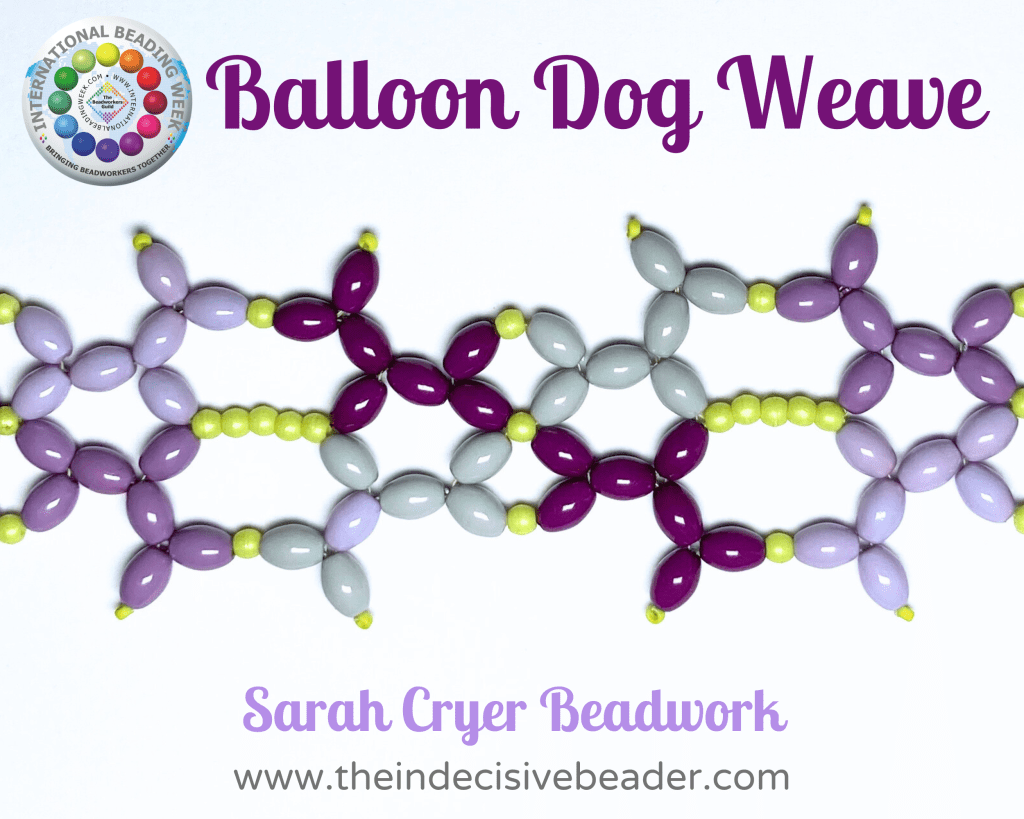
As an IBW Ambassador I’ve also donated a very silly set of instructions for ‘Balloon Dog Weave’ which you can download from my website here, or from the Beadworker’s Guild site where there are lots more free patterns from a whole range of lovely designers here.
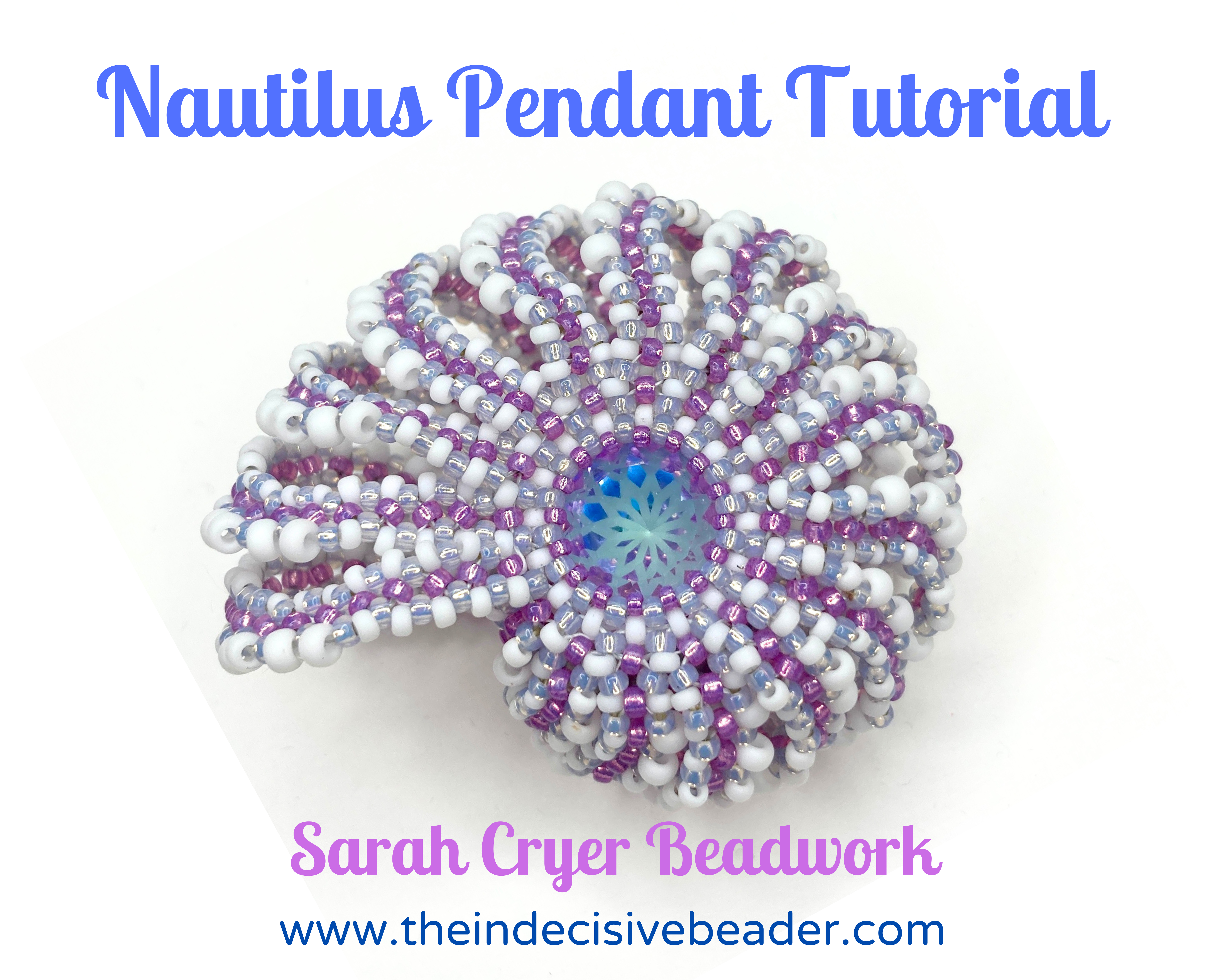
I know, I’m on a roll, two new tutorials in a row! This one is another pure beadweaving tutorial – I’ve been doing a lot of bead embroidery and goldwork as part of other projects, so I’ve returned to beadweaving as a break from the stress of very creative work, spending some time refining some samples made a little while ago and writing them up.
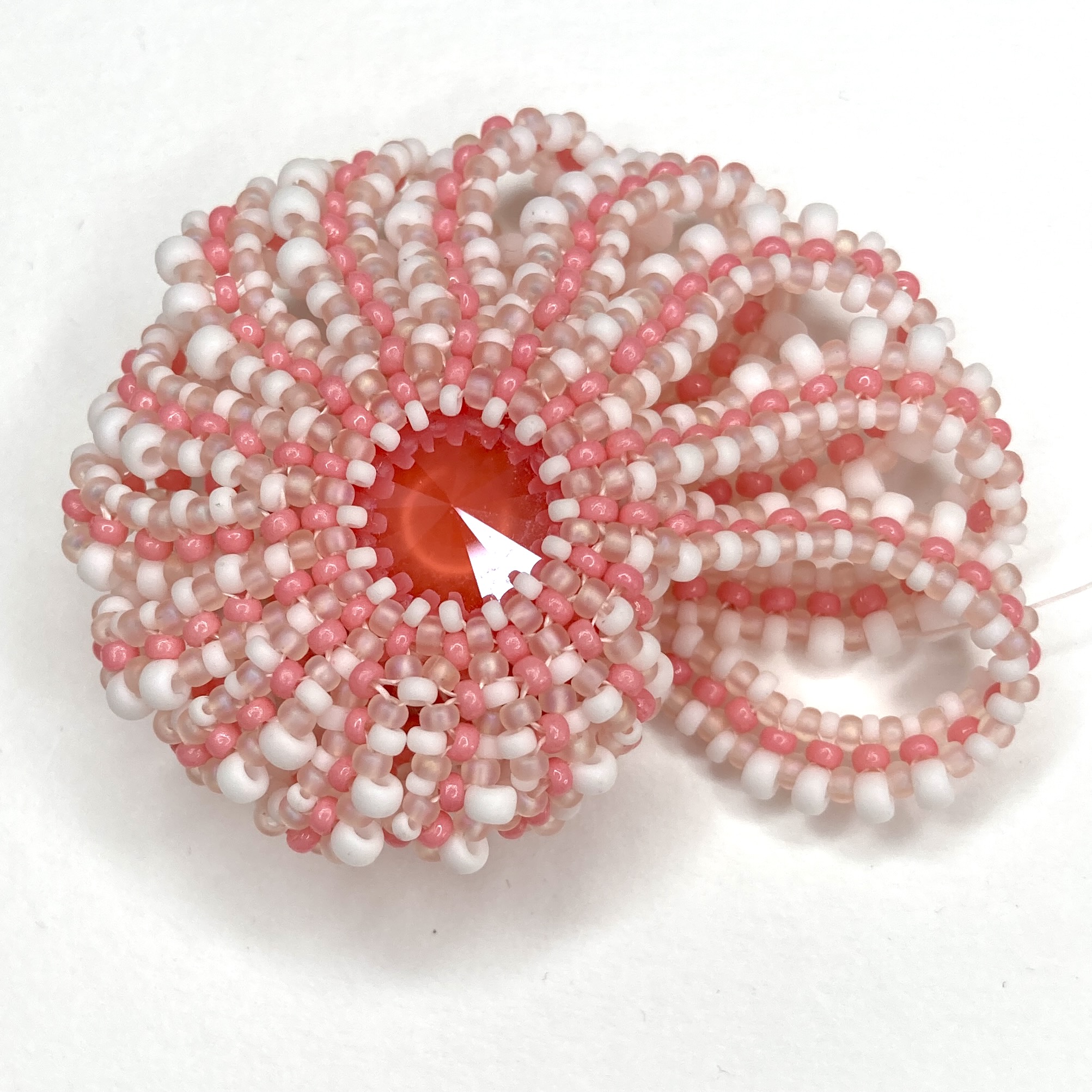
This piece was started last year as an attempt to create a shell shape in beads.
The original idea was to work with CRAW, and whilst that came out as I’d planned, it wasn’t really shelly enough (you definitely had to be told what it was supposed to be!!). CRAW is also not a universally popular stitch – some beaders love it and some completely hate it, so I moved on…….
The idea of increasing strips seemed sensible, but there needed to be more of them to give a clearer shape, and they needed to not be CRAW – so I had a go with RAW, using twice as many strips and something altogether more shell like emerged.
There were a few mis-steps along the way – early versions had a terrible wobble in the middle until I changed the central join to make it more rigid, and I had a lot of trouble getting the spines rigid enough without busting needles weaving through (and getting bored as well as annoyed in the process). A offset version was hopeless but did give me some ideas. Overall the set up was a little plain – still not shelly enough, and the metallic beads weren’t helping either.
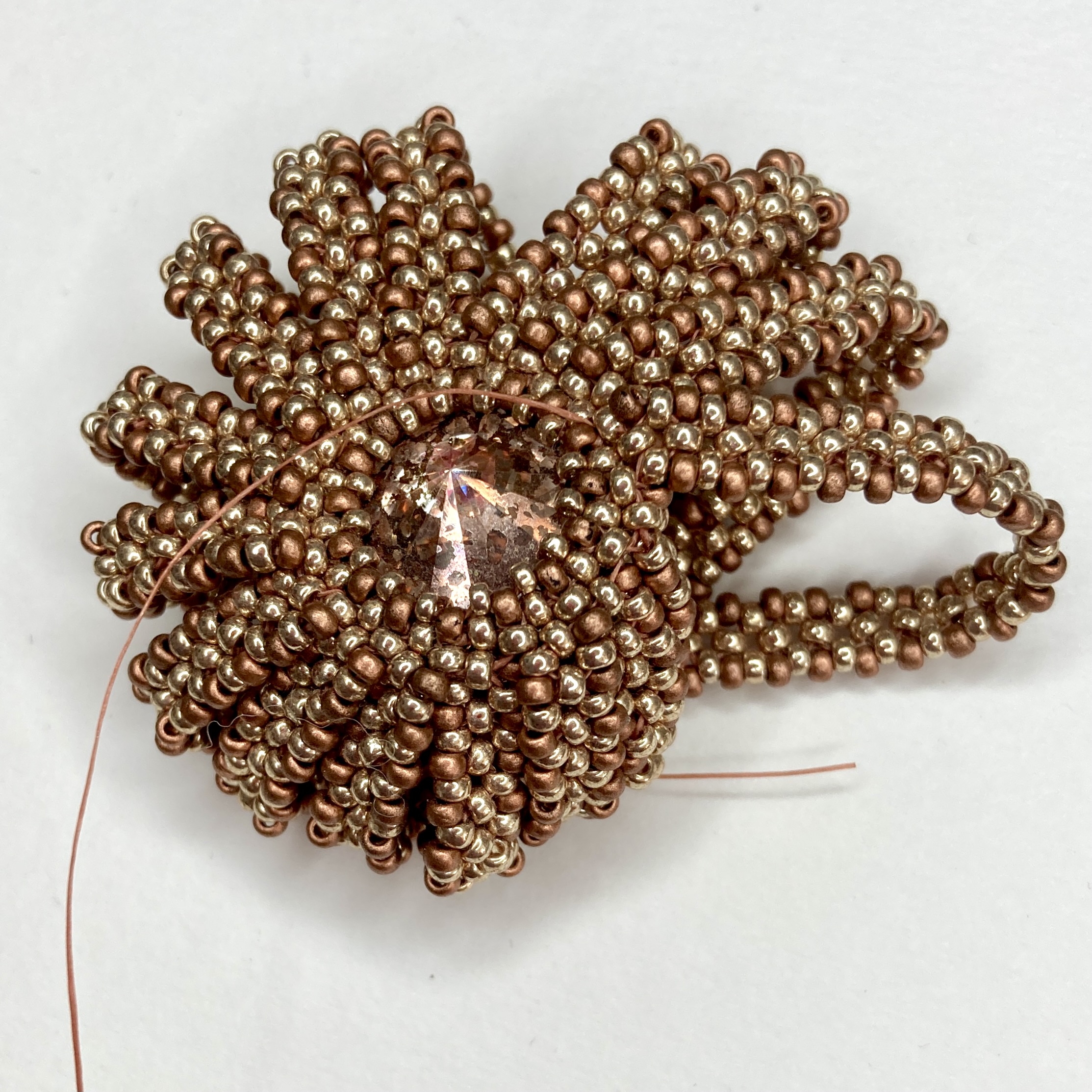
Then I had the idea to add Cellini to the spine edges – that immediately gave a beautiful S shaped curve and an instantly rigid shape, but I was still having issues with getting through some of the beads to get the spines in place and to make them rigid enough. That meant lots of new versions, trying different bead sizes, thread paths, even altering the bezels. Colours became less metallic, sometimes a little bright (for clarity) but mainly staying in a ‘shell’ palette.
After all that fiddling and frogging I had a breakthrough, managing to come up with a cunning trick to improve the thread path at a critical point to save needles, remove the need to weave through to strengthen and best of all, preventing bad language! Ironically the diversions were all red herrings – the final piece is very close to the two first Cellini versions, just with that slight critical adjustment. Brighter colours to help with picture taking at this stage……
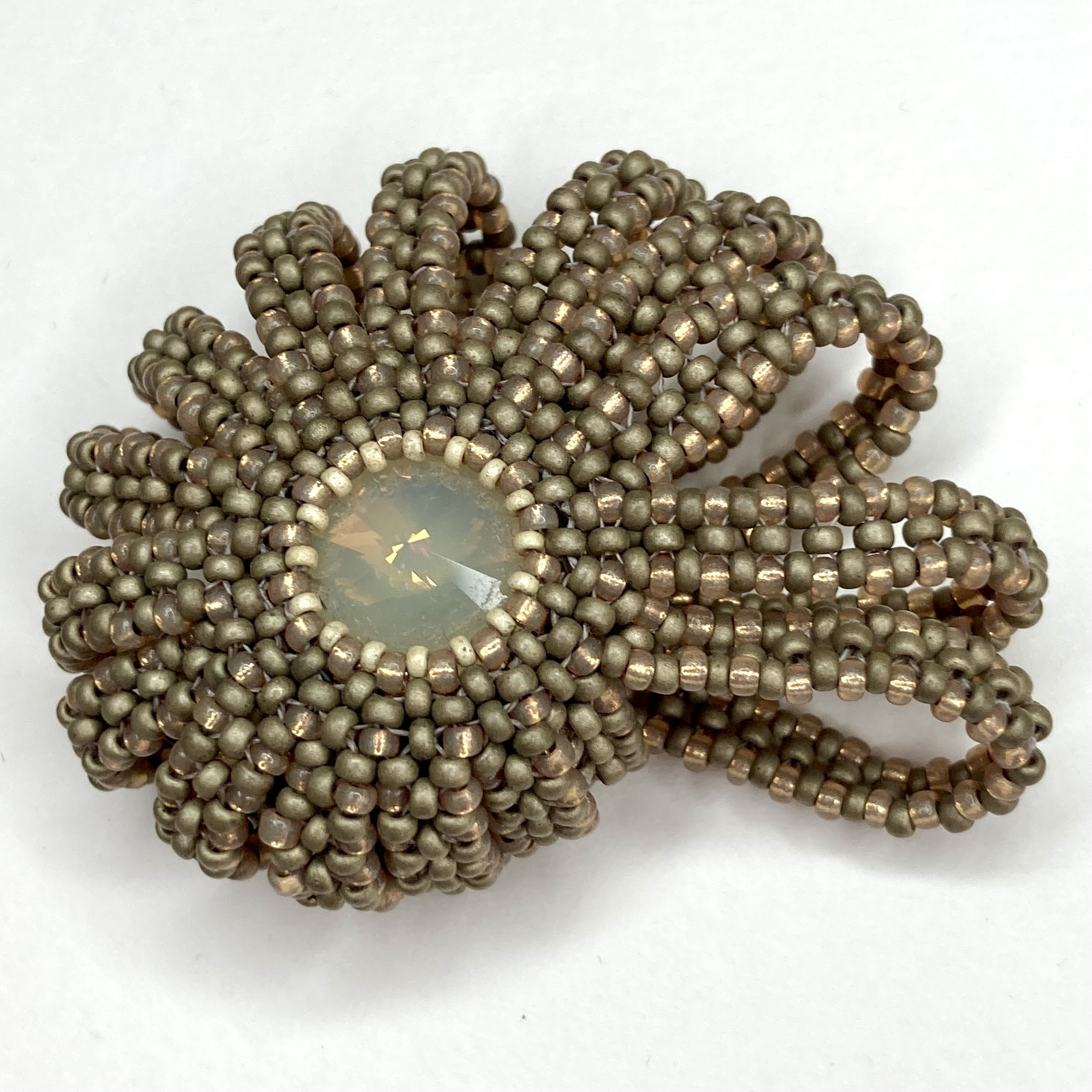
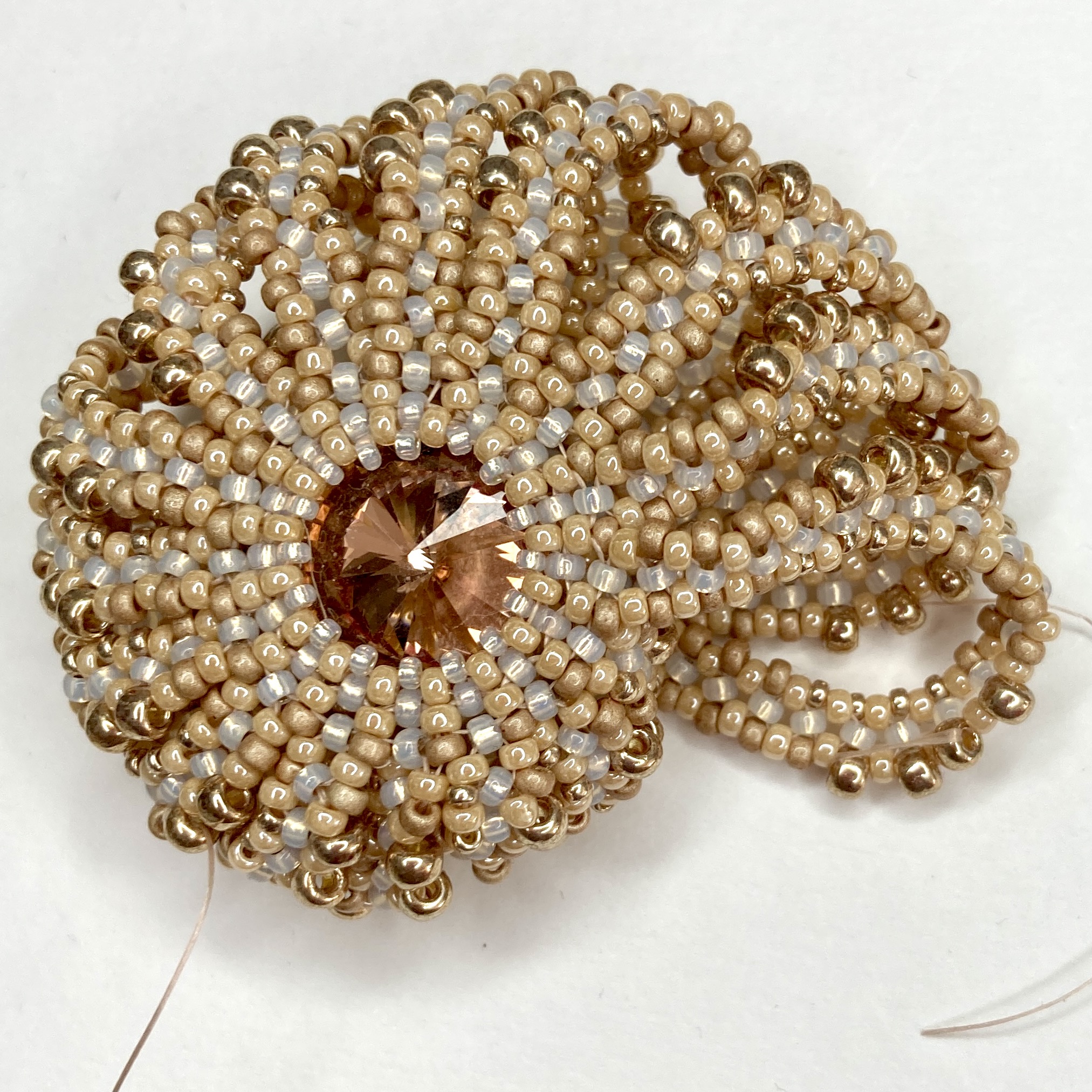
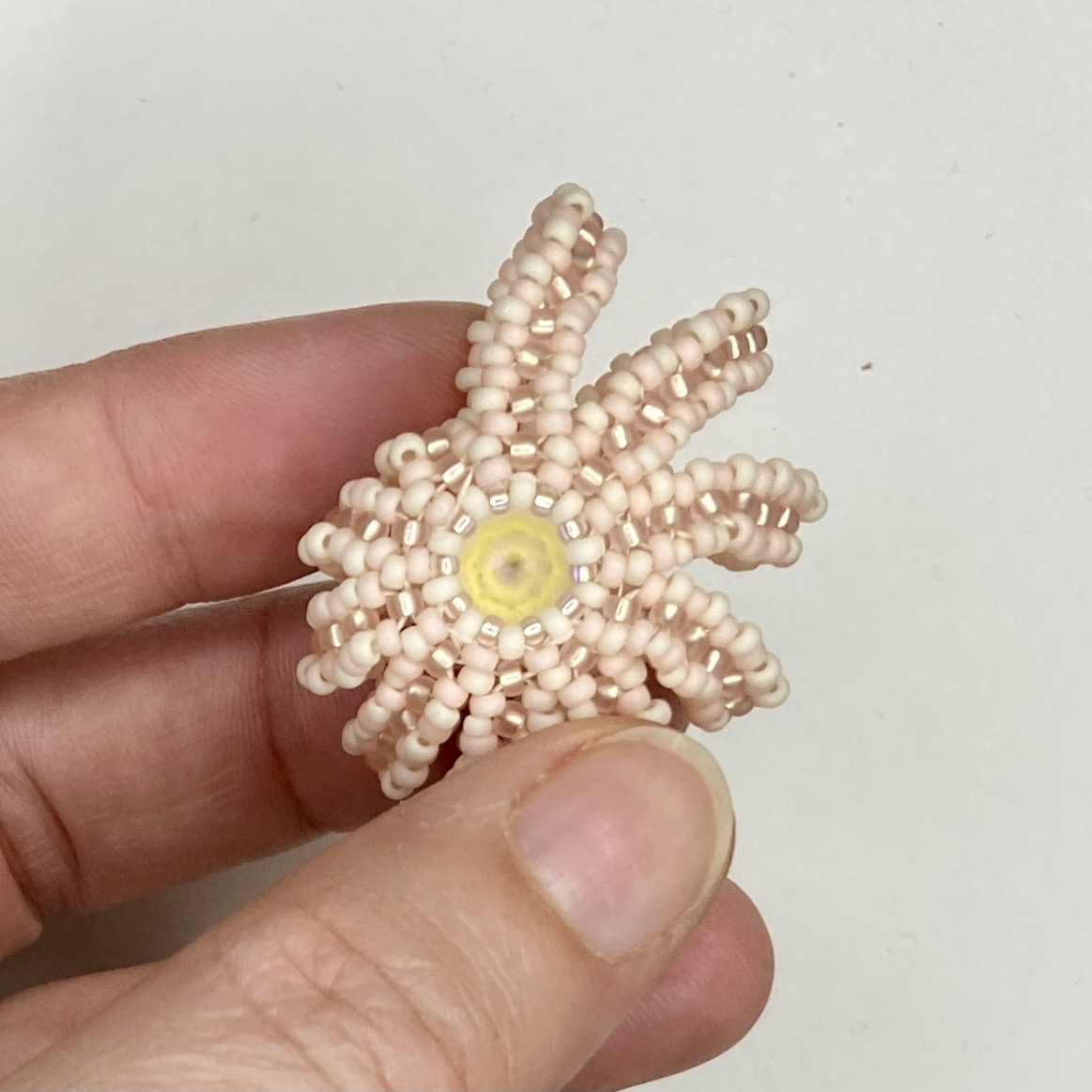
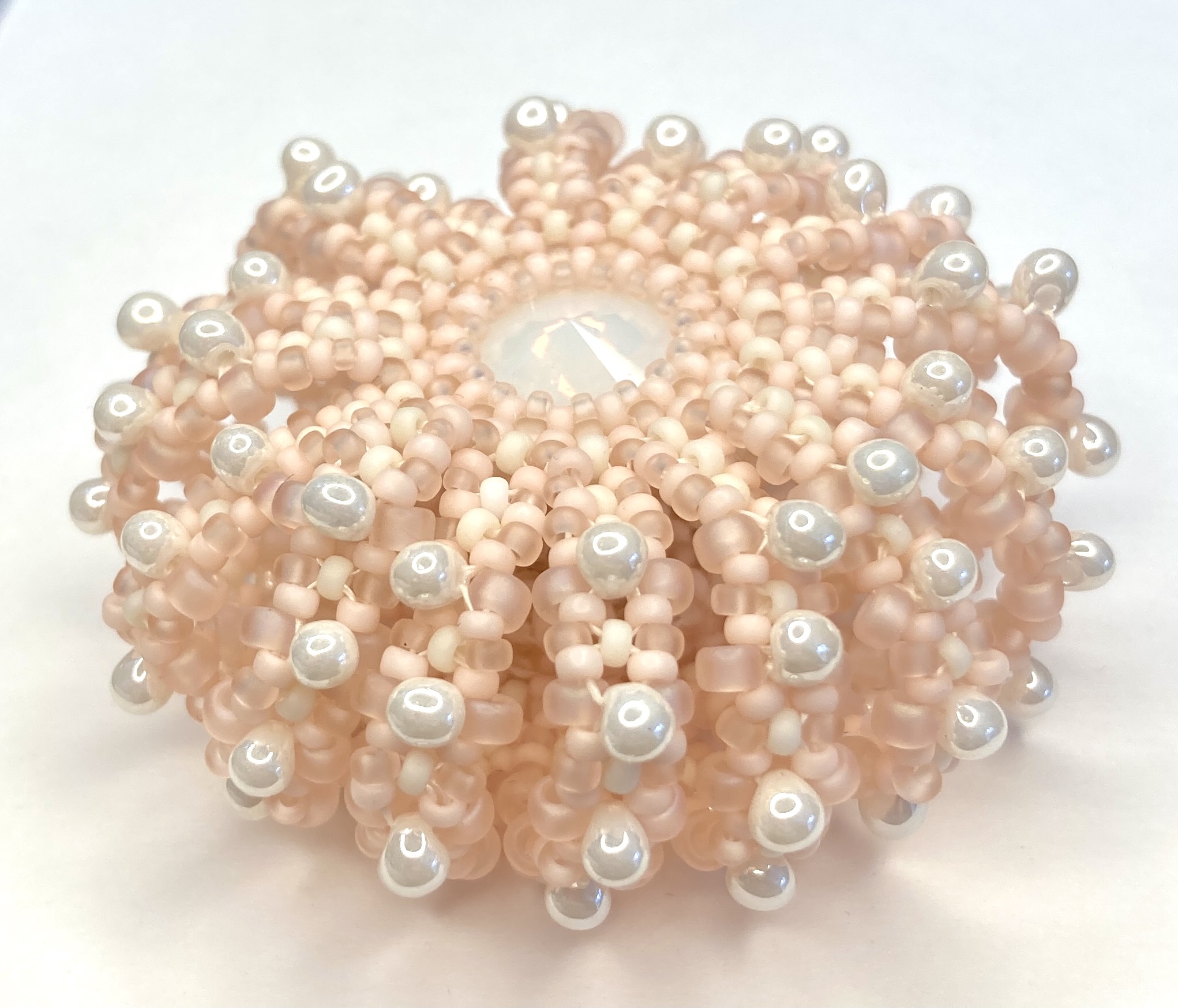
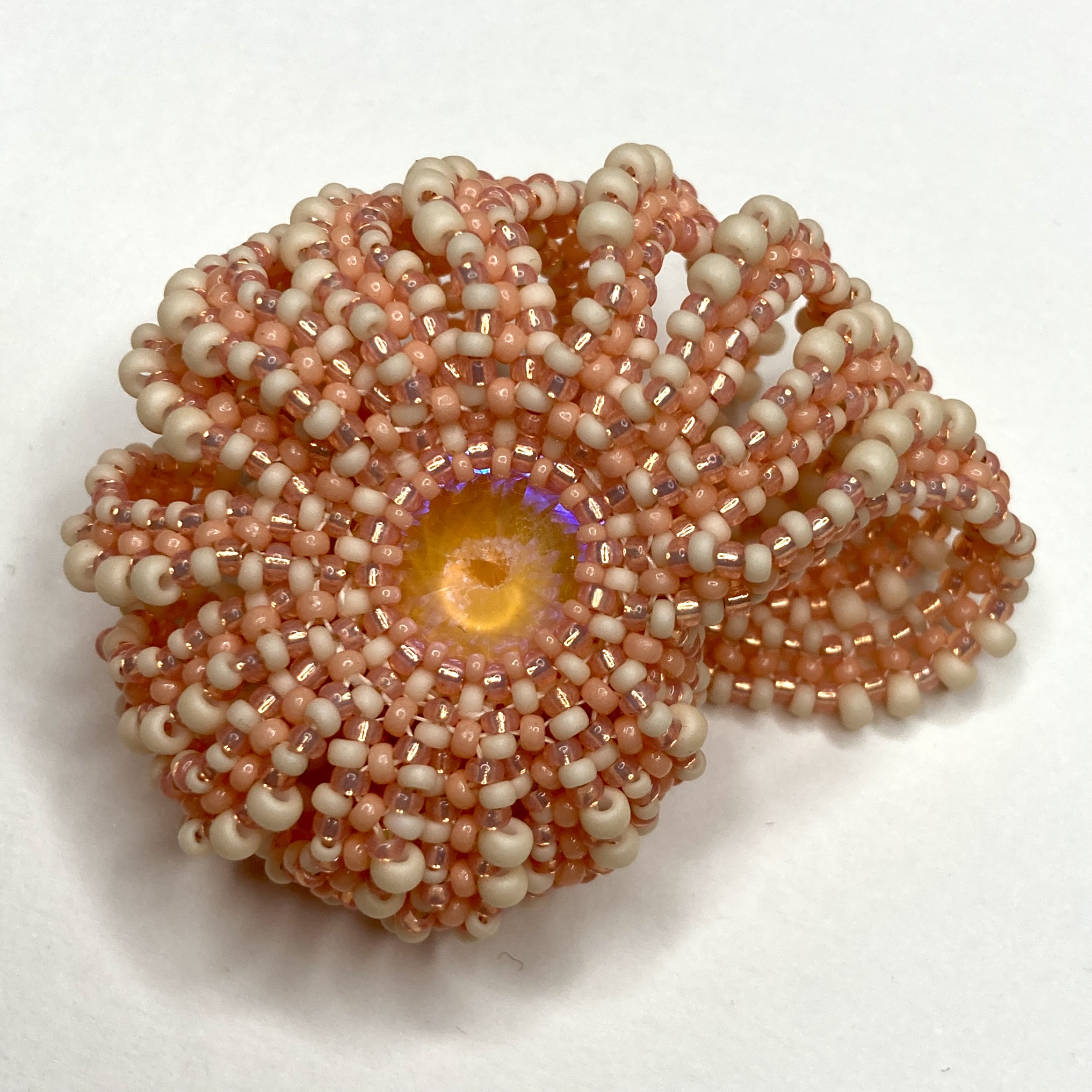
Along the way I made another plain version (no Cellini, but refined from the earlier plain versions), and after some useful comments on Instagram when I showed some in progress pieces, I added a baby variation using an 8mm chaton, and a Sea Urchin variation using the 14mm and some 3.4mm drops. These are in my favourite colour palettes for this piece – warm palest peachy pinks and soft creams or whites (very pretty and an indulgence after having to work with more distinctive colours for tutorial images).
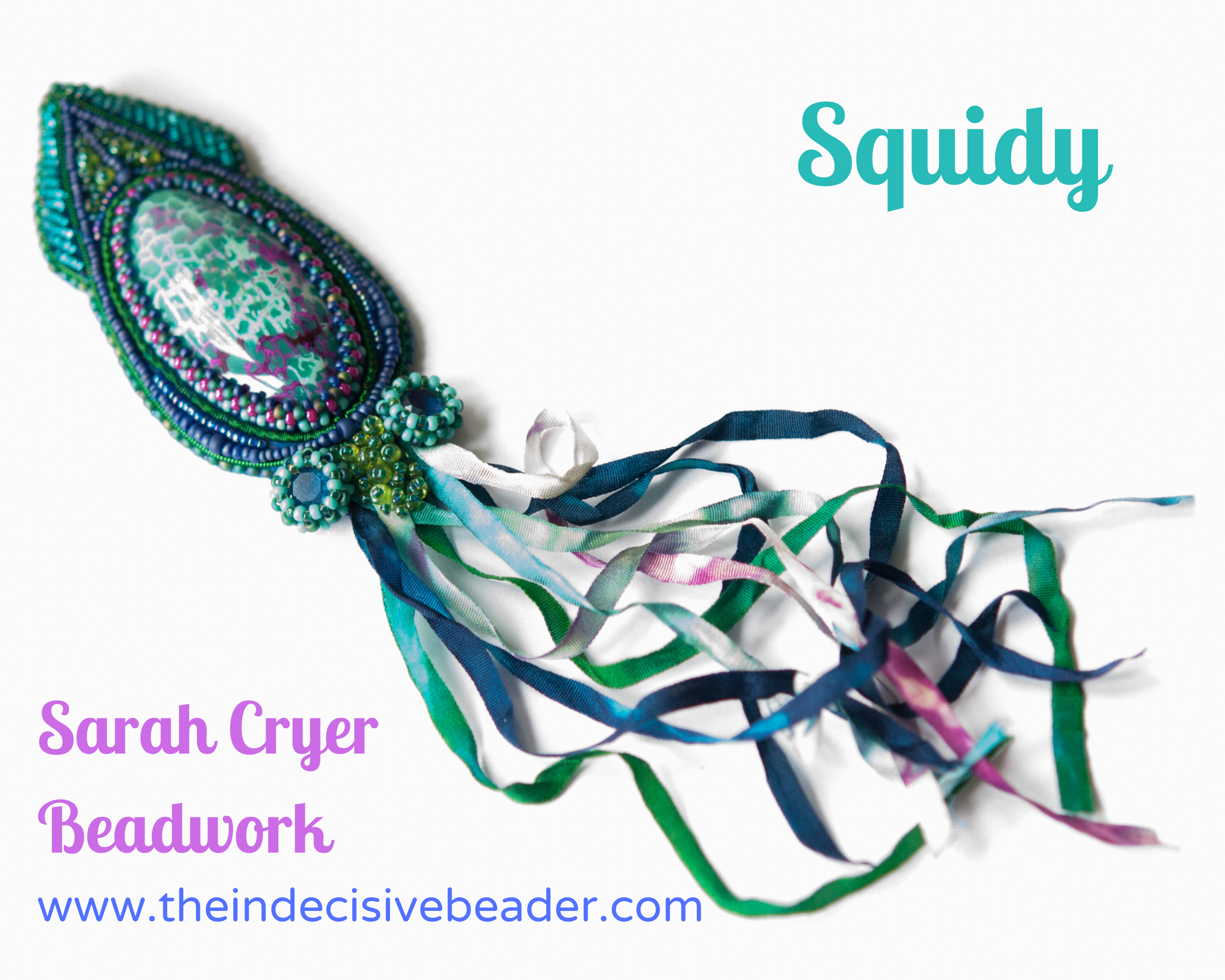
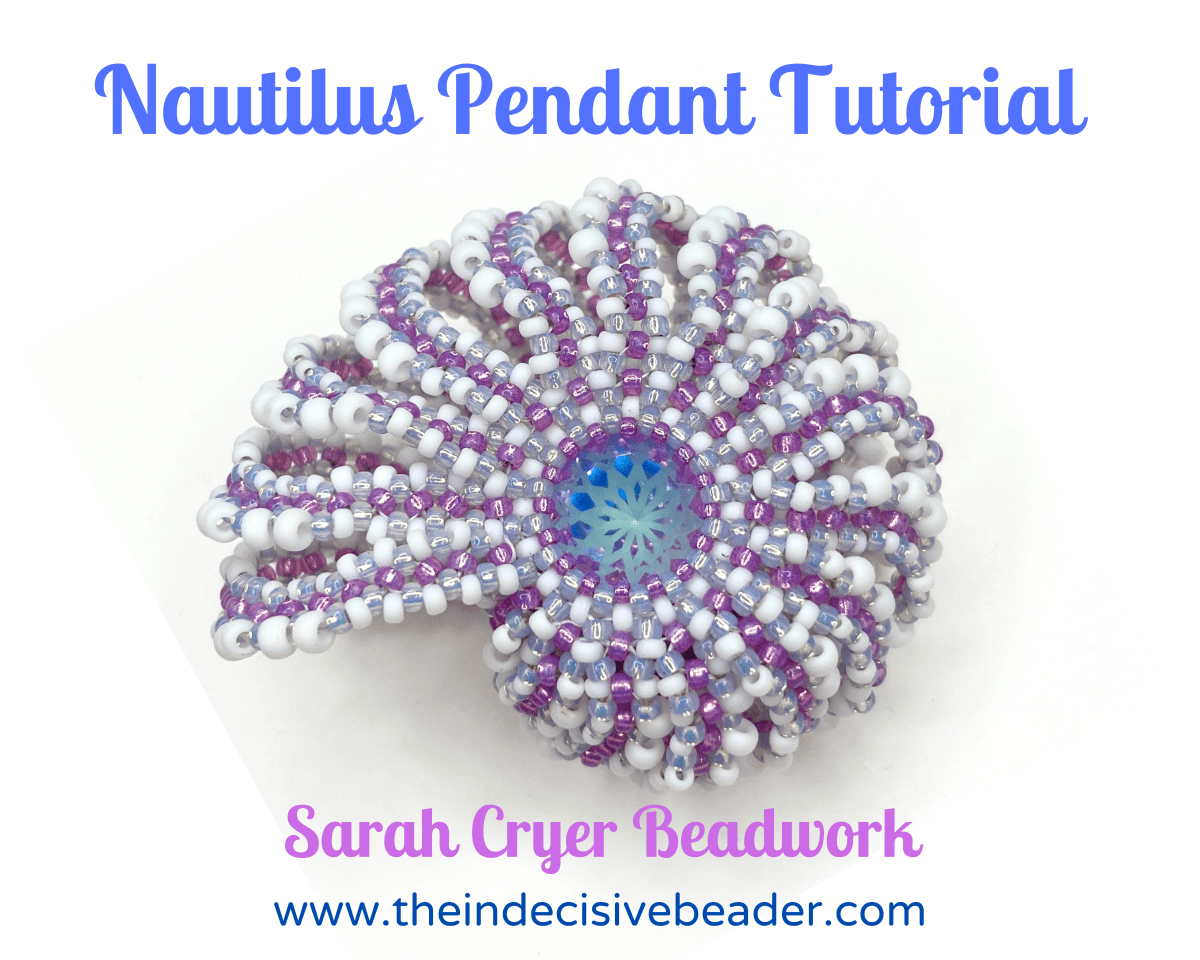
So here it is – Nautilus, made with just Miyuki seed beads and 2 14mm Rivolis or Chatons (any brand will do), using RAW, MRAW and Peyote stitches.
Intermediate level, suitable for anyone who is confident with RAW strips in particular (there are 16!), and fully illustrated with both diagrams and photos, written out steps and even some listed out colourways (with bead numbers) or your own colouring in sheets if you’d like to plan your own colours. A full detailed list of bead requirements is available on the usual page here.
Available in my Etsy or PayHip shops as a PDF download. Etsy don’t like my decent quality illustrations or photos so force me to turn it into 3 PDFs to meet their teeny file limit- if that annoys you as much as it does me, the PayHip version is a single PDF and exactly the same price.
I may not do Black Friday or Cyber Monday but I do like to try to offer a discount on my Tutorials in December as a seasonal gift to my lovely customers around the world.
Please note that this only applies to Tutorials, but hopefully that will still keep most of you happy. So, 10% off all Tutorials in my Etsy & PayHip shops throughout December, links below, discount automatically applied at checkout.
OK, I did another one – I skipped a day or so earlier in the week so catching up now! This is nearly the last (I’ve finished one more this afternoon and then I have plans for a completely bonkers one as a final hurrah), and I’ve kept it quite simple whilst trying to include some new touches to keep the experimental spirit going. If you’re at the Bead Embroidery Zoom tomorrow (Saturday) morning you might get to see how that’s progressing when I walk you through some of my work.
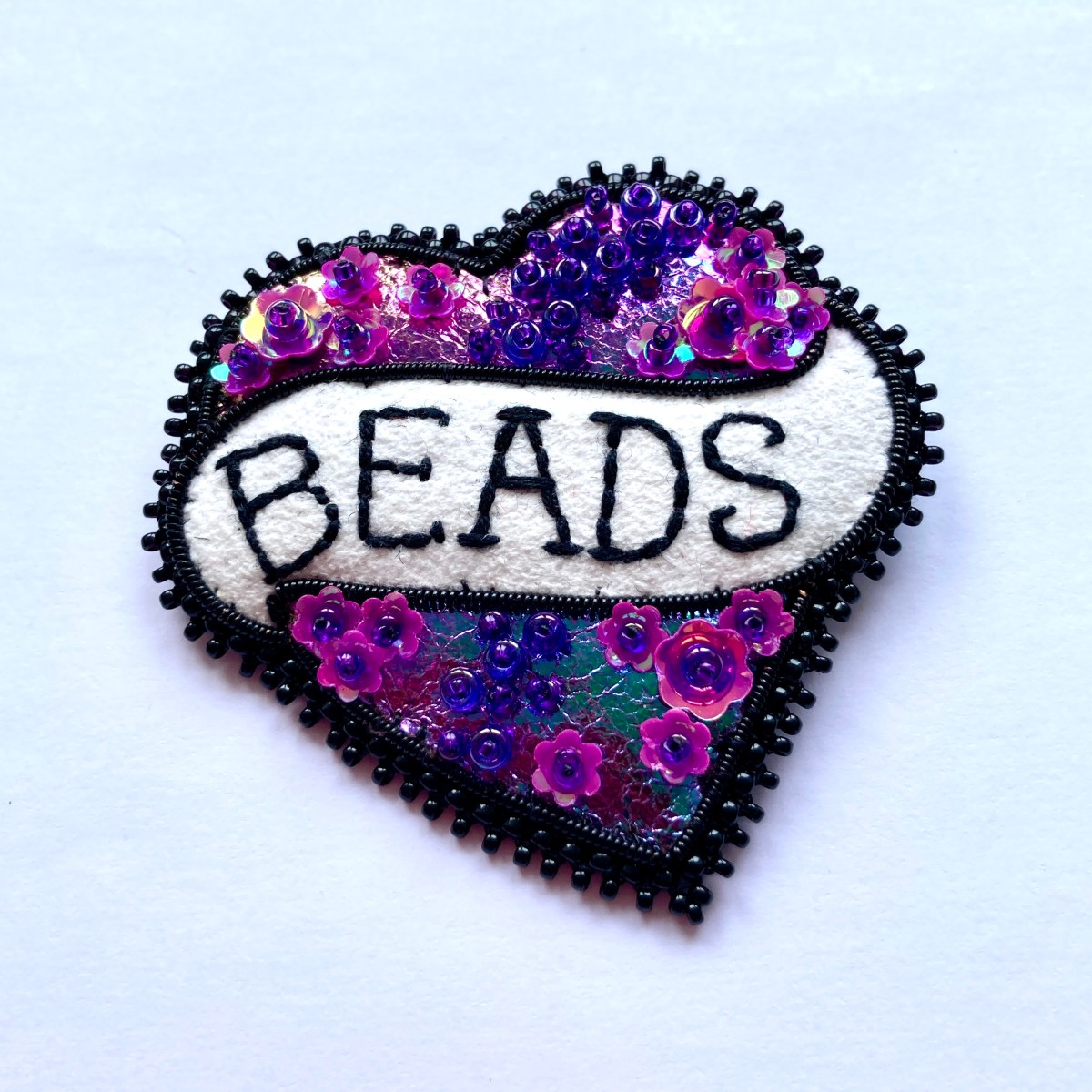
As you may have noticed I bought some sheets of metallic pleather recently so I’ve gone back to those for the base and backing here. Nice and simple – here are the steps and the template and stitch guides are as ever in with the new for 2023 IBW patterns on the Guild website.
1) Black hard felt foundation, rainbow metallic heart (cut from the purple/blue area).
2) Ribbon is white ultrasuede with back stitched DMC stranded cotton letters. I did many of the banners in a batch earlier in the week working on a frame, this was an early one and I think the stem stitched ones I’ve used on other pieces were better.
3) 1.25mm black pearl purl around the ribbon and heart.
4) Seeded tiny flower sequins and size 11 and 8 seeds in diagonal bands for simplicity, all with the seeds as stop beads. The pleather makes enough of a statement so I just wanted to get the feeling of a scatter of flowers across it.
5) Backed in the metallic pleather, with an edging of black 11 seeds, then round again to add the 15 seeds as a mini picot edge for a bit of frilliness (and because I’d only used plain edging until this point).
Really nice and quick to make, and I think quite pretty. Looks even better in the flesh because of the shine from the metallic finish.
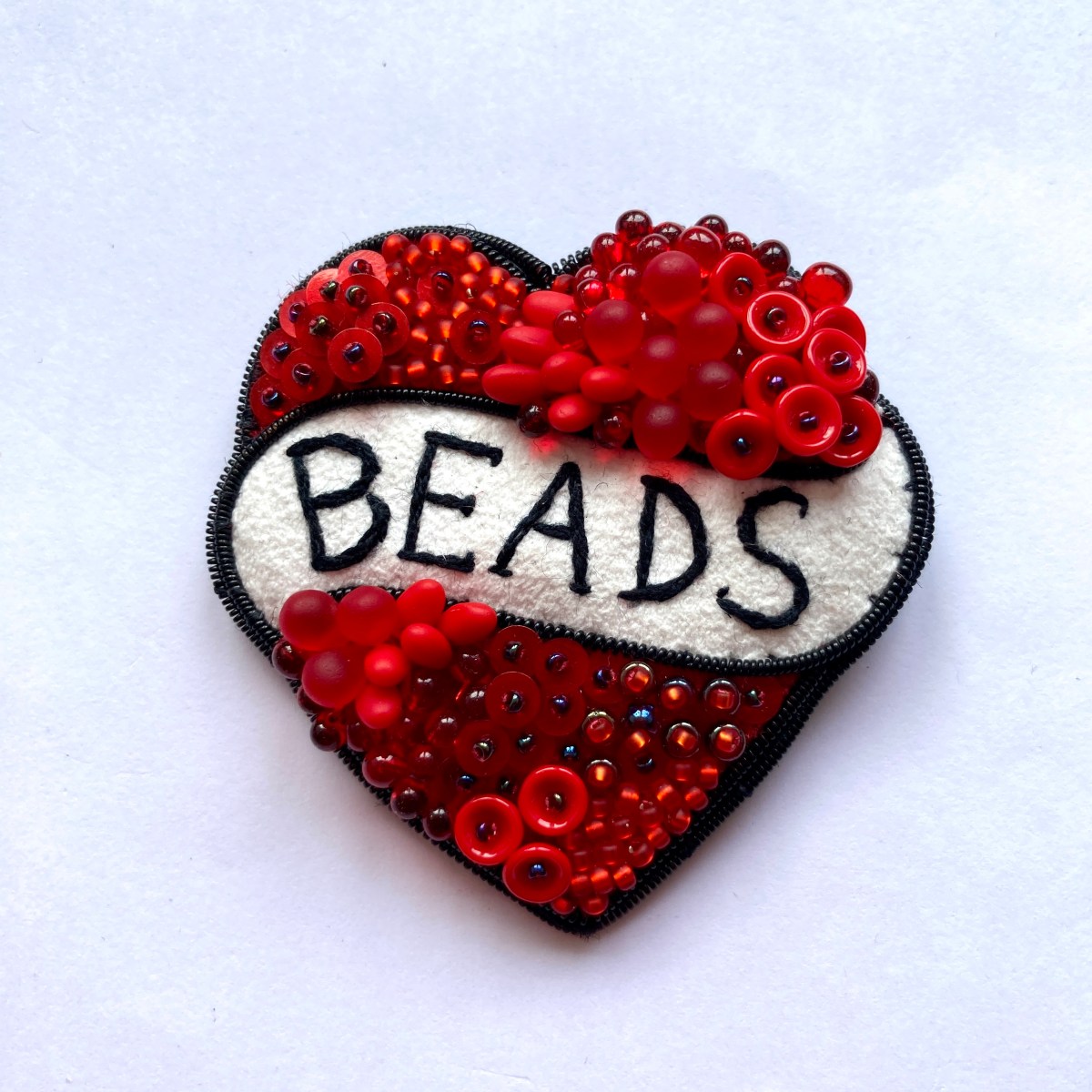
Yesterday’s Barbie version of my ‘I Heart Beads’ brooch may have been a big pink failure, but hopefully today you can see I took what I learnt, made some slightly different decisions and came up with something which is very me and actually works! Whilst the pre-Barbie versions were light on beads, this one brings me back to the heavily encrusted style I usually work with and I was relieved to be able to use it. So, here’s what I did:
1) Back to ultrasuede for the ribbon, and stem stitched letters with 2 strands of black DMC cotton.
2) Red hard felt heart on another piece of black hard felt. No padding. Both heart and ribbon outlined with couched 1.25mm black pearl purl.
3) Beads added with stacking (cup beads on varying height 11 seed stalks, sequins sandwiched with seeds for height and texture, size 8 seeds stacked singly). All with size 15 seed stop beads.
4) Other beads added with seeding – rizos, small czech drops, miyuki 2.8 & 3.4mm drops, and 11 seeds.
Those two combinations allowed me to vary the finished heights for interest and texture – work as if you’re contouring a landscape, with gradual transitions between the higher and lower patches using either the stacking on stalks of fringe or varying sizes of bead.
5) Finally backed on black ultrasuede and finished by couching black 1.25mm pearl purl onto the edge to hide the layers. I’d tried using seed beads but it looked too busy.
So the big lesson today was about getting some balance back – I pared back the black and white elements as far as they could go, and then went wild with the beads. A success!
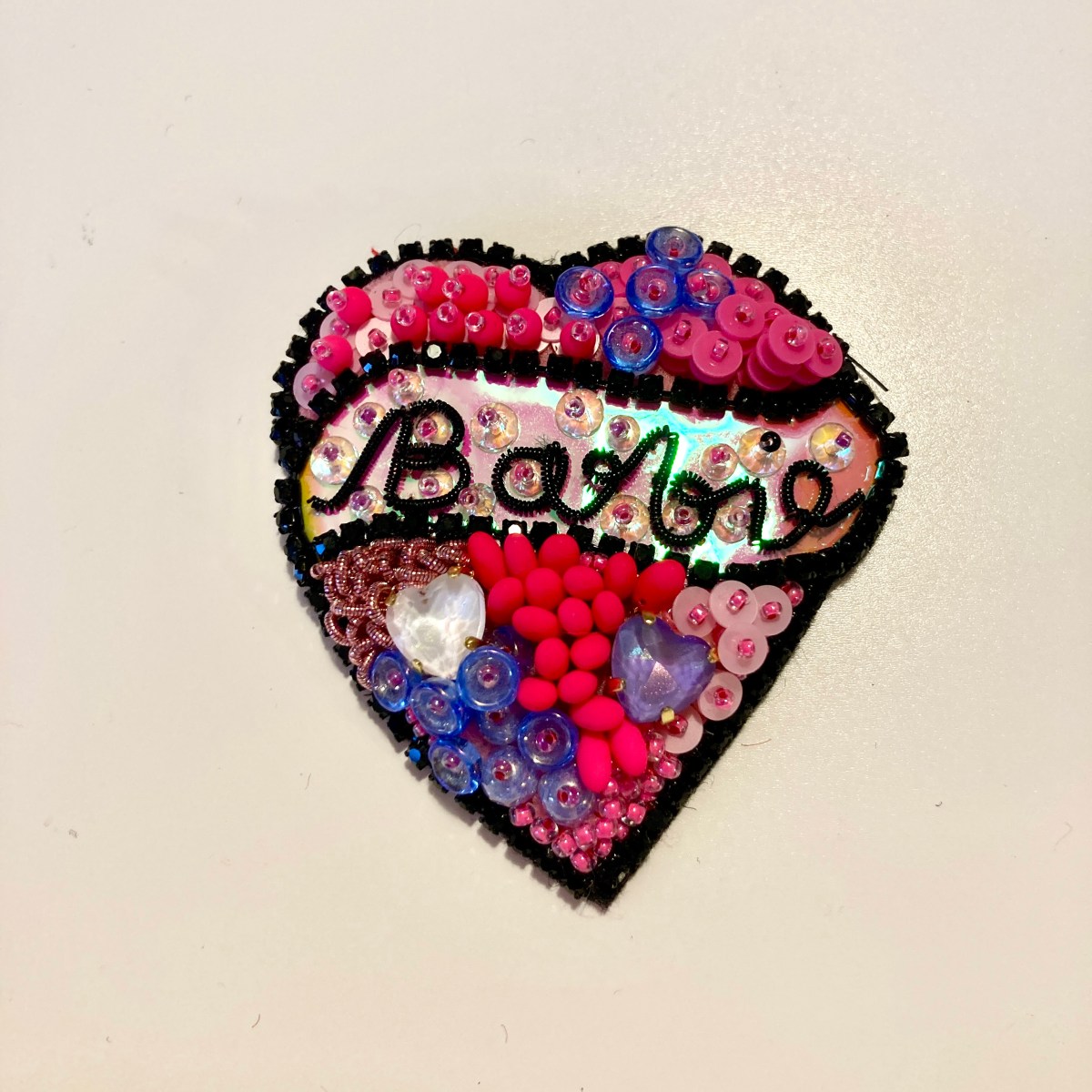
The trouble with undertaking to publish every version of my ‘I Heart Beads’ IBW project here is that I have to show you the ones which didn’t work. Whilst that’s rather embarrassing for me I guess it’s an important principle to help us all remember that not everything we attempt comes out how we envisioned, but we still learn from trying. So, with a deep breath and some embarrassment (and amusement) I have to tell you that the promised Barbie version totally failed! I made a number of very bad decisions which I hope sharing here will stop you from repeating……….
1) I used a very stiff iridescent plastic fabric for the ribbon. Pretty, but hard to work with, and extra hard to write on with 1mm pearl purl. That might have worked on my usual ultrasuede but not on this stuff, particularly as all needle piercings left a visible hole. I need more practice with materials like this.
2) The ribbon somehow ended up about 1mm too far to the right and 3mm too far up, which has really significantly upset the balance. A silly mistake, and I should have realised as I was working.
3) I attempted to hide the mess with crystal lochrosen in a kind of ‘bubble’ effect which made it look even messier.
4) Something is wrong with the beading too – too many pink rizos, not enough sequins, the groupings are too small on the top section and I probably shouldn’t have bothered with the blue cup beads. What a mess.
5) The black cup chain, which worked really well on the previous versions now looks messy with the heavier beading. I should have gone with pearl purl to pull it back and give cleaner lines to balance it.
6) And finally the pink smooth purl I looped is the wrong shade – daft given the number of shades of pink I stock. Matching an iridescent fabric is tough and what worked in daylight doesn’t work in artificial light.
But all is not lost – I won’t be finishing this one, but I’ve learnt a lot, and I can frog it and re-use the beads and cup chain. And the even better news is that the one I made before I got sidetracked by #barbiecore actually worked, so I’ll show you that later!
Hello again, here’s my second version of my ‘I Heart Beads’ brooch. I’ve gifted the template and stitch instructions to IBW, but rather than just one final version I’m going to try lots of different combinations of stitches and materials over IBW to show you all how versatile bead embroidery can be and encourage you to experiment (and if that experiment looks like mine that’s fine).
Anyway, this one is quite similar to the first one, with a few tweaks of course. Here are the key steps/ingredients:
1 – Black foundation again (hard felt) with a single layer of felt padding (heart shape 3mm smaller than template), followed by a metallic/iridescent artificial leather.
2 – White ultrasuede with ‘beads’ couched on using metallic DMC embroidery thread. I worked this on a larger sheet on an embroidery frame (I did several at once) and switched to thread as I hadn’t got the accuracy I wanted in my 15 seed backstitch yesterday. It’s better but this thread is a pain to work with and I guess I miss it actually being beads, so I’ll try some other options. The ribbon is again surrounded and attached to the main piece with couched down 2mm cup chain from my Etsy shop.
3 – The heart was also surrounded with couched down 3mm fuchsia cup chain, and I then used stacking to add some clusters of jewel coloured flower beads, with a tiny blue 15 seed as the stop bead, putting the central one on a stalk of size 8 seeds to add height.
4 – Metallic leather again as a backing, plus the brooch back, then used a cross between couching and a brick stitch edge to join the layers and capture a 1.25mm Pearl Purl on the edge. I did try a sunshine (brick stitch) edge in size 11 black seeds but it was too much next to the cup chain, but unfortunately I don’t think the final edge has enough black to get the tattoo look.
Verdict – great quick technique for a fun and flashy piece but considering the theme, definitely not enough beads on it! Also I promised something ‘Barbie’ and this doesn’t take it far enough (needs more pink!). Tomorrow I will be sure to go all in on the beady and Barbie front……